
 Worksheets
5th Six Weeks Makeup Homework
Total questions: 110
Worksheet time: 4hrs 35mins
8n3 + 2n2
4h² - 17h + 4
3x2 + 18x +15
Hint: Factor GCF first.
3x2+9x-30=0
x= 2, -5
x= 5, -2
x= -5, -2
Factor and Solve: 16a2−9=0
a = −43 , 43
a = −34 , 34
a = −169 , 169
a = −916 , 916

16x2 - 16x - 12?

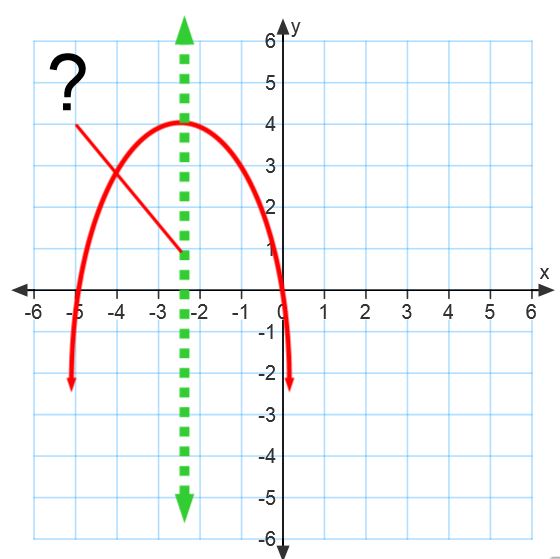
What is the vertex?
(-3, 0)
(3, 0)
(0, 18)
(18, 0)
What is the equation of the axis of symmetry?
y = 0
x = 0
x = 3
x = -3
Which of the statements about the graph is FALSE?
The vertex is a maximum
There are two zeros at x = -3 and x = 3
The y-intercept is (0, 18)
The range is y ≥ 18

What is the significance of the ordered pair (0, -2) to the graph?
It is the vertex
It is an x-intercept
It is the y-intercept
It is the axis of symmetry
What is the significance of the ordered pair (2, -4) to the graph?
It is the vertex
It is an x-intercept
It is the y-intercept
It is the axis of symmetry
Determine the domain and range of the function
Domain: All real numbers, Range: All real numbers
Domain: x ≥ -4, Range: All real numbers
Domain: All real numbers, Range: y ≥ -4
Domain: -1 ≤ x ≤ 5, Range: y ≥ -4

What are the zeros of the function? Choose all that apply.
x = 0
x = -3
x = -6
y = 18
Which statement about the graph is FALSE?
The vertex is (-3, 18)
The vertex is a maximum
The y-intercept is y = 0
The axis of symmetry is y = -3

Which statement about the graph is FALSE?
The vertex is also a zero of the function
The y-intercept is (0, -2)
The axis of symmetry is x = 2
The range is y ≥ 0

What is the significance of the ordered pair (1, -2) to the graph?
It is the maximum point
It is the vertex
It is the y-intercept
It is an x-intercept
What is the significance of the ordered pair (3, 0) to the graph?
It is the maximum point
It is the vertex
It is the y-intercept
It is an x-intercept
What is the significance of the ordered pair (0, -1.5) to the graph?
It is the maximum point
It is the vertex
It is the y-intercept
It is an x-intercept

Which point is the vertex?
(-8, 0)
(-5, -9)
(-2, 0)
(-9, -5)
State the domain and range.
Domain: All real numbers, Range: y ≥ -9
Domain: All real numbers, Range: All real numbers
Domain: x ≥ -8, Range: y ≥ -9
Domain: x ≥ -8, Range: All real numbers
Which function has a domain of all real numbers?


All of the above
Which function has an absolute minimum?


All of the above
Which function has an axis of symmetry of x = 0?


None of the above
Which function has an x-intercept and y-intercept at (0, 0)?


Which function has a range y ≥ -4?


None of the above
Which function has a maximum at (2, 0)?


Define X-intercept
The highest or lowest point on the graph
Where the parabola touches or intersects the x-axis
Where the parabola touches or intersects the y-axis
A line that divides the graph into two equal parts. i.e. cuts the graph in half
Define Y-intercept
Where the parabola touches or intersects the x-axis, also called the x-intercept
The lowest y-value on the graph
The highest y-value on the graph
Where the parabola touches or intersects the y-axis
Define Zero
Where the parabola touches or intersects the x- axis, also called the x-intercept
A line that divides the graph into two equal parts. i.e. cuts the graph in half
The highest or lowest point on the graph
Where the parabola touches or intersects the y-axis
Define Maximum
The highest or lowest point on the graph
The highest y-value on the graph
The lowest y-value on the graph
A line that divides the graph into two equal parts. i.e. cuts the graph in half
Define Minimum
The highest y-value on the graph
Where the parabola touches or intersects the y-axis
Where the parabola touches or intersects the x-axis, also called the x-intercept
The lowest y-value on the graph
Define Vertex
Where the parabola touches or intersects the x-axis
The highest or lowest point on the graph
Where parabola line touches or intersects the x- axis, also called the x-intercept
A line that divides the graph into two equal parts. i.e. cuts the graph in half
Define Axis Of Symmetry
A line that divides the graph into two equal parts. i.e. cuts the graph in half
Where the parabola touches or intersects the x-axis, also called the x-intercept
The highest y-value on the graph
The highest or lowest point on the graph
Define Roots
Where the parabola touches or intersects the y-axis
The lowest y-value on the graph
Where the parabola touches or intersects the x-axis, also called the x-intercept
A line that divides the graph into two equal parts. i.e. cuts the graph in half
Define Solution
The highest y-value on the graph
Where the parabola touches or intersects the y-axis
The highest or lowest point on the graph
Where the parabola touches or intersects the x-axis, also called the x-intercept
Define Roots, Zeros, X-intercept, and Solutions
Where the parabola touches or interests the x-axis
Where the parabola touches or interests the y-axis
What does the h term tell you?
left or right
left or right, opposite sign, axis of symmetry, x-value of the vertex.
axis of symmetry, x-value of the vertex
nothing.
What does the k term tell you?
up.
down.
up/down, y-value in the vertex
nothing
Identify the a, h, and k term from the following equation: (x+3)2+2
a=-1, h=3, k=2
a=3, h=3, k=3
a=1, h=-3, k=2
a=1, h=-3, k=-2
Identify the a, h, and k terms in the following equation: 2(x+4)2−1
a=2, h=-4, k=-1
a=-2, h=4, k=1
a=2, h=4, k=1
a=-2, h=-4, k=1
Identify the a, h, and k terms in the following equation: (x+4)2−3
a=-1, h=4, k=3
a=-1, h=-4, k=3
a=1, h=4, k=3
a=1, h=-4, k=-3
Determine the vertex from the following equation: −3(x−4)2+1
Vertex: (4,1)
Vertex: (-4, -1)
Vertex: (4, -1)
Vertex: (-4, 1)
Determine the vertex from the following equation: −(x+1)2−1
Vertex: (1,-1)
Vertex: (-1, 1)
Vertex: (-1, -1)
Vertex: (1, 1)
Determine the vertex from the following equation: 21(x+4)2+1
Vertex: (-4, 1)
Vertex: (-4, -1)
Vertex: (4, 1)
Vertex: (4, -1)
Determine the axis of symmetry from the following equation: −(x−2)2+4
A. O. S: 2
A. O. S: 4
A. O. S: -2
A. O. S: -1
Determine the axis of symmetry of the following equation: −2(x+2)2+3
A. O. S: 3
A. O. S: -2
A. O. S: 2
A. O. S: 1
Determine the axis of symmetry of the following equation: (x−3)2+5
A. O. S: 1
A. O. S: -3
A. O. S: 3
A. O. S: 5
What is a quadratic funtion in the form of f(x)=a(x−h)2+k called?
Factored Form
Standard Form
Vertex Form
y = 3(x + 5)2 - 4,
what is the vertex of the parabola?
f(x)=4(x-2)2 + 3

f(x) = x2 - 8x + 1
written in vertex form?
f(x) = x2 to the graph of g(x) = (x + 4)2?

Reflected over the x-axis
Stretched by a factor of 2

Moves up 2
Moves left 4

Moves right 7

- moves down 3


Moves down 1
Moves right 1
y = 4x2
y = 2x2 - 2
y = 0.5 x2
y = x2
y = 2x2 - 2
y = 4x2
y = 2x2 - 2
y = x2
y = 0.5 x2
y = 4x2
y = 0.5x2
y = x2
How many solutions does −x=2x2−4 have?
No Solution
One Solution
Two Solutions
Not Possible
What are the roots to 4x2−35x+29=0 ?
x = 0 & 0.927
x= 0.972 & 29
x = 0.927 & 7.823
x = 29 & -35
Find the x-intercepts of x2−11x=−10
x = 1 & x = 10
x = -1 & x = -10
x = -1 & x = 10
x = 1 & x = -10
What are the solutions to n2+2n−24 ?
-8,3
-4,6
12,-2
-6,4
How many zeros does −2x2−11x−5 have?
No solutions
One Solution
Two Solutions
How many roots does 2p=3p2−5 have?
One Solution
No Solution
Two Solutions
What are the x-intercepts to 4x2−36 ?
-6,6
3,-3
2,-2
No solution
How many x intercepts does x2−14x+49 have?
Two Solutions
One Solution
No Solution
What are the solutions to x2−12x+36 ?
6
6,-6
No Solution
6,0
Find the solutions to 2x2
4
2,0
0
No Solution
Determine the values of a, b, and c for the quadratic equation:
4x2 – 8x = 3
a = 4, b = -8, c = 3
a = 4, b =-8, c =-3
a = 4, b = 8, c = 3
a = 4, b = 8, c = -3

What is this formula?
This is the standard formula.
This is the quadratic formula.
This is the square root formula.
This is the Pythagorean formula
Use the quadratic formula to solve 2x2 + 2x - 12.
-2, 3
2, 3
2, -3
-2, -3
Solve 2x2 + 7x - 15 = 0
-3/2 or 5
No Solution
-5 or 3/2
0.7 or 5
x2 + 4x - 40 = -8
What should you do first in solving this equation?
x2 + 6x - 13 = 3
Factor
Write down: a = 1, b = 6, c = -13
Subtract 3 from both sides.
Add 3 to both sides.
X intercepts are also called....
Solutions
Parabolas
Roots
Puppies
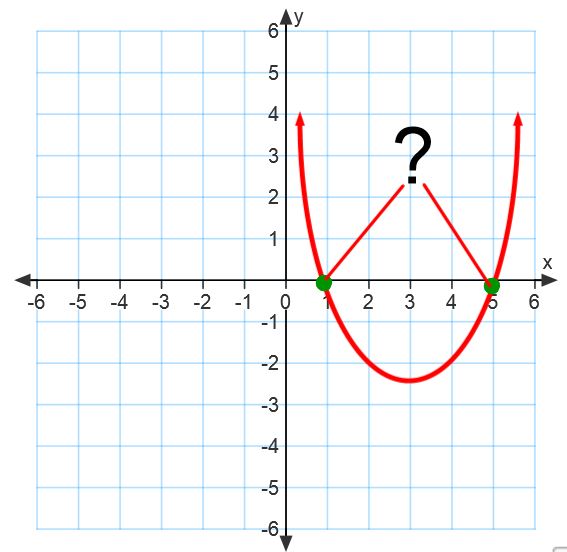
What are the green dots called?
roots
vertex
solutions
x intercepts
1 The discriminant is
aX2 + bX + c
b - 4ac
b2 - 4ac
b2 + 4ac
1 In the equation
y = x2 +5x +7,
match each leading coefficient with its correct letter.
a=0, b=5, c=7
a=1, b=5, c=7
a=7, b=5, c=1
1 What does the discriminant tell us?
The maximum or minimum
The y-intercept
The number and type of solutions
The axis of symmetry
2 For the function below, is the discriminant positive, negative, or zero?
y = x² + 4x + 4
Positive
Negative
Zero
2 A function has a discriminant of 4.
How many x-intercepts does it have?
0
1
2
4
2 A function has a discriminant of 0.
How many x-intercepts does it have?
0
1
2
5
3 What is the discriminant of
-2x2 − x − 1 = 0 ?
76
-7
9
none of these

3 For the function above, is the discriminant positive, negative, or zero?
Positive
Negative
Zero

3 For the function above, is the discriminant positive, negative, or zero?
Positive
Negative
Zero
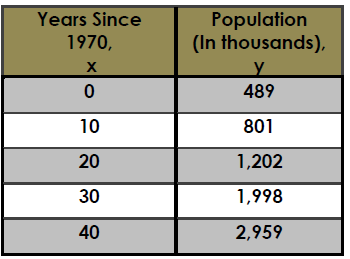
Find the best fitting quadratic model for the data given.
1.2x2+13x+504.3
12x2+13x+504.3
0.12x2+1.3x+504.3
Find the population for 1975.
HINT: Read the headers on the table!
623 thousand people
650 thousand people
599 thousand people
513 thousand people
Use the model y=-16x2+400 to predict when the object will hit the ground.
It will hit the ground after (a) seconds.
Use the model y=-16x2+400. How high was the object when it was dropped?
It was dropped at (a) feet.

Find the best fitting Quadratic model for the data
−0.26x2−17.3x+222.8
−0.26x2+22.59x+23.02
2.6x2+22.9x+20.03
2.6x2+2.3x+23.02

Determine the curve of best fit.
y=−2.7x+7.4
y=0.95x2−2.08x−0.75
y=−.05x−3.26
y=0.95x2+2.08x+0.75
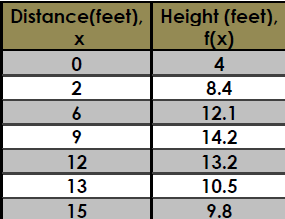
Find the height of the ball when it traveled a distance of 10 feet.
12.8 ft
13.5 ft
11.1 ft
17 ft

Based on the table, what was the maximum height of the projectile?
4, 440 feet
30 feet
3, 940 feet
35 feet

