
Font size
 Worksheets
Cells, Cell Theory, and History of Cells Quiz
Total questions: 25
Worksheet time: 25mins
Who was the scientist to use the early compound microscope to look at cork slices and coined the term ‘cell’ to describe the tissue.
Hans & Zacharias Jansen
Robert Hooke
Gregor Mendel
Francis Crick & James Watson
Who was the scientist to state that all animal tissues are made of cells, adding to the Cell Theory that the cell is basic unit of ALL life.
Matthias Schleiden
Robert Hooke
Gregor Mendel
Theodore Schwann
Who was the scientist to state that all plant tissues are composed of cells and that cell is basic building block of all plants.
Matthias Schleiden
Robert Hooke
Gregor Mendel
Theodore Schwann
Who was the scientist to describe cells in a drop of pond water; first person to observe bacteria and protozoa.
Matthias Schleiden
Anton van Leeuvenhoek
Francisco Redi
Theodore Schwann
Scientist put all cells they observe into two groups. Choose the groups they are put into.
Prokaryotic
Eukaryotic
Plant
Animal
Which group of cells have NO nucleus, are all unicellular, have single strand DNA, and can be found in bacteria?
Prokaryotic Cells
Eukaryotic Cells
Both
Neither
Which group of cells have a nucleus, are all unicellular or multicellular, have double stranded DNA, and can be found in animals, plants, & fungi?
Prokaryotic Cells
Eukaryotic Cells
Both
Neither
The invention of the ___ made it possible for scientist to view and study the cell.
blow horn
microscope
slides
telescope
Choose the 3 answer choices that are part of the cell theory.
All living things are made of one or more cells.
Cells are the basic unit of structure and function in living things.
All cells come from other cells.
Only bacteria is made of cells

Which scientist did NOT contribute to the cell theory?
Rudolf Virchow
Robert Hooke
Albert Einstein
Matthias Schleiden
Which statement is a part of the cell theory?
all cells come from preexisting cells
bacteria are prokaryotic cells
eukaryotic cells are complex
humans are multicellular
What type of organisms does the cell theory apply to
bacteria
multicellular organisms
plants and animals
all of the above

Students use a microscope to look for structures present in four different cells. The students placed an X for each structure that was viewed for each cell on the table shown. Which cell that was viewed is most likely a prokaryote?
Cell W
Cell X
Cell Y
Cell Z

The picture shows a student using a microscope to study a prepared slide of a single-celled organism. A single-celled organism can be classified as a prokaryote based on the absence of -
a cell membrane
ribosomes
chromosomes
a nucleus
Prokaryotic cells don't have:
Membrane bound organelles.
Ribosomes
Genetic material (DNA or RNA).
All of the above

E. coli (a bacteria) is an example of a...
Prokaryote
Eukaryote
Both
Neither

A sunflower is an example of a...
Prokaryote
Eukaryote
Both
Neither
Which of the following would only be found in a eukaryotic cell?
Cell Membrane
DNA
Ribosomes
Mitochondria
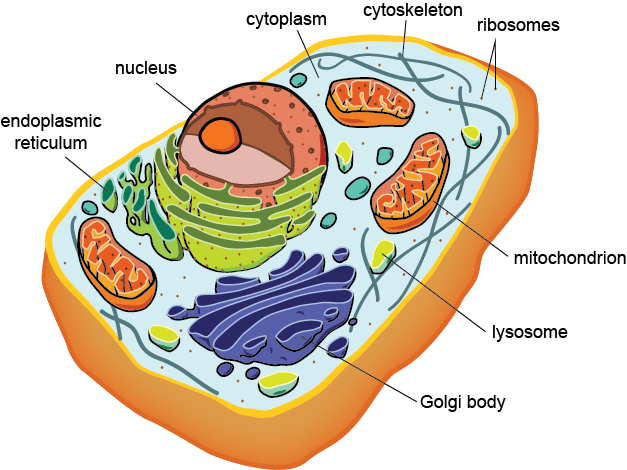

Prokaryotes are
bacteria
fungi
plants
animals

Prokaryotic cells do NOT have membrane bound organelles or ______________________________.
cytoplasm
a nucleus
ribosomes
DNA

In eukaryotic cells DNA is primarily contained within the:
cytoplasm
ribosomes
vacuoles
nucleus

Of the two types of cells, which one is smaller and more simplistic?
prokaryotic cells
eukaryotic cells

Structures that have different jobs within the cell:
antibodies
lipids
organelles
blood cells

