wayground logo

Free Printable Worksheets

NEW

Font size

S
M
L
XL
Worksheets

ISTQB Question Bank 461 to 500

Total questions: 40

Worksheet time: 10hrs 0mins

Name
Class
Date
1.
What is the main difference between a walkthrough and an inspection?
a)
An inspection is lead by the author, whilst a walkthrough is lead by a trained moderator.
b)
An inspection has a trained leader, whilst a walkthrough has no leader.
c)
Authors are not present during inspections, whilst they are during walkthroughs.
d)
A walkthrough is lead by the author, whilst an inspection is lead by a trained moderator.
2.
Which of these activities provides the biggest potential cost saving from the use of CAST?
a)
Test management
b)
Test design
c)
Test execution
d)
Test planning
3.
Which of the following is NOT true of incidents?
a)
Incident resolution is the responsibility of the author of the software under test.
b)
Incidents may be raised against user requirements.
c)
Incidents require investigation and/or correction.
d)
Incidents are raised when expected and actual results differ.
4.
Which of the following characterizes the cost of faults?
a)
They are cheapest to find in the early development phases and the most expensive to fix in the latest test phases.
b)
They are easiest to find during system testing but the most expensive to fix then.
c)
Faults are cheapest to find in the early development phases but the most expensive to fix then.
d)
Although faults are most expensive to find during early development phases, they are cheapest to fix then.
5.
Which one of the following statements, about capture-replay tools, is NOT correct?
a)
They are used to support multi-user testing.
b)
They are used to capture and animate user requirements.
c)
They are the most frequently purchased types of CAST tool.
d)
They capture aspects of user behaviour.
6.
Which of the following is true of the V-model?
a)
It states that modules are tested against user requirements.
b)
It only models the testing phase.
c)
It specifies the test techniques to be used.
d)
It includes the verification of designs.
7.
Error guessing:
a)
Supplements formal test design techniques.
b)
Can only be used in component, integration and system testing.
c)
Is only performed in user acceptance testing.
d)
Is not repeatable and should not be used.
8.
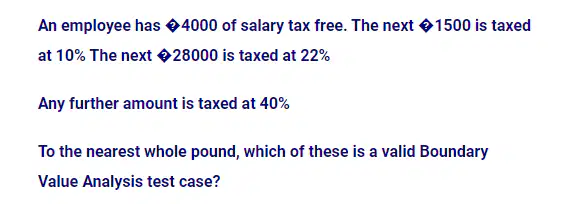
In a system designed to work out the tax to be paid:
a)

�4800; �14000; �28000

b)

�5200; �5500; �28000

c)

�28001; �32000; �35000

d)

�5800; �28000; �32000

9.
The oracle assumption:
a)
Is that there is some existing system against which test output may be checked.
b)
Is that the tester can routinely identify the correct outcome of a test.
c)
Is that the tester knows everything about the software under test.
d)
Is that the tests are reviewed by experienced testers.
10.
In prioritising what to test, the most important objective is to:
a)
Find as many faults as possible.
b)
Test high risk areas.
c)
Obtain good test coverage.
d)
Test whatever is easiest to test.
11.
The most important thing about early test design is that it:
a)
Makes test preparation easier.
b)
Means inspections are not required.
c)
Can prevent fault multiplication.
d)
Will find all faults.
12.

Which of the following are potential drawbacks of independence in testing?

<br>

01. Independent testers may feel they are not part of the development team

02. Developers may lose a sense of personal responsibility for quality

03. Project managers will not have as much control on the project

04. Customers may end up requesting features that are technically impossible

a)

01 and 02

b)

01, 02 and 03

c)

03 and 04

d)

01, 02, 03 and 04

13.
Integration testing in the small:
a)
Tests the individual components that have been developed.
b)
Tests interactions between modules or subsystems.
c)
Only uses components that form part of the live system.
d)
Tests interfaces to other systems
14.
Which of the following requirements is testable?
a)
The system shall be user friendly.
b)
The safety-critical parts of the system sall contain 0 faults.
c)
The response time shall be less than one second for the specified design load.
d)
The system shall be built to be portable.
15.
An important benefit of code inspections is that they:
a)
Enable the code to be tested before the execution environment is ready.
b)
Can be performed by the person who wrote the code.
c)
Can be performed by inexperienced staff.
d)
Are cheap to perform.
16.
Test cases are designed during:
a)
Test recording.
b)
Test planning.
c)
Test configuration.
d)
Test specification.
17.
A failure is:
a)
Found in the software; the result of an error.
b)
Departure from specified behaviour.
c)
An incorrect step, process or data definition in a computer program.
d)
A human action that produces an incorrect result.
18.
How would you estimate the amount of re-testing likely to be required?
a)
Metrics from previous similar projects
b)
Discussions with the development team
c)
Time allocated for regression testing
d)
A. & B.
19.

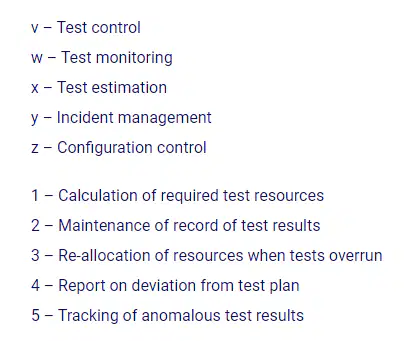
Given the following sets of test management terms (v-z), and activity descriptions (1-5), which one of the following best pairs the two sets?

a)

v-3,w-2,x-1,y-5,z-4

b)

v-2,w-5,x-1,y-4,z-3

c)

v-3,w-4,x-1,y-5,z-2

d)

v-2,w-1,x-4,y-3,z-5

20.
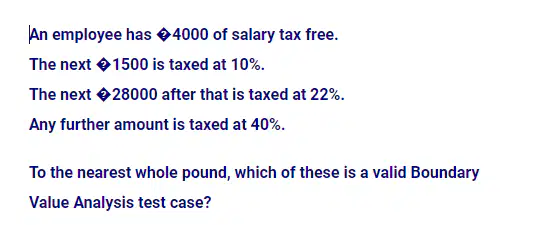
In a system designed to work out the tax to be paid:
a)

1500

b)

32001

c)

33501

d)

28000

21.
Which of the following is NOT true of test coverage criteria?
a)
Test coverage criteria can be measured in terms of items exercised by a test suite.
b)
A measure of test coverage criteria is the percentage of user requirements covered.
c)
A measure of test coverage criteria is the percentage of faults found.
d)
Test coverage criteria are often used when specifying test completion criteria.
22.
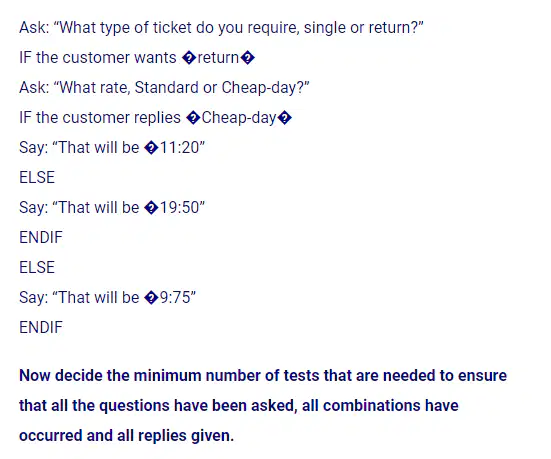
Analyze the following highly simplified procedure:
a)

3

b)

4

c)

5

d)

6

23.
Which of the following should NOT normally be an objective for a test?
a)
To find faults in the software.
b)
To assess whether the software is ready for release.
c)
To demonstrate that the software doesn't work.
d)
To prove that the software is correct.
24.
Enough testing has been performed when:
a)
Time runs out.
b)
The required level of confidence has been achieved.
c)
No more faults are found.
d)
The users won't find any serious faults.
25.
Which of the following is the best source of Expected Outcomes for User Acceptance Test scripts?
a)
Actual results
b)
Program specification
c)
User requirements
d)
System specification
26.

Which of the following are disadvantages of capturing tests by recording the actions of a manual tester?

<br>

i The script may be unstable when unexpected events occur.

ii Data for a number of similar tests is automatically stored separately from the script.

iii Expected results must be added to the captured script. iv The captured script documents the exact inputs entered by the tester.

v When replaying a captured test, the tester may need to debug the script if it doesn't play correctly.

a)

i, iii, iv, v.

b)

ii, iv and v.

c)

i, ii and iv.

d)

i and v.

27.
Which of the following is a characteristic of good testing in any life cycle model?
a)
All document reviews involve the development team.
b)
Some, but not all, development activities have corresponding test activities.
c)
Each test level has test objectives specific to that level.
d)
Analysis and design of tests begins as soon as development is complete.
28.

The process of designing test cases consists of the following activities:

<br>

i. Elaborate and describe test cases in detail by using test design techniques.

ii. Specify the order of test case execution.

iii. Analyse requirements and specifications to determine test conditions.

iv. Specify expected results.

<br>

According to the process of identifying and designing tests, what is the correct order of these activities?

a)

iii, i, iv, ii.

b)

iii, iv, i, ii.

c)

iii, ii, i, iv.

d)

ii, iii, i, iv.

29.
Which is the MOST important advantage of independence in testing?
a)
An independent tester may find defects more quickly than the person who wrote the software.
b)
An independent tester may be more focused on showing how the software works than the person who wrote the software.
c)
An independent tester may be more effective and efficient because they are less familiar with the software than the person who wrote it.
d)
An independent tester may be more effective at finding defects missed by the person who wrote the software.
30.

Given the following specification, which of the following values for age are in the SAME equivalence partition?

<br>

If you are less than 18, you are too young to be insured. Between 18 and 30 inclusive, you will receive a 20% discount. Anyone over 30 is not eligible for a discount.

a)

17, 18, 19.

b)

29, 30, 31.

c)

18, 29, 30.

d)

17, 29, 31.

31.

Consider the following statements:

<br>

i.100% statement coverage guarantees 100% branch coverage.

ii.100% branch coverage guarantees 100% statement coverage.

iii.100% branch coverage guarantees 100% decision coverage.

iv.100% decision coverage guarantees 100% branch coverage.

v.100% statement coverage guarantees 100% decision coverage.

a)

ii is True; i, iii, iv & v are False

b)

i & v are True; ii, iii & iv are False

c)

ii & iii are True; i, iv & v are False

d)

ii, iii & iv are True; i & v are False
32.
What is the difference between a project risk and a product risk?
a)
Project risks are potential failure areas in the software or system; product risks are risks that surround the project's capability to deliver its objectives.
b)
Project risks are the risks that surround the project's capability to deliver its objectives; product risks are potential failure areas in the software or system.
c)
Project risks are typically related to supplier issues, organizational factors and technical issues; product risks are typically related to skill and staff shortages.
d)
Project risks are risks that delivered software will not work; product risks are typically related to supplier issues, organizational factors and technical issues.
33.
During which fundamental test process activity do we determine if MORE tests are needed?
a)
Test implementation and execution.
b)
Evaluating test exit criteria.
c)
Test analysis and design.
d)
Test planning and control.
34.
What is the MAIN purpose of a Master Test Plan?
a)
To communicate how incidents will be managed.
b)
To communicate how testing will be performed.
c)
To produce a test schedule.
d)
To produce a work breakdown structure.
35.
Which of the following defines the sequence in which tests should be executed?
a)
Test plan.
b)
Test procedure specification.
c)
Test case specification.
d)
Test design specification.
36.
Which of the following is a major task of test planning?
a)
Determining the test approach.
b)
Preparing test specifications.
c)
Evaluating exit criteria and reporting.
d)
Measuring and analyzing results.
37.
What is the main purpose of impact analysis for testers?
a)
To determine the programming effort needed to make the changes.
b)
To determine what proportion of the changes need to be tested.
c)
To determine how much the planned changes will affect users.
d)
To determine how the existing system may be affected by changes
38.
In a system designed to work out the tax to be paid:
a)

28000

b)

33501

c)

32001

d)

1500

39.
Which of the following tools is most likely to contain a comparator?
a)
Dynamic Analysis tool.
b)
Test Execution tool.
c)
Static Analysis tool.
d)
Security tool.
40.
When software reliability measures are used to determine when to stop testing, the best types of test cases to use are those that
a)
Exercise system functions in proportion to the frequency they will be used in the released product
b)
Push the system beyond its designed operation limits and are likely to make the system fail
c)
Exercise unusual and obscure scenarios that may not have been considered in design
d)
Exercise the most complicated and the most error-prone portions of the system