
 Worksheets
Ancient Civ Final
Total questions: 80
Worksheet time: 44mins
Which two dates describe the same year?
1000 AD and 1000 BC
1000 BCE and 1000 CE
1000 AD and 1000 BCE
1000 BCE and 1000 BC
How did hunter-gatherers make tools?
They used fire to shape metal pieces.
They used artifacts to bend and sharpen wood.
They hit flint on other stones to break off pieces.
They rubbed two pieces of wood together to sharpen them.
Which types of shelters did hunter-gatherers use? (Choose 2)
Permanent shelters like villages
Temporary shelters made of wood and stone
Natural shelters like caves and rock overhangs
Temporary shelters made of animal skins and plant materials
Permanent shelters made of clay and plant materials
How did hunter-gatherers use fire?(Choose 2)
Fire was used to build shelters.
Fire was used for heat and light at night.
Fire was used to make weapons from metals.
Fire was used to cook food and smoke meat to preserve it.
Fire was used in slash-and-burn agriculture.
Which factors contributed to the Agricultural Revolution?(Choose 2)
People discovered how to domesticate animals.
The earth warmed and plants grew more easily.
People discovered how to make tools.
People discovered how to use fire.
Which geographic characteristics promoted the growth of ancient Mesopotamia by allowing the first settlers to grow crops?(Choose 2)
fertile soil
access to water
abundant rainfall
moderate climate
How did the Tigris and Euphrates Rivers benefit ancient Mesopotamia?(Choose 3)
They provided water used to water crops.
They flooded the area, depositing fertile silt.
They were used to escape frequent invasions by enemies.
They were used for transportation of people and resources.
They flooded the area, destroying homes.
How did the surrounding desert and mountains help the advancement of civilization in Mesopotamia?
They protected it from invasion.
They were a means of transportation.
They provided it with natural resources.
They were home to nearby trading partners.
Who developed the first civilization in Mesopotamia?
Akkadians
Babylonians
Sumerians
Chaldeans
How was Sumerian civilization structured?
a collection of many small city-states, each ruled by its own king
a single city-state ruled by one king
a collection of many small city-states, all ruled by one central king
a single city-state ruled by priests
What basic principle of justice does Hammurabi’s code support?
Punishment should fit the crime.
Forgiveness should be granted at all times.
Executions make citizens obey the law out of fear.
The rights of Babylonians were above those of other people.
What ideas from the Code of Hammurabi are still important today?(Choose 2)
holding people accountable for their actions
having one set of laws for all people under a government
making punishments more severe than the crime
using an oral tradition to pass down laws
How did government in Ancient Mesopotamia change after the decline of the Sumerian city-states?
The Akkadians created the first democracy, and all of Mesopotamia was part of it.
The Akkadians created new monarchies, and a different king ruled in each city-state.
The Akkadians created the first regional empire, and all of Mesopotamia was ruled by one king.
Which desert does the Nile River run through?
Sahara
Gobi
Taklimakian
Crater Lake
Which statements accurately describe the Nile River?(Choose 2)
When the Nile River flooded, it deposited fertile silt across the river valley.
The land around the Nile River is a green oasis in a barren desert.
When the Nile River flooded, it caused major problems for Egypt’s farmers.
The Nile River is the second-longest river in the world.
________is located at the top part of the map, nearest to the Mediterranean Sea.
Upper Egypt
Lower Egypt
Nubia
Memphis
Which body of water resembles "bunny ears"
Red Sea
Mediterannean Sea
Persian Gulf
Dead Sea
How does the Nile River flow?
N to S
S to N
E to W
W to E
How were social classes organized in Egypt?
geography
occupation
achievements
religious beliefs
What social class was a soldier in during Egypt time?
Pharaoh
Upper
Middle
Lower
Which of the following statements accurately describe the role of slaves in ancient Egypt?(Choose 2)
They were often prisoners of war.
Many could earn their freedom over time.
They kept the records of Egyptian life.
They received a plot of land to farm from the pharaoh.
Ancient Egyptian writing was called
Hieroglyphics
Papyrus
Cuneiform
Sanskrit
How did Egyptians develop and use their calendar?
They used astronomy to determine when to plant and harvest crops.
The used geometry to determine when to plant and harvest crops.
They used astronomy to determine when to build their pyramids.
They used geometry to determine when to build their pyramids.
Where is the Sinai Peninsula located?(Choose 2)
north of the Red Sea
in Egypt
in Israel
along the coast of the Indian Ocean
Which statements accurately describe the sacred texts of Judaism?(Choose 2)
They are called the Tanakh.
They contain the same books as the Old Testament of the Christian Bible.
They were meant to replace the Torah.
They were written on large tablets originally.
Why is individual worth emphasized in Judaism?
Jews believe every individual is created in the image of God.
Jews believe every individual is part of the community.
Jews believe every individual has his or her own story to tell.
Jews believe individuals should make sacrifices to gods that control nature.
Which king of Israel united the tribes under a unified Monarchy?
Saul
David
Solomon
Nebuchadnezzar
How did the Babylonian Captivity end?
The Persians conquered the Babylonians and allowed the exiles to return to Israel.
The Assyrians conquered the Babylonians and allowed the exiles to return to Israel.
The Babylonians conquered the Persians and released the captives.
The Babylonians conquered the Assyrians and released the captives.

What is here?
Euphrates River
Tigris River
Sumer
Persian Gulf
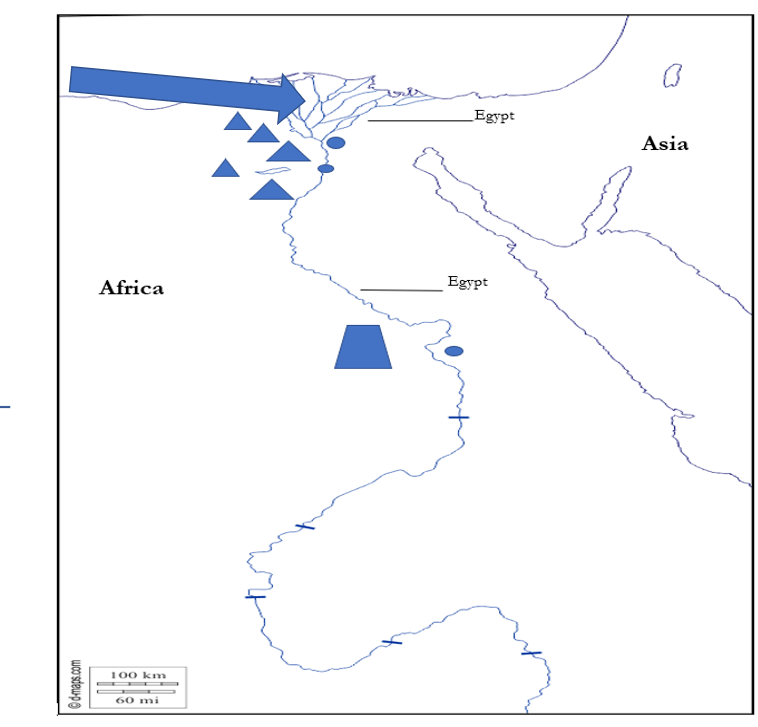
What area is here?
Canann
Nile Delta
Thebes
Nubia

What is a ziggurat?
a government building
a temple
a school
a place to store grain


What is located at position A?
Mediterranean Sea
Dead Sea
Jordan River
Red Sea

Which spot could you find the Sinai Peninsula?
C
D
E
F

At which position could you find the capital of Israel?
C
D
E
F

What is located at Position C?
The Dead Sea
The Jordan River
Jerusalem
Bethlehem
Ancient Israel is a relatively small region, but it is home to some very important and complex history. This history is not only about a specific place or time. This history is also the history of a people and the development of a religion that would ultimately change the course of human civilization.What Is Ancient Israel?The modern-day nation of Israel is located in the same region as the Kingdom of Israel, an ancient nation that rose and fell during the Iron Age, starting around 1200 BCE. Although separated by time, the two nations are directly connected by both history and religious faith. The region of ancient Israel was once known as the land of Canaan. It included not only modern-day Israel but also all of Lebanon, most of western Jordan (along the fertile Jordan River Valley), and bits of modern-day Syria and Egypt. Which of the following statements are true about ancient Israel? (Choose two)
The modern-day nation of Israel is located in the same region as the ancient Kingdom of Israel.
The ancient Kingdom of Israel began during the Bronze Age around 1200 BCE.
Ancient Israel was once known as the land of Canaan.
The region of ancient Israel only included modern-day Israel.
What was one of the major effects of the ancient Kingdom of Israel's location in the land of Canaan?
The region became a center for trade and cultural exchange.
The Kingdom of Israel was isolated from other civilizations.
The region was unsuitable for agriculture and settlement.
The Kingdom of Israel had no significant religious influence.
The land of ancient Israel is small compared to other regions, but its geography is very diverse.
The central and southern coastal plains are hot and dry in the summer and cool and wet in the winter, like most places along the Mediterranean Sea.
The northern region is quite mountainous.
The Jordan River Valley is the heart of the region. Over time, the Jordan River carved a deep, fertile valley surrounded by hills.
Everything south and east of the Dead Sea is very hot and dry, like the vast deserts that extend for hundreds of miles in almost every direction.
Bodies of water near Israel include the Mediterranean Sea to the west, the Red Sea to the south, and the Dead Sea at the southern end of the Jordan River.
The city of Jerusalem, is located on a plateau in the Judaean Mountains. Which of the following statements accurately describe the geography of ancient Israel? (Choose three)
The central and southern coastal plains are cool and wet in the summer.
The northern region is quite mountainous.
The Jordan River Valley is a deep, fertile valley surrounded by hills.
The area south and east of the Dead Sea is very hot and dry.
Jerusalem is located in the Jordan River Valley.
How did the fertile Jordan River Valley impact ancient Israel?
It limited agricultural opportunities.
It supported agriculture and settlements.
It discouraged trade due to its isolation.
It was unsuitable for any form of habitation.
Part of Egypt, the _____________ is bordered by the Mediterranean Sea to the north and the Red Sea to the south.
Jordan River
Sinai Peninsula
Fertile Crescent
Dead Sea
Which statements accurately describe the sacred texts of Judaism?
(Choose 2)
They are about the many gods of Judaism.
They are called the Tanakh.
They were meant to replace the Torah.
They contain the same books as the Old Testament of the Christian Bible.
They were written on large tablets originally.
How was Judaism different from other religions practiced in the region at the time it began?
Judaism told the story of all people.
Judaism focused on the afterlife.
Judaism was monotheistic.
Judaism was matriarchal.
How do historians MOST use the Hebrew Bible?
as a primary source documenting the history and religion of Mesopotamia
as a secondary source documenting the history and religion of Canaan
as a secondary source documenting the history and religion of Egypt
as a primary source documenting the history and religion of Israel
Which event happened first?
Abraham goes to Canaan from Mesopotamia
Famine causes the Israelites to leave Canaan and travel to Egypt
The pharaoh forces the Israelites into slavery
Joshua conquers much of Canaan
Why is individual worth emphasized in Judaism?
Jewish people believe individuals should make sacrifices to gods that control nature.
Jewish people believe every individual is part of the community.
Jewish people believe every individual has a significant role to play in Buddhism.
Jewish people believe every individual is created in the image of God.
What rules do Jews try to follow because they believe these rules come from God?
Hammurabi's Code
Ten Commandments
Epic of Gilgamesh
The Rosetta Stone
Which lists the first three kings of Israel in order from earliest?
Saul, Paul, David
Solomon, David, Saul
Saul, David, Solomon
David, Solomon, Saul
Why did King Nebuchadnezzar allow the Israelites to establish their own community during the Babylonian Captivity?
He wanted them to convert to Babylonian religious beliefs.
He wanted them to fight against the Assyrians.
He wanted them to keep their two kingdoms separate.
He wanted them to help revive the Babylonian economy.
How did the Babylonian Captivity end?
The Babylonian army conquered the Assyrian army and released the captives.
The Babylonian army conquered the Persian army and released the captives.
The Assyrian army conquered the Babylonian army and allowed the exiles to return to Israel.
The Persian army conquered the Babylonian army and allowed the exiles to return to Israel.
Who united the tribes of Israel under one king?
Saul
Solomon
David
Yahweh
Who established the capital at Jerusalem?
Saul
Solomon
David
Yahweh

The Hebrews in Canaan eventually became known as “Israelites.” This new name came from Abraham’s grandson named
Jacob
Abraham Jr.
Moses
Cyrus

The changes in these maps took place after the death of which historical figure?
Ashoka
Confucius
Saul
Solomon
Which of the following statements about ancient Israel are true? (Choose all that apply)
Ancient Israel was located in the region known as Canaan.
The capital of ancient Israel was Babylon.
The Jordan River was a significant water source for ancient Israel.
Ancient Israel was an isolated region with little trade.
What was one major effect of King Solomon building the First Temple in Jerusalem?
It led to the immediate decline of the Kingdom of Israel.
It became a central place of worship and religious pilgrimage for the Israelites.
It resulted in the Israelites abandoning their religious practices.
It caused Jerusalem to become isolated from other regions.
Abraham, the Patriarch of the Hebrew people, originiated from where?
Ur, Mesopotamia
Cairo, Egypt
Luxor, Egypt
Jerusalem, Israel

