
 Worksheets
Outer planets
Total questions: 47
Worksheet time: 29mins
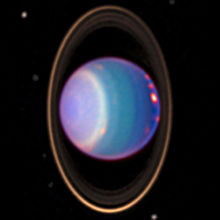
What is a planetary ring?
A thin disk of small particles of ice and rock
What you wear on your finger
The noise your cell phone makes when you get a call
A layer of helium surrounding the atmosphere
Uranus is blue/green because of traces of ___________ in its atmosphere.
oxygen
methane
helium
hydrogen
The great red spot on Jupiter is
A storm
A red dot
Lightning
rusty dirt
What is the second largest planet in our solar system?
Neptune
Jupiter
Uranus
Saturn

Which planet in our solar system is the largest?
Mercury
Neptune
Jupiter
Uranus

All of the outer planets are known as the _________.
terrestrial giants
titanium planets
helium giants
gas giants


Which planet is Saturn?
5
6
7
8

This planet was discovered using mathematics.
Neptune
Uranus
Saturn
Jupiter
This planet has the strongest winds in our solar system.
Jupiter
Saturn
Neptune
Uranus

7th planet from the sun. It orbits on its side.
Jupiter
Neptune
Uranus
Saturn

Which planet has the Great Red Spot?
Saturn
Neptune
Uranus
Jupiter
The larger of the 2 blue ice giants
Uranus
Saturn
Jupiter
Neptune
Smallest Gas Planet
Uranus
Saturn
Neptune
Jupiter
A day on Neptune is much longer than a day on Earth.
TRUE
FALSE
A year on Neptune is much longer than a year on Earth.
FALSE
TRUE
Neptune has rings
True
False
What probe got the closest to Neptune?
Voyager 2
Pioneer
Galileo
LARGEST MOON OF NEPTUNE?
TRITON
TRINTON
SAO
NAIAD

The gas element ___ is responsible for the overall colors of both Uranus & Neptune.
methane
hydrogen
helium
nitrogen

Neptune's faint rings were finally discovered with the flyby of ___ in 1989.
Voyager I
Voyager II
New Horizons
Pioneer 11
Why was Neptune discovered
Something was disturbing Uranus orbit
By accident
By William Hershel and his sister- looking for comets
Voyager II went there in 1989

In general, storm systems in Jupiter's atmosphere are ___ than storms on Earth.
not as intense
are more localized
shorter-lived
longer-lived

Jupiter has colorful bands of clouds (tan, red, white & brown). This is mostly due to
the tidal effects of its moons.
differential spin ratios.
differing chemical composition.
external heating from the Sun.

What is thought to be responsible for Jupiter's incredibly strong magnetic field?
core & outer liquid metallic spin differentiation
the pull of Jupiter's four main moons
the Sun's solar wind
strong gravitational attraction

This moon of Jupiter is even larger than the planet Mercury.
IO
Europa
Ganymede
Callisto

Jupiter has a solid surface that is located just below its outer most cloud layers.
True
False

The spacecraft ___ has orbited and studied Saturn up-close since 2005 & did so until 2017.
Voyager
Cassini
New Horizons
Galileo

Saturn has the most extensive ring system in the solar system - but it is only
a few meters thick.
a few thousand years old.
an optical illusion that "disappears" sometimes.
made up of rock & small debris.

The atmosphere of Saturn is very similar to that of Jupiter because
the two planets are about the same size.
they both have a single giant storm system.
it contains mostly hydrogen & helium.
it has traces of methane which gives it cloud bands.

Saturn's largest moon Titan is also the largest in the solar system.
True
False

A large enough moon within a planet's ___ limit will be broken down due to gravitation forces.
gravity
Roche
gas
tidal force

Saturn's rings consists of trillions of particles of ice, dust & rock most likely because
of Enceladus' ice volcanoes (or geysers).
a moon collided with the planet which shattered it.
Mimas' gravitational pull creating the Cassini division.
a moon (or moons) came within the planet's Roche limit.

