
 Worksheets
8 SS All-STAARS: Best of Semester 1
Total questions: 15
Worksheet time: 8mins
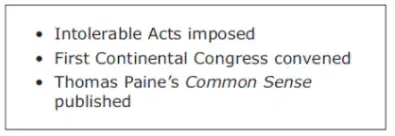
ALL of the events shown occurred during....
The Era of Westward Expansion
The Era of Good Feelings
The Revolutionary Era
The Jacksonian Era
Colonists objected to the Proclamation of 1763 because they...
feared it would provoke attacks from American Indians
did not want to share control of the fur trade with France
resented the limits it imposed on westward expansion
wanted to be able to trade freely with foreign nations

Which government principle is illustrated in this diagram?
Federalism
Popular sovereignty
Republicanism
Separation of Powers
How did the American colonies react to enforcement of the Intolerable Acts?
By collecting funds to pay for the tea destroyed in Boston Harbor
By sending ambassadors to France to request military aid
By placing a tax on all goods imported from Great Britain.
By holding the First Continental Congress to discuss unified resistance
An immigrant sails to North America in the early 1700s hoping to start a tobacco farm. He has done some research on the best environment for tobacco farming. Where is the immigrant most likely to settle?
Massachusetts
Virginia
Rhode Island
Pennsylvania
Why did the Constitutional Convention agree to the Three-Fifths Compromise?
To settle debates over the issue of counting the enslaved population for representation
To settle debates over the issue of abolishing the importation of enslaved people
To create a government based on the principle of federalism
To create a government with a bicameral legislature.

This diagram shows a sequence of events in colonial history.
Why is the sequence of events important?
Colonists created a legislature with two houses
Colonists declared independence from English rule
Colonists defended the concept of unalienable rights
Colonists established a tradition of self-government
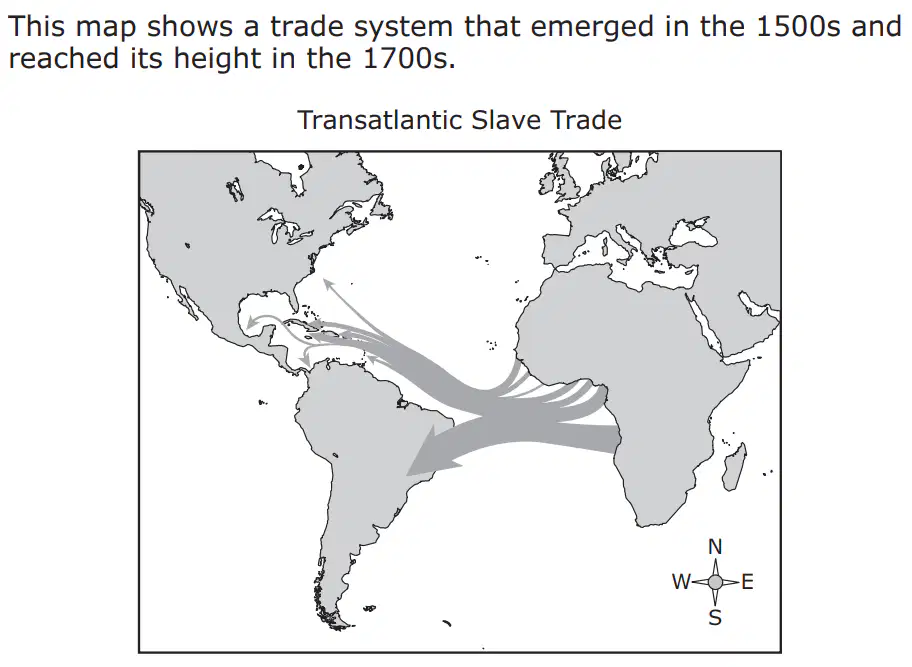
Which factor was a reason for the trade system illustrated on this map?
Labor demands of the factory system
Invention of the steamboat
Labor demands of the plantation system
Invention of the mechanical loom

In the early days of the colonies, a belief in these rights helped lead to....
the establishment of royal courts
the growth of representative government
the implementation of the mercantile system
the abolishment of indentured servitude
Which geographic feature allowed the Mid-Atlantic colonies to have a longer growing season than the New England colonies?
thick forests
navigable rivers
flat land with rocky soil
mild climate
Which group helped establish the colony of Maryland in the 1630s?
English Catholics seeking religious freedom
Spanish workers seeking job opportunities
Irish families escaping a natural disaster
Russian merchants escaping political conflict

Which reason best completes this list?
to spread democratic ideals
to improve efficiency in manufacturing
to located potential military allies
to claim new territory

The except shown here reflects the dissatisfaction of the American colonists with the...
political debates that took place at the Albany Convention
interference of Great Britain in the slave trade
economic consequences of the Great Awakening
economic policies imposed by Great Britain following the French and Indian War

Which of these completes this graphic organizer?
Parliament repeals the Stamp and Sugar Acts
King George III allows colonists to petition Parliament for tax relief
Parliament passes the Intolerable Acts
King George III appoints colonial representatives to Parliament

The colonies in this list were founded primarily to offer settlers a greater degree of...
freedom from debts
religious freedom
economic freedom
freedom of speech

