wayground logo

Free Printable Worksheets

NEW

Font size

S
M
L
XL
Worksheets

ISTQB Question Bank 741 to 780

Total questions: 40

Worksheet time: 10hrs 0mins

Name
Class
Date
1.

Consider the following activities that might relate to configuration management:

<br>

I. Identify and document the characteristics of a test item

II. Control changes to the characteristics of a test item

III. Check a test item for defects introduced by a change

IV. Record and report the status of changes to test items

V. Confirm that changes to a test item fixed a defect

<br>

Which of the following statements is true?

a)

Only I is a configuration management task.

b)

All are configuration management tasks.

c)

I, II and III are configuration management tasks.

d)

I, II and IV are configuration management tasks.

2.
A test plan included the following clauses among the exit criteria:
a)

II, III and IV are possible explanations, but I and V are not possible.

b)

All five are possible explanations.

c)

I, IV and V are possible explanations, but II and III are not possible.

d)

III, IV and V are possible explanations, but I and II are not possible.

3.
What is the most important factor for successful performance of reviews?
a)
A separate scribe during the logging meeting
b)
Trained participants and review leaders
c)
The availability of tools to support the review process
d)
A reviewed test plan
4.

Consider the following statements about maintenance testing:

<br>

I. It requires both re-test and regression test and may require additional new tests.

II. It is testing to show how easy it will be to maintain the system.

III. It is difficult to scope and therefore needs careful risk and impact analysis.

IV. It need not be done for emergency bug fixes.

<br>

Which of the statements are true?

a)

I and III

b)

I and IV

c)

II and III

d)

II and IV

5.

Which of the following statements are correct?

<br>

I. Software testing can be required to meet legal or contractual requirements.

II. Software testing is mainly needed to improve the quality of the developer's work.

III. Rigorous testing can help to reduce the risk of problems occurring in an operational environment.

IV. Rigorous testing is used to prove that all failures have been found.

a)

I and III

b)

II and III

c)

II and IV

d)

III and IV

6.
Which two specification-based testing techniques are most closely related to each other?
a)
Decision tables and state transition testing
b)
Equivalence partitioning and state transition testing
c)
Decision tables and boundary value analysis
d)
Equivalence partitioning and boundary value analysis
7.
Which of the following is an advantage of independent testing?
a)
Independent testers don’t have to spend time communicating with the project team.
b)
Programmers can stop worrying about the quality of their work and focus on producing more code.
c)
The others on a project can pressure the independent testers to accelerate testing at the end of the schedule.
d)
Independent testers sometimes question the assumptions behind requirements, designs and implementations.
8.
DDP formula that would apply for calculating DDP for the last level of testing prior to release to the field is
a)
DDP = {Defects (Testers) � Defects (Field)} / Defects (Testers)
b)
DDP = {Defects (Testers) + Defects (Field)} / Defects (Testers)
c)
DDP = Defects (Testers) / {Defects (Field) + Defects (Testers)}
d)
DDP = Defects (Testers) / {Defects (Field) – Defects (Testers)}
9.
What would trigger the execution of maintenance testing?
a)
Inspection results and modification.
b)
Migration and inspection results.
c)
Migration and retirement of the system.
d)
Alpha testing results and migration.
10.
Popular specification-based techniques are:
a)
Equivalence partitioning
b)
Boundary value analysis
c)
Decision tables
d)
All three described above
11.
As a test leader you are collecting measures about defects. You recognize that after the first test cycle � covering all requirements – subsystem C has a defect density that is 150% higher than the average. Subsystem A on the other hand has a defect density that is 60% lower than the average. What conclusions for the next test cycle could you draw from this fact?
a)
It is probable that subsystem C has still more hidden defects. Therefore we need to test subsystem C in more detail.
b)
Because we have already found many defects in subsystem C, we should concentrate testing resources n Subsystem A.
c)
Observed defect density does not allow any conclusions about the amount of additional testing.
d)
We should try to equalize the amount of testing over all modules to ensure that we test all subsystems evenly.
12.
Which of the following is a TRUE statement about the use of static analysis tools?
a)
Static analysis tools can change the code to reduce complexity.
b)
Static analysis tools are intended to support developers only.
c)
Static analysis tools aid in understanding of code structure and dependencies.
d)
Static analysis tools cannot be used to enforce coding standards.
13.
Which of the following best describes typical test exit criteria?
a)
Reliability measures, number of tests written, and product completeness.
b)
Thoroughness measures, reliability measures, cost, schedule, tester availability and residual risks.
c)
Thoroughness measures, reliability measures, test cost, amount of time spent testing and product completeness, number of defects.
d)
Time to market, residual defects, tester qualification, degree of tester independence, thoroughness measures and test cost.
14.
How does testing contribute to software quality?
a)
Testing ensures that the system under test will not error out in a production environment.
b)
Testing identifies defects which ensures a successful product will be released to market.
c)
Testing increases the quality of a software system by avoiding defects in the system under test.
d)
Testing through verification and validation of functionality identifies defects in the system under test.
15.
A company is going to provide their employees with a bonus which will be based on the employee�s length of service in the company. The bonus calculation will be zero if they have been with the company for less than two years, 10% of their salary for more than two but less than five years, and 25% for five to ten years, 35% for ten years or more. The interface will not allow a negative value to be input, but it will allow a zero to be input. How many equivalence partitions are needed to test the calculation of the bonus?
a)
Two equivalence partitions.
b)
Three equivalence partitions.
c)
Four equivalence partitions.
d)
Five equivalence partitions.
16.

Which of the statements about reviews are correct?

<br>

I. Reviews are useful because, through their use, defects can be found early, resulting in cost savings.

II. Reviews are useful because they help management understand the comparative skills of different developers.

III. Testers should not get involved in specification reviews because it can bias them unfavorably.

IV. Many early defects are found in reviews, lengthening the time needed for the development life cycle

a)

I

b)

IV

c)

I and IV

d)

I and III

17.
What is integration testing?
a)
Integration of automated software test suites with the application under test.
b)
Testing performed to expose faults in the interaction between components and systems.
c)
Testing to verify that a component is ready for integration with the rest of the system.
d)
Testing to verify that the test environment can be integrated with the product.
18.
Below you find a list of descriptions of problems that can be observed during testing or operation. Which is most likely a failure?
a)
The product crashed when the user selected an option in a dialog box.
b)
One source code file included in the build was the wrong version
c)
The computation algorithm used the wrong input variables.
d)
The developer misinterpreted the computational requirement for that algorithm.
19.
Which one of the following describes best the difference between testing and debugging?
a)
Testing shows failures that are caused by defects. Debugging finds, analyzes, and removes the causes of failures in the software.
b)
Testing pinpoints the defects. De bugging analyzes the faults and proposes preventing activities.
c)
Testing removes faults. Debugging identifies the causes of failures.
d)
Dynamic testing prevents causes of failures. Debugging removes the failures.
20.
Which of the following is a good reason for a developer to use a Test Harness tool?
a)
To help the developer to compare differences between files and databases.
b)
To reduce the quantity of component tests needed to be run.
c)
To make it easier for developers to peer-test each other's code.
d)
To simplify running unit tests when related components are not available yet.
21.
Which of the following is true of acceptance testing?
a)
A goal of acceptance testing is to stress-test the system.
b)
A goal of acceptance testing is to establish confidence in the system.
c)
Acceptance testing is performed by technical staff.
d)
Acceptance testing is only used to address functionality issues within the system.
22.

An estimate of resources should be made so that an organization can create a schedule for testing. Which of the following approaches can be used for creating an estimate?

<br>

I. A skills-based approach, in which the estimate is based on all the testers' skills.

II. An expert-based approach, in which the owner or other expert creates the estimate.

III. A metrics-based approach, in which the estimate is based on previous testing efforts.

IV. A bottom-up approach, in which each tester estimates their work and all estimates are integrated.

a)

II, III, and IV

b)

I, III, and IV

c)

I and IV

d)

II and III

23.
When conducting reviews, psychological sensitivity is required. Which mistake often occurs when conducting reviews and may lead to interpersonal problems within teams?
a)
Testers and reviewers expect that defects in the software product are already found and fixed by the developers.
b)
Due to time constraints, testers and reviewers do not believe they can afford enough time to find failures.
c)
Testers and reviewers communicate defects as criticism against humans instead of against the software product.
d)
Testers and reviewers are not sufficiently trained to accurately identify failures and faults in the item under review.
24.
Which of the following statements about functional testing is TRUE?
a)
Functional testing is primarily concerned with �what� a system does rather than �how� it does it.
b)
Control flow models and menu structure models are used primarily in functional testing.
c)
Functional testing includes, but is not limited to, load testing, stress testing and reliability testing.
d)
Functional testing is often referred to as �structural� testing by testers and developers.
25.

Which of the following statements about test design are TRUE?

<br>

I. During test design, the test cases and test data are created and specified.

II. If expected results are not defined, a plausible but erroneous result may be accepted as correct.

III. The IEEE 829 standard describes the content of test design and test case specifications.

IV. Test design is a formal process in which the conditions to be tested are determined.

a)

II, III and IV

b)

III and IV

c)

I and IV

d)

I, II and III

26.

What factors should an organization take into account when determining how much testing is needed?

<br>

I. Level of risk

II. Tools to be used during test sub-project

III. Project constraints such as time and budget

IV. Skill of the testers

V. Expected selling cost of the system

a)

All of the factors should be taken into account.

b)

I and III

c)

I, III and IV

d)

I, II, IV, and V

27.
What is testing without executing the code?
a)
Non-functional testing.
b)
Structure-based testing (white box).
c)
Static testing.
d)
Functional testing (black box).
28.
What is the purpose of regression testing?
a)
It enables us to reuse all our tests to improve ROI.
b)
It can be used to replace acceptance testing.
c)
To reduce the amount of impact analysis we must do when modifying a system.
d)
To discover any defects introduced or uncovered as a result of a change.
29.
For the following piece of code, how many test cases are needed to get 100% statement coverage?
a)

5

b)

3

c)

1

d)

2

30.
Which of the following statements about static analysis is FALSE?
a)
Static analysis can find defects that are likely to be missed by dynamic testing.
b)
Static analysis is a good way to force failures in the software.
c)
Static analysis tools examine code or other types of product documentation.
d)
Static analysis can result in cost saving by finding bugs early.
31.
Given the following sample of pseudo code:
a)

male rabbits = 1, female rabbits = 1, breed = “yes”.

b)

male rabbits = 1, female rabbits = 1, breed = “no”.

c)

male rabbits = 1, female rabbits = 2, breed = “yes”.

d)

male rabbits = 1, female rabbits = 0, breed = “no”.

32.
Which ADDITIONAL test level could be introduced into a standard V-model after system testing?
a)
System Integration Testing
b)
Acceptance Testing
c)
Regression Testing
d)
Component Integration Testing
33.
A system under development contains complex calculations and decision logic, and it is assessed as high risk because of the relative inexperience of the development team in the application domain. Which of the following would be the MOST appropriate choice of test design technique for component testing?
a)
Decision testing.
b)
Statement testing
c)
State transition testing
d)
Equivalence partitioning
34.
Four testers have each submitted an incident report in which each reported a problem with the User log-on process. User log-on is a critical component of the system. The table below describes the four defect reports submitted.
a)

Tester 3

b)

Tester 1

c)

Tester 2

d)

Tester 4

35.
Which of the following software work product can be used as a basis for testing?
a)
Incremental scenarios
b)
Design documents
c)
Undocumented features
d)
V-model specifications
36.
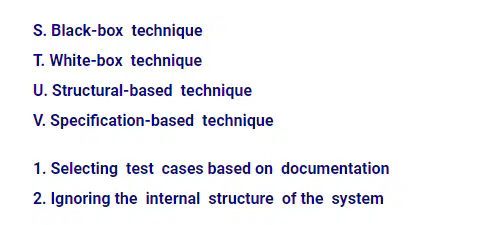
Match the test design techniques to the correct descriptions.
a)

S1, S2, U1 and U2

b)

T1, T2, U1 and U2

c)

S1, S2, V1 and V2

d)

T1, T2, V1 and V2

37.
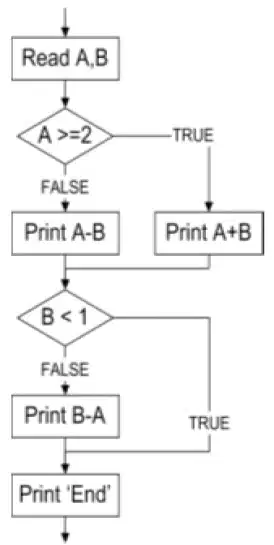
Given the following flow chart diagram. What is the minimum number of test cases required for 100% statement coverage and 100%decision coverage, respectively?
a)

Statement Coverage = 1, Decision Coverage = 3.

b)

Statement Coverage = 2, Decision Coverage = 3.

c)

Statement Coverage = 2, Decision Coverage = 2.

d)

Statement Coverage = 3, Decision Coverage = 3

38.

Which ordering of the list below gives increasing levels of test independence?

<br>

a. Tests designed by a fellow-member of the design team.

b. Tests designed by a different group within the organization.

c. Tests designed by the code author.

d. Tests designed by different organization.

a)

c, a, b, d.

b)

d, b, a, c

c)

c, a, d, b.

d)

a, c, d, b.

39.
During which activity of the Fundamental Test Process test process do you review the test basis?
a)
Evaluating exit criteria and reporting.
b)
Test implementation and execution
c)
Test analysis and des
d)
Test planning and control
40.

Which of the following are structure-based techniques?

<br>

a. Decision table testing

b. Boundary value analysis

c. Multiple condition coverage

d. Use case testing

e. Decision testing

a)

a and c.

b)

b and d.

c)

b and e.

d)

c and e.