
NEW
Font size
 Worksheets
POE C5
Total questions: 20
Worksheet time: 10mins
According to the law of diminishing marginal utility, the marginal utility associated with consuming successive units of a good will
increase as the amount consumed decreases.
remain constant as the amount consumed increases.
eventually decline as the amount consumed increases.
eventually increase as the amount consumed increases.
When marginal utility is decreasing but positive, total utility is
increasing at a decreasing rate.
increasing at an increasing rate.
decreasing at a decreasing rate.
decreasing at an increasing rate.
An indifference curve explains
the maximum utility that can be achieved for consuming a product.
the maximum utility that can be achieved for a given budget.
the combination of two goods giving equal utility to a consumer.
the best number of consumption between prices of good.
The study of consumers as they exchange something of value for a product or services that satisfies their needs with their scarce income is the definition of ___________.
production theory
market demand
the law of demand
consumer behaviour
When the second glass of orange juice does not provide as much satisfaction as the first glass of orange juice, this illustrates _____________.
opportunity cost
diminishing marginal utility
the budget line
consumer equilibrium
Which of the following statements is correct?
The indifference curve is upwards sloping
The indifference curve is convex to the origin
If an indifference curve touches the Y- or X-axis, this means utility is maximum.
An indifference curve may intersect with other indifference curves.
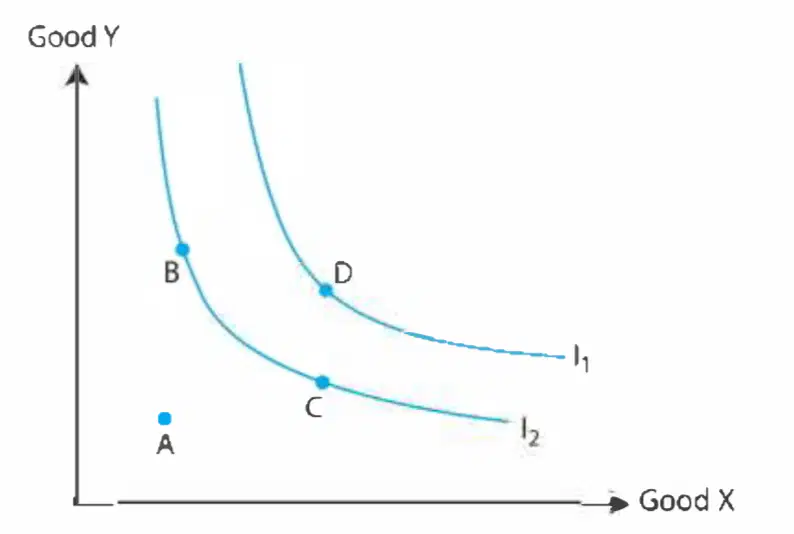
The graph shows part of a consumer’s indifference map for units of Good X and Good Y, where I1 and I2 represent indifference curves.
Which of the following statements is correct?
The consumer prefers A to D
The consumer prefers C to D
The consumer prefers C to B
The consumer prefers D to B
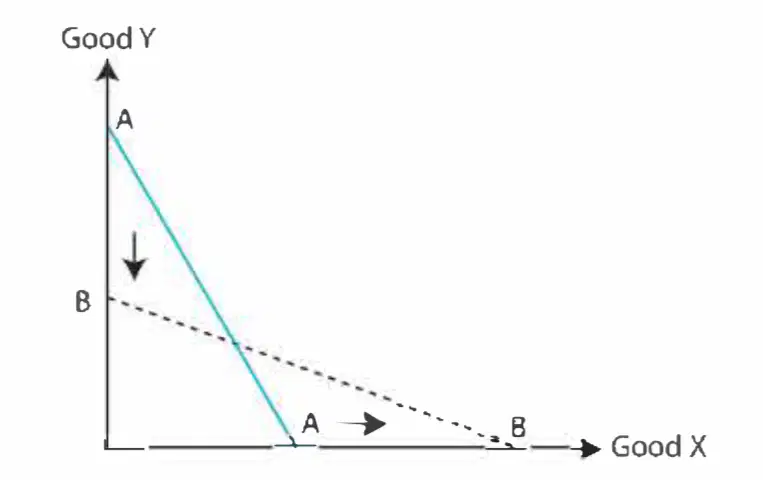
In the graph, AA is the initial budget line and BB is the new budget line. Which of the following changes might have occurred?
Px decreased, Py is constant, income increased.
Px increased, Py decreased, income is constant.
Px decreased, Py increased, income is constant.
Px is constant, Py increased, income decreased.
A parallel leftward shift of a consumer’s budget line could indicate that
the price of both goods have decreased in the same proportion.
the price of one product has increased in relation to the other.
the consumer’s income has decreased.
the marginal utilities derived from both products have decreased.
An increase in the income of a buyer will move his/her
budget line to the right
budget line to the left
indifference curve to the left
indifference curve to the right
Total utility is maximum when marginal utility is
positive
zero
maximum
negative
When the price of X is USD4 and the price os Y is USD10, which of the following combinations would be the intercept of axes (X,Y) if you have an income of USD100?
(10X, 25Y)
(5X, 20Y)
(20X,5Y)
(25X, 10Y)
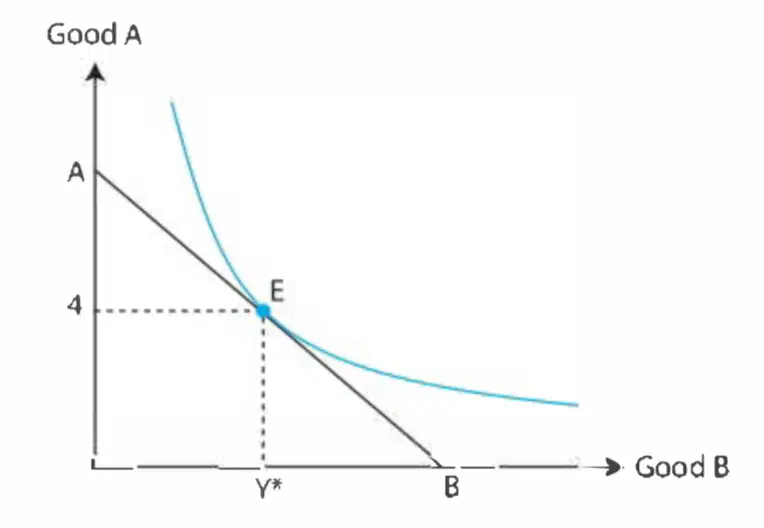
Assume the consumer’s income is USD80, calculate the value of Y* if the price of A is USD10 and the price of B is USD20.
5 units
4 units
3 units
2 units
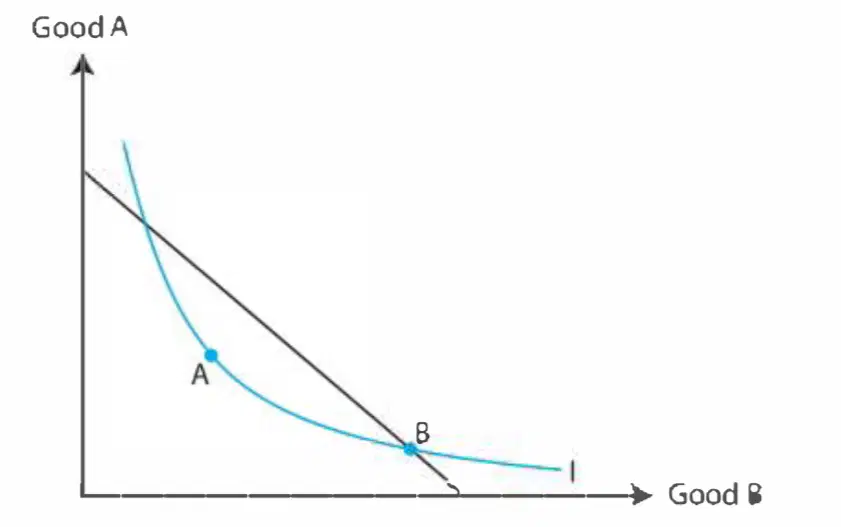
Which of the following statements is correct about the diagram?
The consumer prefers B to A.
The consumer prefers A to B.
Points A and B yields the same level of satisfaction.
B is a point of consumer equilibrium.
When an indifference curve is tangent to the budget line, it means that
buyers are satisfied with the product
buyers have spent all their income, but not maximizing their total utility
buyers have not spent all their income, yet maximised their total utility
buyers have spent all their income and maximised their total utility
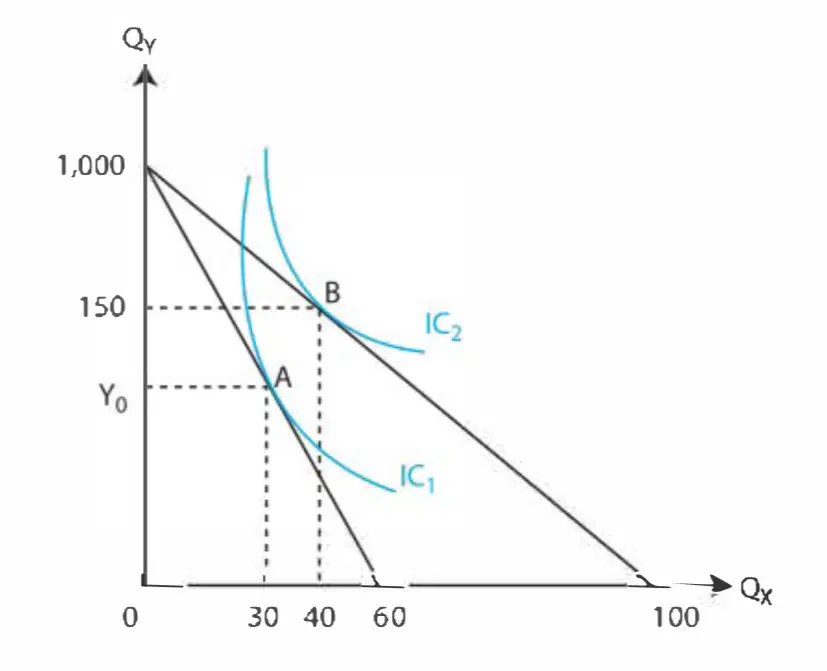
The consumer’s income is USD1,000.
The price of Y is ___________.
USD0.50
USD1.00
USD1.50
USD2.00
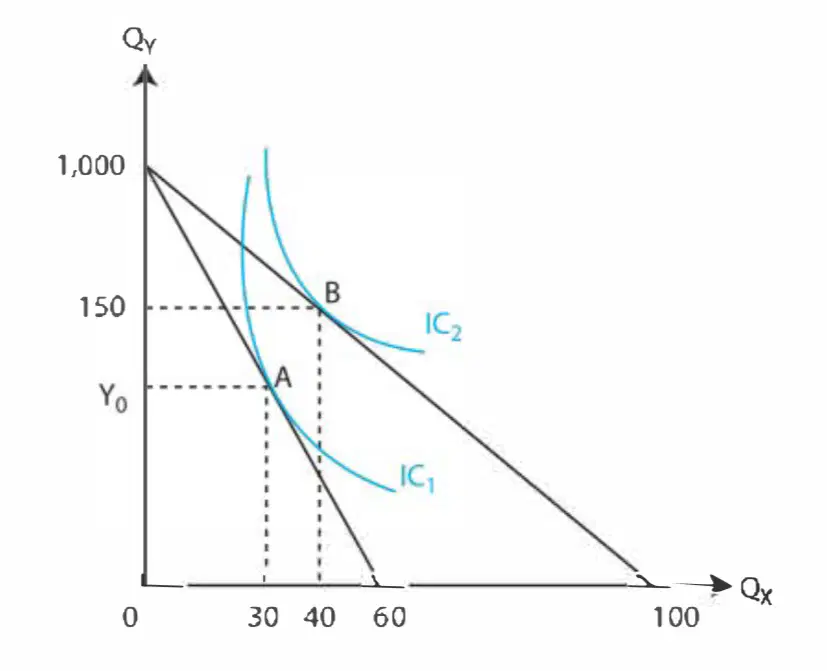
The consumer’s income is USD1,000.
The price of X at point B is _________.
USD5.00
USD5.50
USD10.00
USD10.50
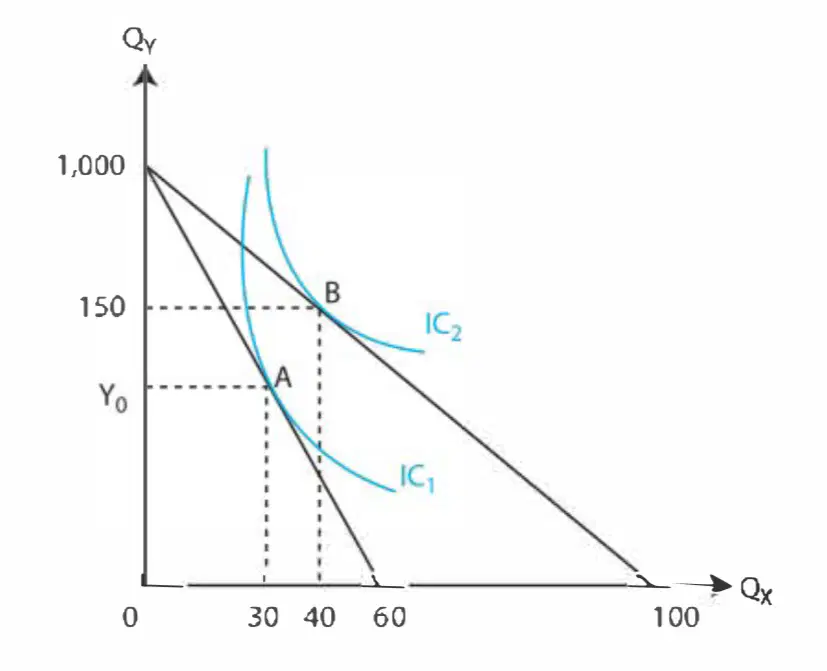
The consumer’s income is USD1,000.
The price of X at point A is ________.
USD15.67
USD16.67
USD17.76
USD18.76
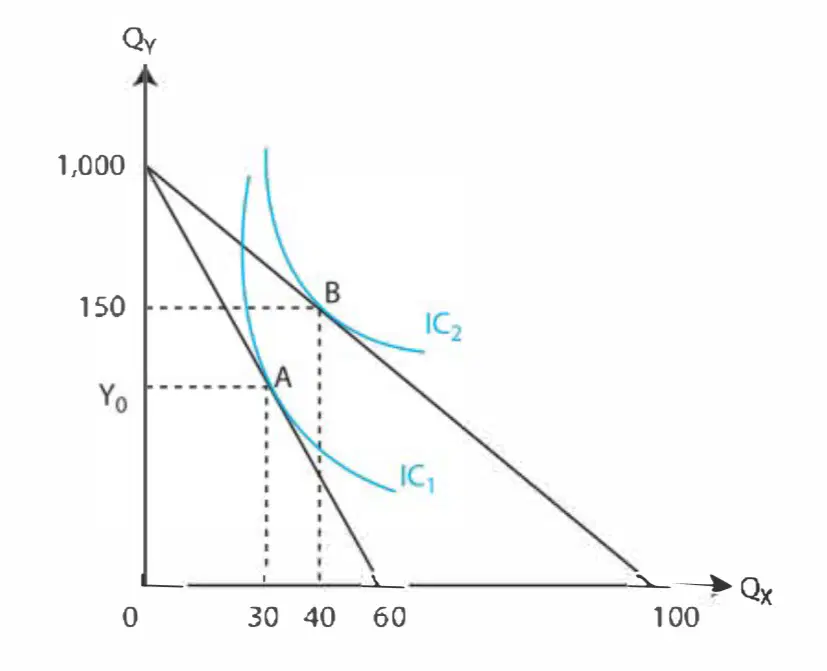
The consumer’s income is USD1,000.
The value of Yo is ___________.
800
700
600
500
At the price of USD for a hamburger and USD3 for a can of soft drink, a consumer can afford to buy 11 hamburgers and 9 cans of soft drinks. If the consumer is maximising his/her utility at this combination of food and drink. What is his/her income?
USD81
USD71
USD61
USD51

