
 Worksheets
Reaction kinetics for AQA
Total questions: 50
Worksheet time: 1hrs 6mins
For the reaction:
4NH3(g) + 5O2(g) → 4 NO(g) + 6H2O(g)
the rate of disappearance of oxygen is 0.020 M/s. What is the rate of formation of H2O?
0.03 Ms-1
0.02 Ms-1
0.017 Ms-1
0.024 Ms-1

What is the overall order of reaction?
The rate law for the reaction 2NO(g) + O2(g) → 2NO2(g) is first order with respect to O2 and third order overall. What is the rate law for the reaction?
Rate = k [NO]2[O2]2
Rate = k [NO]1[O2]2
Rate = k [NO]2[O2]1
Rate = k [2NO]2[O2]1

Look at the table of experimental results. Determine the order of reaction with respect to the concentration of reagent A
zero
1st
2nd
3rd
A catalyst alters the rate of a chemical reaction by,
providing an alternative pathway with a lower Ea
changing the products formed in the reaction
providing a surface on which the molecules react
increasing the frequencies of collisions between molecules
Liz observes 2 reactions, A and B.
Reaction A is performed in a beaker placed on top of a hotplate.
Reaction B is is performed in a beaker placed within a container of ice.
Which of the following statements is true?
Reaction A will react more slowly because the higher temperature will cause more collisions - the heat makes the molecules tired.
Reaction A will react more slowly because the higher temperature will give the reactants higher speed and greater kinetic energy.
Reaction B will react faster because the lower temperature causes the particles to move more slowly, allowing them to have more time to attach to one another.
Reaction B will react slower because the lower temperature makes the particles move slower (they have a lower KE), resulting in less effective collisions.
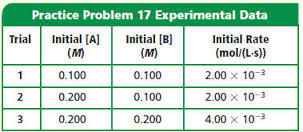
What two trials would you use to find the order for B?
trials 1 and 2
trials 1 and 3
trails 2 and 3
The reaction A + 2B → products ……was found to have the rate law, Rate = k[A][B]2. Predict by what factor the rate of reaction will increase when the concentration of B is doubled and the concentration of A remains unchanged
2
4
6
8
What is the unit for the rate constant, k, if the rate equation is:
Rate = K [A]
s-1
Mol dm-3 s-1
s-2
Mol2 d-6 s-1
The rate expression for the reaction
X(g) + 2Y(g) → 3Z(g) is
rate = k[X]0 [Y]2
By which factor will the rate of reaction increase when the concentrations of X and Y are both increased by a factor of 3?
6
9
18
27

rate = k[A]
The rate constant in the rate law above is 0.5 L/mol·s. If the initial concentration of A is 0.1 M, how long will it take for [A] to drop to 0.025 M?
0.7 s
1.4 s
2.8 s
There is not enough information given.
Which of the following plots will show a linear relationship for a second order reaction?
[A] vs time
1/[A] vs time
ln[A] vs time
[A]2 vs time
How are the exponents n and m determined?
Which of the following factors can affect the value of the activation energy of a reaction?
1. the presence of a catalyst
2. changes in temperature
3. changes in the concentration of the reactants
1 only
1 and 2 only
3 only
1,2, and 3
The oxidation of butadiene using air or oxygen is catalysed by a hot aqueous solution of palladium(II) ions, Pd2+ .
Which statement about the action of the Pd2+ is NOT correct?
Pd2+ lowers the activation energy for the reaction.
Pd2+ increases the energy for the reacting molecules.
When Pd2+ is used, the reaction proceeds by a different route.
Changing the concentration of the Pd2+ affects the rate of oxidation
Why does a mixture of hydrogen gas and bromine gas react together faster at a temperature of 500K than it does at temperature of 400K?
(You can choose more than 1 answer)
A higher proportion of effective collisions occurs at 500K
The activation energy of the reaction is lower at 500K
Hydrogen and bromine molecules collide more frequently at 500K

The distribution of molecular energies in a sample of a gas at a given temperature is shown bỵ the graph below. If the temperature is increased, what will happen to the position of point X?
Fewer molecules possess the most probable energy value so X will shift to the right.
Fewer molecules possess the most probable energy value so X will shift to the left.
More molecules possess the most probable energy value so X will shift to the right.
The position of X will stay the same but the area under the distribution curve increases
The dotted-line curve on each graph below represents the corresponding distribution for a gas at 300K. Which solid-line curve most accurately represents the distribution of molecular energies?


The diagram shows a reaction pathway for an endothermic reaction. Which arrow represents the activation energy for the forward reaction?
A
B
C
D

The diagram below represents, for a given temperature, the Boltzmann distribution of the kinetic energy of the molecules in a mixture that react slowly together without a catalyst.
The activation energy for the reaction, Ea, is marked for the uncatalysed reaction.
What would be the position of Ea be if the reaction took place with an effective catalyst?
A
B
C
D

The diagram shows a Boltzmann distribution of molecular energies for a gaseous mixture. The distribution has a peak, labelled Q on the diagram.
What happens when an effective catalyst is added to the mixture?
The height of the peak decreases and the activation energy moves to the right.
The height of the peak decreases and the activation energy moves to the left.
The height of the peak remains the same and the activation energy moves to the right.
The height of the peak remains the same and the activation energy moves to the left.

Boltzmann distribution are shown in the diagrams.
- In diagram 1, one line, P or Q, corresponds to the activation energy in the presence of a catalyst and the the other line corresponds to the activation energy in the same reaction in he absence of a catalyst.
- In diagram 2, one curve, X or Y, corresponds to a temperature higher than that of the other curve.
The line with the presence of catalyst and the curve with thigher temperature are ....... and ......., respectively.
P, X
P, Y
Q, X
Q, Y
The collisions which bring about a chemical reaction are called:
Consistent collisions
Normal collisions
Effective collisions
Given the chemical equation, Haber Prosess
N2(g) + 3H2 (g) --> 2NH3 (g)
Based on this reaction, first order for concentration N2 and zero order for concentration H2………..
Which of these would be a suitable Rate Equation?
Rate = K [N2] [H2]
Rate = K [N2]
Rate = K [H2]0
Rate = K [N2]1 [H2]3
The half-life of a reactant, t1/2, is the amount of time needed for a reactant concentration ......
to increase by three times original concentration.
increase by half of original concentration.
decrease by ten times original concentration.
decrease by half of original concentration.
What does the term Activation energy mean?
The maximum energy a reaction can release
The minimum amount of energy that reacting particles must have when colliding to form products
The energy added by a catalyst
The energy possessed by the products
A reaction has the rate law: Rate = k [A]. What will happen to the rate of reaction if the concentration of A is doubled?
it will double
No change to the rate of reaction
it will triple
It increases by a factor of 4
If a reaction is described as zero order with respect to reactant A, this means that
A is a catalyst in the reaction.
A is not involved in the rate determining step.
the value of the rate constant is independent of A.
the rate of reaction is inversely proportional to the concentration of A.

The following data was measured for the reaction:
2NO(g) + Cl2(g) ⎯→ 2NOCl(g)
Choose the correct rate equation for the reaction.
rate = k[NOCl]2
rate = k[NO][Cl2]
rate = k[NO]2[Cl2]
rate = k[NO][Cl2]0.5
For a reaction 2A + B -> 2C, with the rate equation: Rate = k[A]2[B]
the order with respect to A is 1 and the order overall is 1.
the order with respect to A is 2 and the order overall is 2.
the order with respect to A is 2 and the order overall is 3.
the order with respect to B is 2 and the order overall is 2.
Determine the overall order of the reaction:
rate = k[A][B]0[D]
First order
Zero order
Second order
Third order
all of these

The following data were measured for the reaction
BF3(g) + NH3(g) ⟶ F3BNH3(g)
What is the rate when [BF3] = 0.100 M and [NH3] = 0.500 M ?
.01704 M/s
.0852 M/s
.1704 M/s
.852 M/s

This question is about the Maxwell–Boltzmann distribution of molecular energies in a sample of a gas shown in the figure below.
What does the area under the curve represent?
The total energy of the particles.
The total number of particles.
The number of particles that can react with each other.
The total number of particles that have activation energy.

The question below is about the Maxwell–Boltzmann distribution shown for a sample of a gas, X, at two different temperatures.
Which statement is correct for the higher temperature?
The area under the curve to the left of Ea decreases.
The total area under the curve increases.
The activation energy decreases.
More molecules have the mean energy.

The graph shows the Maxwell−Boltzmann distribution of molecular energies in a sample of gas at a fixed temperature.
The horizontal axis label is
energy
J mol−1
E
mean energy
Which is an appropriate unit for the rate of a reaction?
mol dm-3 s
mol dm-3 s-1
mol dm-3
s
What is the best definition of rate of reaction?
The time it takes to use up all the reactants
The rate at which all the reactants are used up
The increase in concentration of a product per unit time
The time it takes for one of the reactants to be used up

A
B
C
D

A
B
C
D
For the reaction CaCO3(s) + 2HCl(aq) → CaCl2(aq) + H2O(l) + CO2(g), which change does not increase the initial rate of reaction when CaCO3 is added to excess HCl?
Decrease in the size of the CaCO3 particles
Increase in the temperature of the reaction mixture
Increase in the concentration of HCl, keeping the same volume
Increase in the volume of HCl, keeping the same concentration
For the reaction CaCO3(s) + 2HCl(aq) → CaCl2(aq) + H2O(l) + CO2(g), which methods can be used to monitor the progress of this reaction?
I. change in colour of this reaction mixture
II. change in mass of this reaction mixture
III. change in volume of gas evolved
I and II only
I and III only
II and III only
I, II and III

