
 Worksheets
Energy, Work, & Power
Total questions: 75
Worksheet time: 2hrs 35mins
The SI unit for WORK is:
Joules
Watts
Newtons
Kilogram
The SI unit for POWER is:
Watts
Joules
Newtons
Meters
PE = m*g*h
KE = 21mv2
W = F*d
P = W/t
A 180 gram softball is thrown into the air using 40 J of work. The ball rises to its maximum height in 1.96 seconds. How much power was exerted throwing the ball?
144 W
20.4 W
3.52 W
2.11W

Assuming no friction or air resistance, at what point in a pendulum's swing is its Mechanical energy the least?
At the very bottom of its path
Its mechanical energy is constant throughout
Half way between the top and bottom of its path
At the very top of its path

Where does the pendulum have the least amount of potential energy?
A
B
C
D
E
Newtons (N) are the unit for __________.
Work
Distance
Acceleration
Force
Kinetic Energy is defined as:
Energy stored due to its location
Energy of motion
Energy stored in the bonds of molecules
Thermal (Heat) energy
What is the height of a 3200-kg plane if it has 960000 J of potential energy?
10.2 m
30.6 m
307200000 m
300 m
A driver continuously pushes a car stuck in the mud with 900N of force for 70 seconds. The car does not budge. How much work has the driver done on the car?
63000 J
0 J
12.9 J
6300 J


What is the KE at the bottom?
15,000 J
3,750 J
7,500 J
11,250 J

A runner exerts 222,000 J when she runs for 60 seconds. What is the runner's power?
3700 W
600 W
400 J
60 J

A typical internal combustion engine only converts 20-40% of the potential energy stored in fuel to the mechanical movement of the car. Where does a majority of the energy go?
Lost as Light Kinetic energy
Lost as Thermal energy
Lost as Elastic Potential energy
Lost as Gravitational Potential energy
Energy stored inside a leaf would be considered to be:
electrical
chemical
thermal
mechanical
Energy from a compressed spring would be an example of:
kinetic
elastic potential
gravitational potential
chemical potential
What is the difference between calculating Power and Work?
Power takes the time of a task into account
Work takes into account the time it takes to complete a task
Power is the amount of force divided by area used
Work is the amount of seconds needed for energy transfer
Energy that is stored in bonds between atoms in compounds is:
Mechanical energy
Chemical energy
Kinetic energy
Nuclear energy
What is the formula for calculating Power?
P = Fd
P = ham
P = W/t
P = Wt
Energy released when the nucleus of atoms split (fission) or join together (fusion) is called:
Thermal
Radiant
Elastic
Nuclear
Chemical
Energy cannot be created or destroyed. But, it can be _____.
transformed
increased
decreased
evaporated
Energy made available through the flow of electric current through a conductor is called:
Radiant
Thermal
Electrical
Kinetic
Energy that is carried by light is referred to as:
Radiant
Thermal
Kinetic
Potential
Electrical
What is potential energy?
The energy an object has due to its atomic structure.
The energy an object has due to its chemical composition.
The energy an object has due to its motion.
The energy an object has due to its position or condition.
Gravitational potential energy depends on the strength of gravity, ________ and ________ of the object.
height and mass
friction and movement
mass and movement
height and friction
What is the value of the Earth's acceleration due to gravity (g)?
9.8 m/s2
100 m/s2
25 m/s2
3.14 m/s2
Wood, batteries, gasoline, and food are all examples of ____________.
gravitational potential energy
elastic potential energy
chemical potential energy
kinetic (heat) energy
A exercise ball is on a table 2.5 m above the ground. What is the mass of the ball if it has a GPE of 56.8 J?
71 kg
22.72 kg
142 kg
2.32 kg
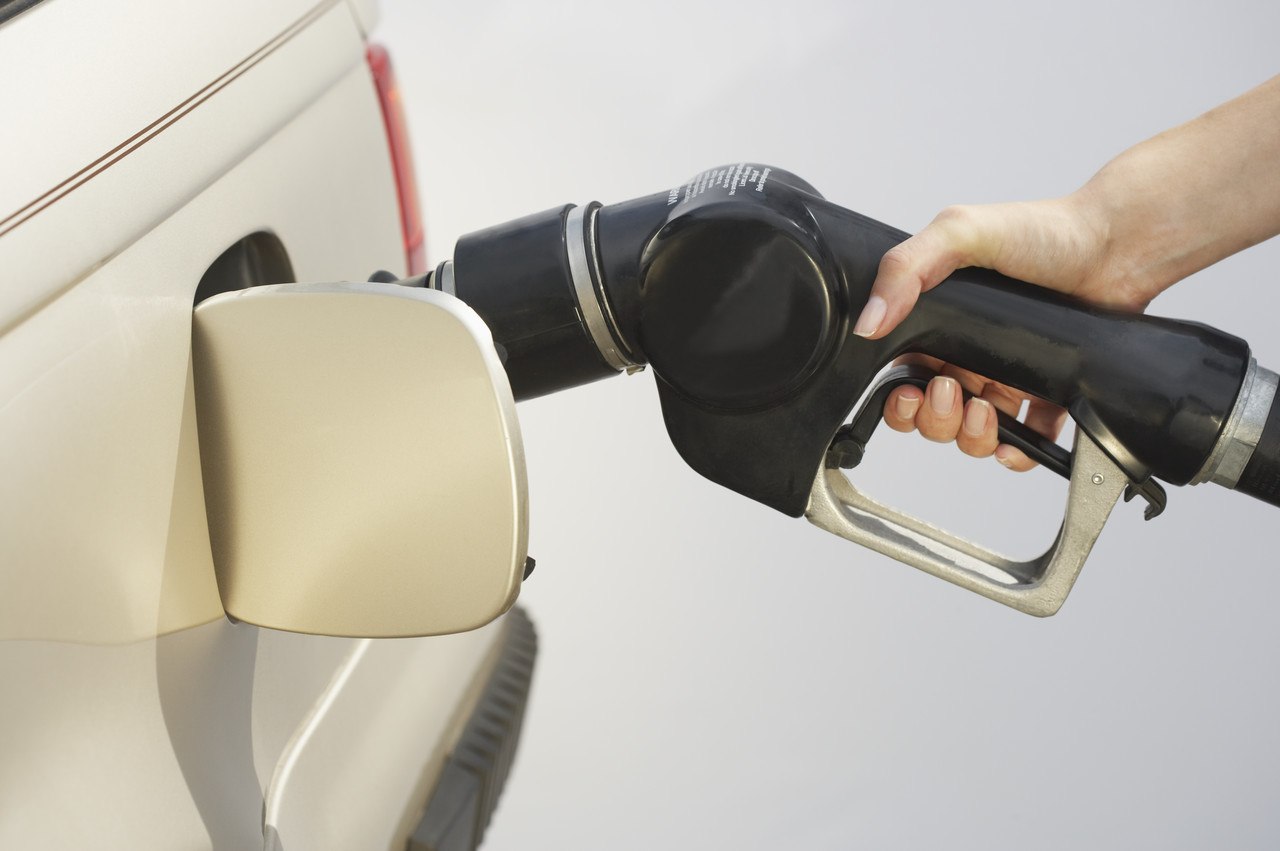
nuclear kinetic -> electrical, radiant, and sound
mechanical potential -> electrical and elastic
chemical potential -> Kinetic, sound and thermal
thermal -> electromagnetic and kinetic
What would 54N be an example of?
work
power
distance
force
If you increase your work and decrease your time, you will have:
more power
less power
the same amount of power
power rating cannot be determined
What are the two types of Mechanical Energy (ME)?
Kinetic & Potential
Potential & Thermal
Kinetic & Electrical
Electrical & Thermal

A cheetah can run briefly with a speed of 31 m/s. Suppose a cheetah with a mass of 47 kg runs at this speed. What is the cheetah’s kinetic energy?
1457 J
728.5 J
45,167 J
22,583.5 J
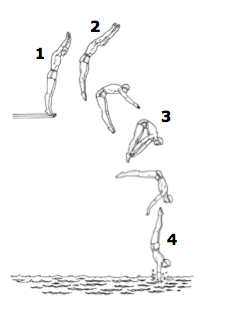
This picture represents a diver’s motion from the top of a high diving board into a pool of water. At what point does the diver have the greatest kinetic energy and the least potential energy?
1
2
3
4
Water currents that flow from the equator to the poles move heat from warmer climates to colder ones are an example of which transfer of heat?
Conduction
Convection
Radiation
Reduction
What type of heat transfer is the following?
Solar panels are used to collect sunlight for energy.
Convection
Conduction
Radiation
None of the above
In the following example, identify the type of heat transfer.
You hold an ice cube in your hand and it begins to melt.
Radiation
Convection
Conduction
In the following example, identify the correct type of heat transfer:
You feel the warmth from the sun on your face.
Convection
Conduction
Radiation
Reduction
In terms of Thermal Energy, heat will:
Always flow from the warmer object when its above 50⁰C
Always flow from higher temperatures to lower temperatures
Always flow from lower temperatures to higher temperatures
It depends on the temperature

There are four cups of hot cocoa. The cup sizes are shown. The temperature of the cocoa in each cup is 25 degrees Celsius. Which cup has the MOST thermal energy?
Large cup (Trenta)
Small cup (Tall)
Medium cup (Venti)
All three are the same temperature so they have the same thermal energy
Grande cup

Which material from the list will take the most energy to heat and raise its temperature?
liquid water
Lead
Granite
Iron
water vapor
The specific heat of platinum is 150 J/kg°C. How much heat (Q) is released when a 12 kg piece of platinum cools from 100°C to 50°C?
90000 J
665 J
-90000 J
0.665 J
-7500 J
During a PennDOT laboratory evaluation, a 25 kg piece of Asphalt heats from 22⁰C to 40⁰C. If it took 411750J of heat to do this, what is the Specific Heat of Asphalt?
105 J/kg⁰C
130.5 J/kg⁰C
880 J/kg⁰C
915 J/kg⁰C

If 68 W of power is produced in 18 seconds, how much Work is done?
1224 J
0.264 J
3774 J
12.24 J

0.125 s
8 s
64800 s
80 s

A 5.8 kg crate is pushed across the floor for 4.5 meters. How much Work was done on the crate?
26.1 J
255.78 J
12.63 J
272.32 J


If mass is doubled what happens to the amount of kinetic energy an object has?
KE doubles
KE is cut in half
KE is reduced to 1/4
KE is quadrupled
____________ is the ability to do work or cause change.
Energy
Force
Friction
Motion
What is the correct unit for mass in energy equations?
Kilogram (Kg)
Newton (N)
Joule (J)
Watt (W)
Gram (g)

What is the KE half way down the ramp?
50 J
25 J
0 J
100 J

What is the total Mechanical Energy at point A?
500,000 J
400,000 J
200,000 J
50,000 J

At which point in the picture must the cart have the most MECHANICAL energy (assuming no friction)?
Point 1
Point 2
Point 3
They would all be the same
What is Thermal Energy?
Energy produced while moving through an electric current
Energy that sound carries in the form of large waves
The sum of the potential and kinetic energy of the particles in an object.
The energy that electromagnetic waves carry through atomosphere
What is an example of sound energy?
A thermometer heating up
Solar panels generating electricity
A guitar string being plucked
A machine in an assembly line
What type of energy transformation occurs in a toaster?
Electrical to radiant only
Electrical to thermal and radiant
Thermal to mechanical and electromagnetic
Solar to electrical and chemical
What type of energy transformation occurs when a piece of wood burns?
Electrical energy is released as radiant and chemical energy
Chemical energy is released as thermal and radiant energy
Mechanical energy is stored as chemical energy
No transformation occurs

A sample of iron receives 50.0 J of heat energy that raises the temperature of the iron by 25.0°C. If iron has a specific heat of 0.10 J/g°C, what is the mass of the iron sample?
25 g
30 g
20 g
50 g
What is the measurement of the average kinetic energy of the particles of a substance? (a)
conduction
ironing a shirt
convection
hot air currents heating a cold room
radiation
a microwave heating food
The amount of energy required to raise the temperature 1ºC for every gram or kilogram is called____?
Thermal Energy
Specific Heat
Temperature
Kinetic Energy
Heat Value
a material that slows the transfer of heat
a material that transfers heat easily
a material that is fluffy and soft
a material that is kept at a lower temperature
What is the BEST example of a conductor of thermal energy?
A wooden block
A wool oven mitt
A plastic mug
A metal pan
What is a Conductor?
a material that slows the transfer of heat
a material that transfers heat easily
a material that is retains and measures heat transfer
a material that is temperature controlled

Which of the following is a good conductor of heat and electricity?
newspaper
copper wire
glass plate
plastic bottle
All of the following are true regarding Einstein's equation, E=mc2 EXCEPT:
The equation evaluates something called "Rest Energy"
It proves that mass and energy are interrelated
It proves that the speed of light a constant value (3 x 10⁸ m/s)
It proves that energy can be created at the speed of light

