wayground logo

Free Printable Worksheets

NEW

Font size

S
M
L
XL
Worksheets

newtons laws

Total questions: 25

Worksheet time: 2hrs 15mins

Name
Class
Date
1.

what is newton's 1st law??!?

a)

every object will remain at rest or in uniform motion in a straight line unless compelled to change its state by the action of an external force.

b)

for every action (force) in nature there is an equal and opposite reaction.

c)

the acceleration of an object is dependent upon two variables - the net force acting upon the object and the mass of the object.

d)

states that the time rate of change of the momentum of a body is equal in both magnitude and direction to the force imposed on it.

2.

which one is newtons 2 law?

a)

every object will remain at rest or in uniform motion in a straight line unless compelled to change its state by the action of an external force.

b)

That the acceleration of an object is dependent upon two variables - the net force acting upon the object and the mass of the object

c)

or every action (force) in nature there is an equal and opposite reaction.

3.

what is newton's 3 law??

a)

every object will remain at rest or in uniform motion in a straight line unless compelled to change its state by the action of an external force.

b)

for every action (force) in nature there is an equal and opposite reaction.

c)

that the acceleration of an object is dependent upon two variables - the net force acting upon the object and the mass of the object.

4.
With unbalanced forces, the object will move in the direction of the _______ force.
a)
larger 
b)
smaller 
c)
equal 
5.
A person not paying attention while skateboarding hits a rock. The skateboard stops...they don't.
a)
The Law of Inertia (1st law)
b)
The Law of Acceleration (2nd law)
c)
The Law of Conservation of Momentum
d)
Action Reaction Law (3rd law)
6.
A magician pulls a tablecloth out from under dishes and glasses on a table without disturbing them.
a)
Newton's 1st Law
b)
Newton's 2nd Law
c)
Newton's 3rd Law
7.

What law states that for every action there is an equal and opposite reaction?

a)

First Law

b)

Second Law

c)

Third Law

d)

Fifth Law

8.
What law is best described by inertia?
a)
1st
b)
2nd
c)
3rd
d)
law of conservation of mass
9.

What law is best described

Equal and Opposite

a)

1st

b)

2nd

c)

3rd

d)

speed

10.
With unbalanced forces, the object will move in the direction that the _______ force is being applied.
a)
larger 
b)
smaller 
c)
equal 
d)
less
11.
What is Newton's First Law
a)
F=ma
b)
Every action has an equal and opposite reaction
c)
An object at rest stays at rest, an object in motion stays in motion. 
d)
Friction 
12.
A person is pushed forward into their seatbelt when a car stops
a)
1st
b)
 2nd
c)
2 and 3
d)
3rd 
13.
You hit a wall with a stick.  The equal but opposite reaction is _____
a)
the wall pushes against you
b)
the stick pushes against you
c)
you push against the stick
d)
the wall pushes against the stick
14.
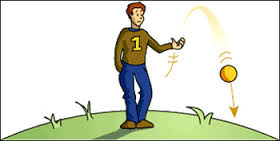
Which one is balanced?
a)
top
b)
bottom
c)
both
d)
neither
15.
What is a PUSH or PULL of an object?
a)
Motion
b)
Force
c)
Friction
d)
Gravity
16.
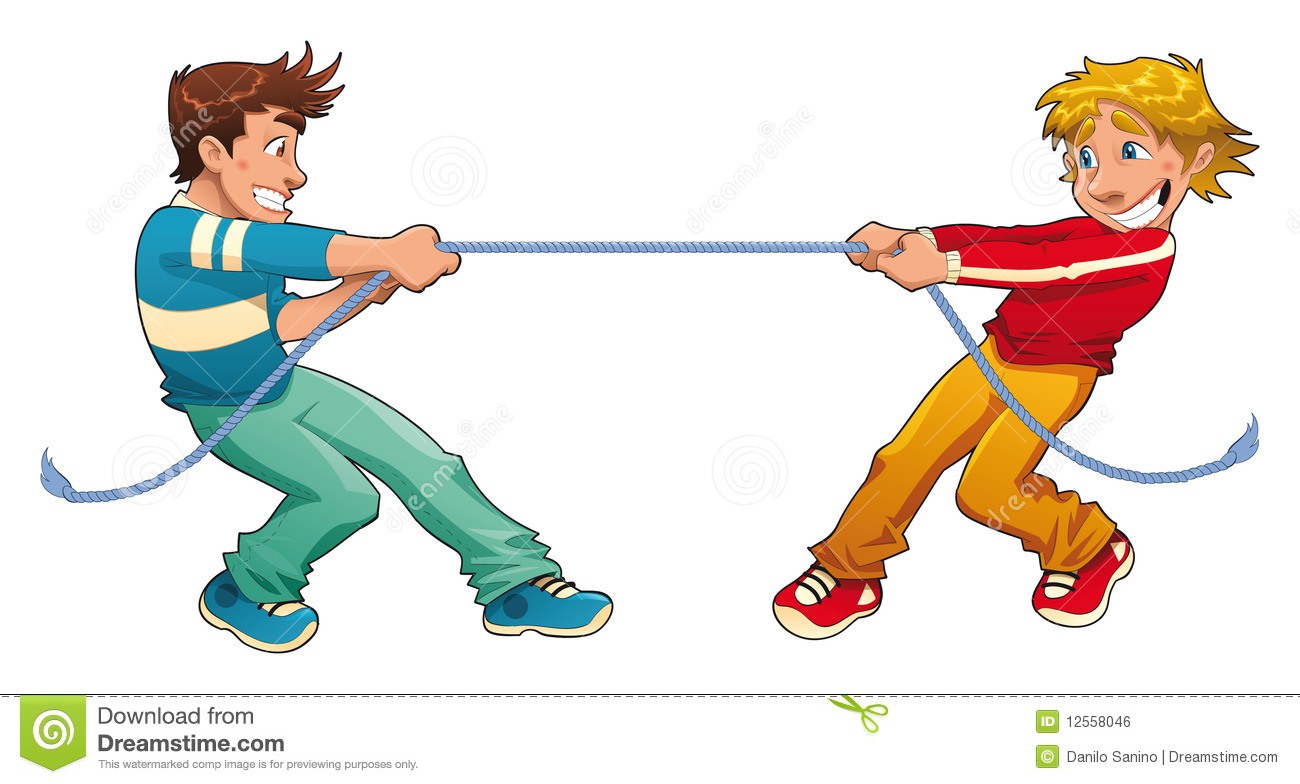
If these boys are pulling with the same amount of force.  What will happen?
a)
The boy in blue will win.
b)
They will not move at all.
c)
The boy in red will win.
d)
Both will fall down.
17.
What is the attractive force that exists between all objects that have mass?
a)
Weight
b)
Mass 
c)
Gravity
d)
Viscosity
18.

sum of forces acting on a particle or body.

a)

Net force

b)

Balnced

c)

Acceleration

19.

one that causes a change in the motion of the object to which the force is applied

a)

Action/Reaction

b)

Unbalanced Force

c)

Acceleration

20.

the rate of change of velocity per unit of time

a)

Acceleration

b)

Balanced Force

c)

Inertia

21.

in every interaction, there is a pair of forces acting on the two interacting objects.

a)

Friction

b)

Action/Reaction

c)

Net Force

22.

the net force acting upon the object and the mass of the object

a)

Newtons 3rd law

b)

Newtons 1st law

c)

Newtons 2nd law

23.

a coherent, typically large body of matter with no definite shape

a)

Force

b)

Mass

c)

Acceleration

24.
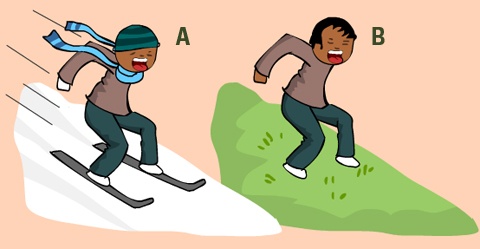
Why is it harder for the boy in Image B to get down the hill?
a)
Motion
b)
Friction
c)
Work
d)
Displacement
25.
If these boys are pulling with the same amount of force.  What will happen?
a)
The boy in blue will win.
b)
They will not move at all.
c)
The boy in red will win.
d)
Both will fall down.