Wayground logo

Free Printable Worksheets

Font size

S
M
L
XL
Worksheets

Agile Tester Foundation Sample Exam 005

Total questions: 40

Worksheet time: 10hrs 0mins

Name
Class
Date
1.
Which of the following is not a principle of Agile Manifesto?
a)
Welcome changing requirements, even late in development. Agile processes harness change for the customer's competitive advantage.
b)
Build projects around motivated individuals. Give them the environment and support they need, and trust them to get the job done.
c)
Deliver working software after all the iterations are completed.
d)
At regular intervals, the team reflects on how to become more effective, then tunes and adjusts its behavior accordingly.
2.
In an Agile team, who is responsible for generating, maintaining, and prioritizing the product backlog.
a)
Development Team
b)
Scrum Master
c)
Product Owner
d)
Team manager
3.
In Kanban, how are parallel active tasks limited?
a)
By setting Work-in-Progress Limit
b)
Customer assign daily task to team
c)
Team Leader assign daily task to team
d)
tasks are assigned daily using an automatic tool
4.
What is not true about Iteration Planning
a)
After release planning is done, iteration planning for the first iteration starts
b)
Iteration planning looks ahead to the end of a single iteration
c)
Iteration planning is concerned with the iteration backlog.
d)
Iteration planning starts before release planning is done
5.
In An Agile project, what does a user story mean?
a)
user stories are written to capture experiences from the perspectives of end users
b)
user stories are written to capture requirements from the perspectives of stake holders
c)
user stories are written to capture requirements from the perspectives of developers, testers, and business representatives
d)
user stories are written to capture requirements from the perspectives of project leader
6.

During a daily stand up meeting. Following agendas were discussed.

<br>

1. Current work progress

2. Tasks completed

3. Tasks to be done today

4. Impediments to progress due to delay in test related activities.

<br>

What should the team do in such a situation

a)

The team discuss and feels that testing is not important and continues on

b)

The team discuss and feels that the tester is not performing as expected and changes the tester in the team

c)

The team discuss with the tester and tries to find out the problems and helps in resolving the issue

d)

the tester is never a part of the daily stand up meeting, so no action was taken

7.
Out of the following which activities are not consistent with Agile’s “Whole Team Approach”?
a)
The whole-team approach means involving everyone with the knowledge and skills necessary to ensure project success.
b)
The whole team is responsible for quality in Agile projects.
c)
Testers will work closely with both developers and business representatives to ensure that the desired quality levels are achieved.
d)
Only the business representatives and the developers are involved in feature discussions
8.
Conducting frequent product demonstrations can help an Agile team avoid which of the following project risks?
a)
Ungroomed user stories.
b)
Shorter sprint size.
c)
Scope creep
d)
Project team heading in a wrong direction.
9.
How can Early and Frequent Feedback helps manage the team better? (SELECT only TWO)
a)
Early and Frequent Feedback helps the team to know how much work can they do in a sprint or iteration
b)
Early and Frequent Feedback helps the team to know What could help them go faster
c)
Early and Frequent Feedback helps the team to know who are the individuals who perform badly to punish them
d)
Early and Frequent Feedback helps the team to know which test management team to use.
10.
The letter V in the INVEST acronym used to depict attributes of user stories
a)
Verifiable
b)
Valuable
c)
viewable
d)
None of the above
11.
Which of the following is an Agile technique that regularly checks the effectiveness of the quality process, looks for the root cause of issues, and suggest trials of new approaches to improve quality?
a)
User stories
b)
Sprints
c)
Retrospectives
d)
Backlog
12.
Which of the following would you avoid during retrospectives?
a)
Identifying small improvements.
b)
Identifying major breakthroughs.
c)
giving the chance for everyone to talk
d)
Blame game.
13.
Which of the following is not a benefit of the Continuous Integration?
a)
Continuous Integration Eliminates the schedule risks associated with big-bang integration
b)
Continuous Integration increases repetitive manual testing activities
c)
Continuous Integration provides quick feedback on decisions made to improve quality and tests
d)
Continuous Integration provides confidence that each day’s development work is based on a solid foundation
14.
Which of the following is not true about pairing in Agile Practice ?
a)
Pairing can involve testers working together in twos to test a feature.
b)
Pairing can involve a tester working collaboratively with a developer to develop and test a feature.
c)
Pairing can involve a tester working collaboratively with a developer where the tester writes the code and automated unit tests and pass it on to the developer.
d)
Pairing can involve two programmers working together at one workstation. One writes the code while the other reviews each line of code as it is typed in. The two programmers switch roles frequently.
15.
Which of the following is not a typically a task of tester in an Agile project?
a)
testers spend time creating, executing, monitoring, and maintaining automated tests and results
b)
testers focus on creating automated integration, system, and system integration tests
c)
Testers will focus on creating unit tests and passing them on to the developers
d)
Testers may also serve as testing and quality coaches within the team, sharing testing knowledge and supporting quality assurance work within the team
16.
Which of the following should NOT be considered Business-oriented work products?
a)
The Requirements Document
b)
User documentations
c)
workflows
d)
Quality plans
17.
In an Agile project, which of the following helps checking if any builds are failing to code compilation errors.
a)
Alpha testing
b)
continuous integration framework
c)
Feature acceptance tests
d)
Beta Testing
18.
To provide an instant, detailed visual representation of the whole team’s current status, including the status of testing, teams may use ----------?
a)
Spreadsheets
b)
Agile task boards
c)
papers
d)
boards
19.
What is the agenda for daily stand up meeting?
a)
What have you completed since the last meeting?
b)
What do you plan to complete by the next meeting?
c)
what have you completed the past week?
d)
What is getting in your way?
20.
Select the true response about the Automated testing
a)
Automated tests are only required at unit levels.
b)
Automated testing and build tools help to manage the regression risk associated with the frequent changes
c)
over-reliance on automated unit testing alone to manage the risks can be a problem
d)
Automated testing is enough to cover all the test types.
21.
What is build verification tests
a)
same as regression tests
b)
Subset of automated tests covering critical functionality and integration points
c)
Subset of automated tests covering every functionality and integration points
d)
Subset of manual tests covering critical functionality and integration points
22.
During a user Story analysis, a tester finds the requirement to be ambiguous. What is the next step a tester should do?
a)
Rely entirely on written specification
b)
Actively acquire information from the stakeholders
c)
Actively acquire information from the developers
d)
Do not create test cases for the requirement
23.
"State whether true or false. The role of a tester in an Agile team includes activities that generate and provide feedback only on test status, test progress, and product quality?"
a)
True
b)
FALSE
24.
During a poker session, stakeholders and developers gives 5 points to a user story, but the tester gives 21 points. Th team discusses why the tester feels so? The tester ask questions to clarify requirements and highlights more testing efforts would be required to ensure the consistency. Which of the following describes the role of the Tester in this situation?
a)
Configuring, using, and managing test environments and test data
b)
Actively collaborating with developers and business stakeholders to clarify requirements, especially in terms of testability, consistency, and completeness
c)
Measuring and reporting test coverage across all applicable coverage dimensions
d)
Participating proactively in team retrospectives, suggesting and implementing improvements
25.
"Which approach allows focus on testing the code based on the expected behavior of the software "
a)
Acceptance Test-Driven Development
b)
Test-driven development
c)
Behavior-Driven Development
d)
Build Verification Test
26.
which testing principle drives the concept of The test pyramid
a)
The pesticide paradox
b)
Early testing
c)
Defect clustering
d)
Absence of errors fallacy
27.
Which of the following is not true about Acceptance Test-Driven Development ?
a)
Acceptance test-driven development defines acceptance criteria and tests during the creation of user stories
b)
Acceptance test-driven development is where the agile team writes the test cases and the testers execute those test cases.
c)
Stakeholders play no role in this kind of development
d)
Acceptance test-driven development creates reusable tests for regression testing
28.
What is a quality risk
a)
When the primary effect of risk is on product quality
b)
When the primary effect of risk is on project success
c)
When the primary effect of risk is on teams productivity
d)
When the primary effect of risk is based on tester's skills
29.
In the testing quadrants, which quadrant contains unit tests?
a)
Q2
b)
Q1
c)
Q4
d)
Q3
30.
Which two test quadrants are would the above test cases be part of?"
a)

Q1 Unit level, technology facing & Q2 System level, Business facing

b)

Q3 System or User Acceptance level, Business facing & Q4 System or Operation acceptance level, technology facing

c)

Q2 System level, Business facing & Q3 System or User Acceptance level, Business facing

d)

Q2 System level, Business facing & Q4 System or Operation acceptance level, technology facing

31.

"A tester joins an Agile project and he is completely new to Agile practices. He gets following advice from his peers.

<br>

1. Testing must be able to respond to change, like all other activities in Agile projects

2. During sprint zero, an initial test strategy is created for all test levels, addressing test scope, technical risks, test types, coverage goals, etc.

3. To enable a continuous testing strategy for the delivered functionality and characteristics, it is important to identify all dependencies between underlying functions and features.

4. Testers create automated unit test cases and pass them on to the developers for better results.

5. Only automation test cases are used in Agile projects. which ones do you think are more appropriate?"

a)

1,2&3

b)

2,3&4

c)

1,3,4 &5

d)

All of the above

32.
Which of the following will qualify as an example for quality risk?
a)
Delay is verifying environment set up
b)
Slow response to user input
c)
Misunderstanding between the developer and the tester
d)
Delay in creation of user Stories
33.
Which of the following will be an example of Fibonacci sequence ?
a)
0, 1, 3, 7, 8, 13,
b)
0, 1, 2, 3,4, 5, 6,
c)
0, 1, 2,4,16,256
d)
1, 1, 2, 3, 5, 8, 13,
34.
The definition of done for the iteration may include the following EXCEPT:
a)
All features for the iteration are ready and individually tested according to the feature level criteria
b)
Integration of all features for the iteration completed and tested
c)
Documentation written, reviewed, and approved
d)
the testing environment is up and verified
35.
What is not true about Acceptance test-driven development?
a)
It is a test-first approach
b)
only automated Test cases are created by the testing team.
c)
Test cases are created prior to implementing the user story.
d)
The test cases are may be manual or automated.
36.

"The following approach is being taken by the team.

<br>

-In a specification workshop, the user story is analyzed, discussed, and written by developers, testers, and business representatives. Any incompleteness, ambiguities, or errors in the user story are fixed during this process.

- Then the tests are created and these test are validated.

- Typically, the first tests are the positive tests, confirming the correct behavior without exception or error conditions, comprising the sequence of activities executed if everything goes as expected

- After the positive path tests are done, the team writes negative path tests and cover non-functional attributes as well (e.g., performance, usability).

- Tests are expressed in a way that every stakeholder is able to understand, containing sentences in natural language involving the necessary preconditions, if any, the inputs, and the related outputs.

<br>

The above approach is example of which kind of development?"

a)

Test Driven development

b)

Acceptance Test-Driven Development

c)

Behavior Driven development

d)

Automated test development

37.
Which of the following is true about a test Charter?
a)
Test Charter records the hours worked by all the testers in the project
b)
Test Charter guides the exploratory testing
c)
Test Charter keeps a record of all test related documents in an Agile project and helps in version control
d)
Test charter records the performance of all the testers and is used to by the management to award\punish the testers based on their performance
38.

"Which of the following questions are good candidates for exploratory testing.

<br>

i. What is most important to find out about the system?

ii. Who developed and who tested the code.

iii. In what way may the system fail?

iv. What should happen when.....?

v. Are customer needs, requirements, and expectations fulfilled? "

a)

i,ii,iii & iv

b)

i,iii,iv & v

c)

i, iii & v

d)

ii,iii & iv

39.
What is the risk of having a tester embedded within the system?
a)
The tester spends more time developing than testing
b)
There is a risk of loss of independence and objective evaluation.
c)
The tester doesn’t feels appreciated
d)
tester feels lonely
40.
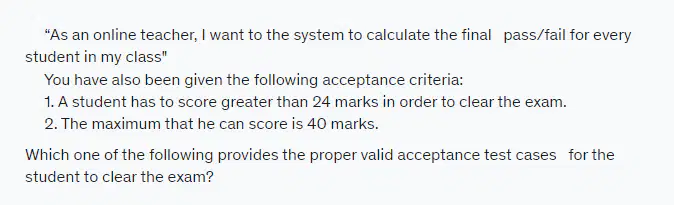
You have been given the following story:
a)

score = 24

b)

score = 18

c)

score = 30

d)

score = 42