
 Worksheets
Temporary Cardiac Pacing Quiz
Total questions: 20
Worksheet time: 10mins
True or False
Temporary Cardiac Pacing is used to maintain a normal heart rate in people whose own heart rate is not pumping enough blood around the body
True
False
When the sinoatrial (SA) node fires, atrial depolarization occurs.
In an ECG complex, this results in:
QRS Complex
T Wave
P Wave
P, QRS and T
When the atrioventricular (AV) node fires, ventricular depolarization occurs.
In an ECG complex, this results in:
P, QRS and T
T Wave
P Wave
QRS Complex
In an ECG complex, ventricular repolarization is represented by a:
T wave
P Wave
QRS Complex
P, QRS and T
Which of the following is NOT an indication for cardiac pacing?
Sinus Bradycardia
Complete Heart Block
Temporary support of a patient after heart surgery
Tamponade
Which type of temporary pacing is commonly used for a patient having major cardiac surgery?
Biventricular Pacing
Transcutaneous Pacing
Epicardial Pacing
Transvenous Pacing
Which cardiac chamber is NOT appropriate for a transvenous pacing wire lead?
Left Atrium
Right Atrium
Right Ventricle
Right Atrium & Right Ventricle
True or False
Transcutaneous pacing is NOT used only in emergency situations and does NOT use defib pads to deliver an electrical stimulus?
True
False
True or False
The pacemaker essentially does two things:
It senses a patient's own intrinsic rhythm & sends out an electrical signal to pace
True
False
Pacing Terminology
Which word defines the pacemaker's ability to "see" the patient's intrinsic electrical activity?
(i.e. the patient's own P wave or QRS complex)
Pace
Capture
Trigger
Sense
Pacing Terminology
Which of the following is illustrated by a small vertical line that sends out an electrical impulse to the heart?
Sense
Pace
Trigger
Capture
Fill in the blank
_________ is when a pacing spike is immediately followed by a P wave
Atrial Capture
Failure to Capture
Ventricular Capture
Failure to Pace
Fill in the blank
_________ is when a pacing spike is immediately followed by a QRS Complex
Capturing the Heart
Ventricular Capture
Failure to Capture
Atrial Capture
True or False
Asynchronous pacing modes are safe and commonly used in our ICU
True
False
Which of the following synchronous pacing modes are commonly used in our ICU?
(select multiple correct answers)
DOO
AAI
DDD
VVI
DDI
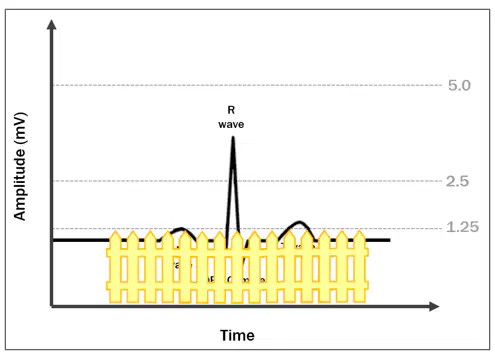
Sensing/Fence Analogy
What type of "sensing" is this?
Under-Sensing
(Not sensitive enough)
Adequate Sensing
(Just right)
Over-Sensing
(Too sensitive)
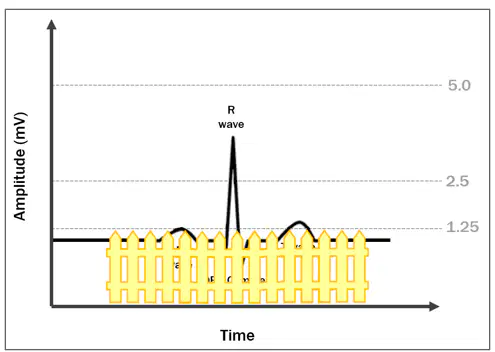
Troubleshooting (Fill in the blank)
Over-Sensing leads to ________
Over Triggering
Failure to Capture
Over Pacing
Under Pacing
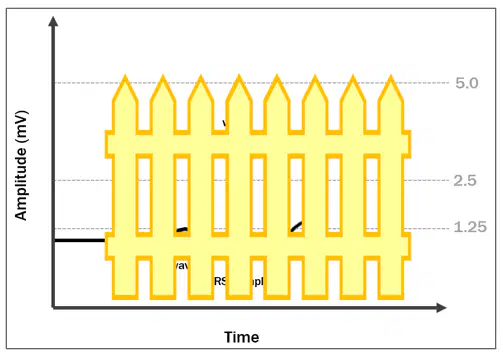
Sensing/Fence Analogy
What type of "sensing" is this?
Under-Sensing
(Not sensitive enough)
Adequate Sensing (Just right)
Over-Sensing
(Too sensitive)
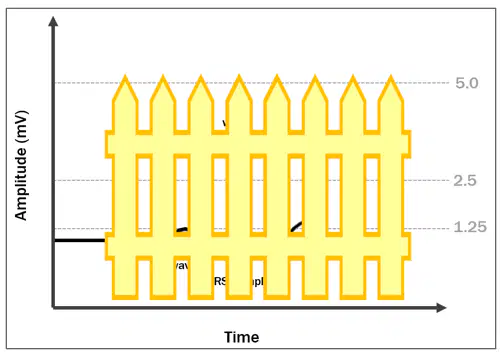
Troubleshooting (Fill in the blank)
Under-Sensing leads to ________
Over Triggering
Failure to Capture
Over Pacing
Under Pacing
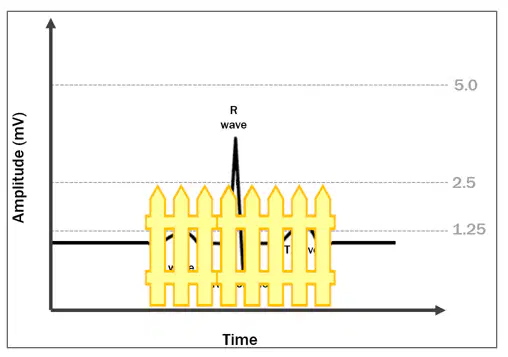
Sensing/Fence Analogy
In VVI, what type of "sensing" would this be?
Under-Sensing
(Not sensitive enough)
Adequate Sensing
(Just right)
Over-Sensing
(Too sensitive)

