wayground logo

Free Printable Worksheets

Font size

S
M
L
XL
Worksheets

Ecology Review

Total questions: 48

Worksheet time: 51mins

Name
Class
Date
1.
An organism that needs to eat other organisms to obtain energy is known as a:
a)
Autotroph
b)
Producer
c)
Consumer
d)
Mutualist
2.
Consumer that eats plants
a)
heterotroph
b)
herbivore
c)
producer
d)
community
3.
What does a food web represent?
a)
All connections of energy flow throughout all organisms in a habitat.
b)
The specific ways that mutualism is carried out.
c)
A single pathway or energy flow between organisms. 
d)
How carnivores get their food. 
4.
The rabbit in this food web would be considered a:
a)
Decomposer
b)
Producer
c)
Secondary Consumer
d)
Primary Consumer
5.
In this Food Web Pyramid Which type of consumer gets only 10% of the energy stored in plants?
a)
Herbivore
b)
Carnivore
c)
Omnivore
d)
Secondary Consumer
6.
What is the term for each step in the transfer of energy and matter within a biological community?
a)
energy path
b)
food web
c)
trophic level
d)
food pyramid
7.
The image provided is an example of a(n):
a)
Carnivore
b)
Herbivore
c)
Producer
d)
Autotroph
8.
The amount of energy that usually transfers from one trophic level to the next...
a)
10%
b)
20%
c)
80%
d)
50%
9.
An illustration that uses arrows to show the MANY possible directions in which matter and energy can pass through the organisms in an ecosystem.
a)
Food chain
b)
Food web
c)
Energy Pyramid
d)
Succession Map
10.
A graphic illustration that shows each trophic level and the amount of useable energy contained within.
a)
Food chain
b)
Food web
c)
Energy Pyramid
d)
All of these
11.
A collection of organisms that make up a community as well as all of the nonliving aspects of the environment.
a)
Population
b)
Community
c)
Habitat
d)
Ecosystem
12.
As you move upward, from level to level, in an energy pyramid, energy _____.
a)
increases
b)
decreases
c)
stays the same
d)
increases exponentially
13.
 plants that convert energy from the sun
a)
decomposer
b)
primary consumer
c)
secondary consumer
d)
producer
14.
Members of a species in a defined area
a)
Ecosystem
b)
community
c)
biodiversity
d)
population
15.
Organisms that relies on other organisms for food; consumer
a)
herbivore
b)
decomposer
c)
heterotroph
d)
species
16.
What does fungi do to dead plants and animals?
a)
Leave them there
b)
Decompose them
c)
Wait for other animals to eat them
d)
Move away
17.
What may happen if the snowshoe hare was removed from the food web pictured?
a)
The insects in the habitat would increase.
b)
The shrew population would decrease due to being only hawk food source.
c)
The willow tree population would decrease.
d)
Foxes would dies due to no food source. 
18.
In the energy pyramid here, how much of the energy in the producers gets passed to the herbivores?
a)
10%
b)
20%
c)
80%
d)
90%
19.
Which of the following leads to a decrease in biodiversity?
a)
protection of ecosystems
b)
pollution control
c)
selective cutting
d)
introduction of exotic or invasive species
20.

Organisms that can make their own food do so by the process of:

a)

decomposition

b)

respiration

c)

photosynthesis

d)

scavenging

21.

The first organism in a food chain is ALWAYS a:

a)

producer

b)

consumer

c)

decomposer

d)

Any of the above

22.

What is a niche?

a)

The habitat that an organism lives in

b)

An organism’s “role” in an ecosystem

c)

A type of consumer

d)

The relationship between a producer and consumer

23.

In what type of relationship do both organisms benefit from the relationship?

a)

Parasitism

b)

Mutualism

c)

Commensalism

d)

Predation

24.

How does oxygen cycle between plants and animals?

a)

Plants and animals both release oxygen

b)

Plants and animals convert water into oxygen

c)

Plants take in oxygen that is produced by animals

d)

Animals take in oxygen that is produced by plants

25.
Which one is NOT an example of a decomposer?
a)
mushroom
b)
leaves
c)
mold
d)
worm
26.
Examples of a producer
a)
frog
b)
algae
c)
worm
d)
mouse
27.
If there is 1000 Kcal available in the producers in trophic level 1, how much energy is available in the herbivores in trophic level 2?
a)
10 Kcal
b)
1 Kcal
c)
100 Kcal
d)
1000 Kcal
28.
Which organism recieves the least amount of energy from the producer?
a)
Owl
b)
Grasshopper
c)
Lilypad
d)
Mouse
29.
A secondary consumer 
a)
eats primary consumers
b)
eats producers
c)
eats plants
30.

A trait caused by the genes of an organism. Cannot change over the organism's lifetime.

a)

Acclimation

b)

Adaptation

c)

Gene Flow

d)

Analogous

31.

An adjustment an organism makes to better deal with its environment. Occurs in the organism's lifetime.

a)

Acclimation

b)

Adaptation

c)

Analogous

d)

Homologous

32.
How do adaptations help animals?
a)
to hide from predators
b)
to hunt for food
c)
to survive in their habitats
d)
All of these are correct
33.
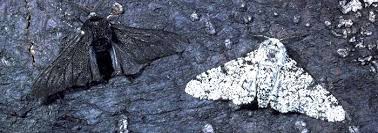
Predict which moth would increase in population
a)
light 
b)
dark
34.
Barnacles create home sites by attaching themselves to whales. This relationship neither harms nor benefits the whales. 
a)
parasitism
b)
commensalism
c)
mutualism
35.
Mistletoe extracts water and nutrients from a spruce tree. The spruce tree is harmed. 
a)
parasitism
b)
commensalism
c)
mutualism
36.

Which of the following greenhouse gases enters our atmosphere through evaporation?

a)

water

b)

carbon dioxide

c)

methane

d)

ozone

37.

If greenhouse gases increase and build up in our atmosphere, what happens?

a)

They trap more heat and global temperatures rise.

b)

They trap more heat and global temperatures decrease.

c)

They trap less heat and global temperatures rise.

d)

They trap less heat and global temperatures decrease.

38.

Which organism in the food web shown to the right would

contain the lowest concentration of chemical pollutants?

a)

producers

b)

primary consumers

c)

secondary consumers

d)

tertiary consumers

39.

The phenomenon by which toxins concentrate in the organisms at higher trophic levels within an ecosystem is known as...

a)

Biotoxicity

b)

Biomagnification

c)

Eutrophication

d)

Predation

40.

In which organism would biomagnification be the most concentrated? (Remember the lab: Rabbits eat the grass, the snake eats the rabbit, the hawk eats the snake--the hawk is the apex predator)

a)

grass

b)

rabbit

c)

snake

d)

hawk

41.

"Only humans make waste nature cannot digest." What did the captain mean by this?

a)

Nature cannot recycle or reuse much of the trash humans produce.

b)

Nature is great at recycling or reusing most of the trash humans produce.

c)

Humans are poor at recycling.

d)

Humans are poor at disposing of trash.

42.

The process of an organism undergoing a TEMPORARY change that is NOT in its DNA to help that organism survive its current environment.

a)

adaptation

b)

acclimation

c)

alteration

43.

The process of a single organism building up toxins to higher and higher levels as it gets older.

a)

adaption

b)

biomagnification

c)

bioaccumulation

44.

An organism can occupy more than one trophic level in a food web.

a)

True

b)

False

45.

Fat soluble toxins and other substances...

a)

build up in organisms over time

b)

leave the body through sweat and uring

c)

Who in the world knows??

46.

Most organisms have more than one niche in their ecosystem.

a)

True

b)

False

47.

If an environment becomes warmer and drier, the change that would help a species adapt would be an increase in its ​ (a)   .

Choose from the below words
ability to store water
amount of body fat
ability to climb trees
amount of body hair
48.

Three different species of plants that live in the desert are shown. Species Z can successfully share the same environment with the other plants shown because species Z absorbs water--

a)

found deep underground, and species X absorbs water near the soil surface

b)

found deep underground, and species X absorbs water found deep underground

c)

near the soil surface, and species Y absorbs water near the soil surface

d)

near the soil surface, and species Y absorbs water found deep underground