wayground logo

Free Printable Worksheets

Font size

S
M
L
XL
Worksheets

Thermochemistry Pre/Post Test

Total questions: 34

Worksheet time: 47mins

Name
Class
Date
1.
If two objects have different temperatures, heat will flow from the warmer object to the cooler one UNTIL ____________
a)
one reaches a temperature of zero
b)
they both have an equal temperature
c)
one runs out of energy
2.
In an exothermic process, the surroundings are are gaining energy.
a)
True
b)
False
3.
For an exothermic reaction, the heat is on the ____ side
a)
reactant
b)
product
c)
either side
4.
In an endothermic reaction the system is releasing energy.
a)
True
b)
False
5.
Is the combustion of gasoline endothermic or exothermic?
a)
Endothermic
b)
Exothermic
6.
As someone is running on the track they begin to perspire.  If the runner is our system, are they endothermic or exothermic?
a)
Endothermic process
b)
Exothermic process
7.
A reaction is performed in a beaker with a temperature probe recording the temperature changes of the reaction.  If the temperature began at 15.0 degrees Celsius and ended at 27.5 degrees Celsius.  If the reaction is our system, is the system endothermic or exothermic?
a)
Exothermic
b)
Endothermic
8.
Do reactants in an endothermic reaction have a higher or lower energy than the products? 
a)
Higher
b)
Lower
9.
Do the reactants in an exothermic reaction have a higher or lower energy than the products?
a)
Higher
b)
Lower
10.

During an endothermic reaction in a beaker if we are part of the surroundings and touched the beaker, it would feel _______.

a)

Warm

b)

Cold

c)

Bubbly

d)

Damp

11.

Calculate ΔT\Delta T  when a substance goes from 10*C to 75*C

a)

-65*C

b)

75*C

c)

10*C

d)

65*C

12.

What does q stand for?

a)

Heat-Joules

b)

Mass-Grams

c)

Specific Heat-J/g*C

d)

Temperature Change-*C

13.

What does c stand for?

a)

Heat-Joules

b)

Mass-Grams

c)

Specific Heat-J/g*C

d)

Temperature Change-*C

14.

What does ΔT\Delta T   stand for?

a)

Heat-Joules

b)

Mass-Grams

c)

Specific Heat-J/g*C

d)

Temperature Change-*C

15.

What does m stand for?

a)

Heat-Joules

b)

Mass-Grams

c)

Specific Heat-J/g*C

d)

Temperature Change-*C

16.

When two samples of similar mass are subjected to the same heat energy, the sample with the SMALLER specific heat will have a _________ temperature change.

a)

SMALLER

b)

LARGER

c)

EQUAL

17.
Heat flows from _______ to ______ objects
a)
cooler to warmer
b)
warmer to warmer
c)
warmer to cooler
d)
cooler to cooler
18.
Heat is measured in 
a)
joules
b)
grams
c)
degrees celcius
19.
Energy can not be created or destroyed, it can only be transferred refers to the....
a)
law of conservation of energy
b)
law of conservation of mass
c)
life facts
d)
law of conservation of chemistry
20.

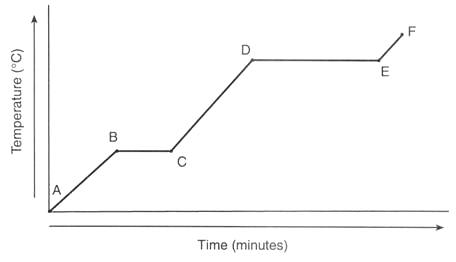
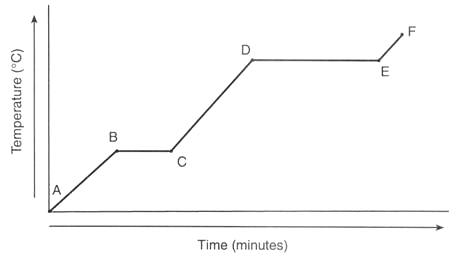
What line segment represents only the solid state? (Diagram F)

a)

A-B

b)

B-C

c)

C-D

d)

D-E

21.

Between which points is the temperature of the substance remaining constant? (Diagram F)

a)

A-B only.

b)

A-B, C-D, E-F

c)

B-C only.

d)

B-C, D-E

22.
True or false: melting and freezing occur at the same temperature!
a)
True
b)
False
c)
I don't know
23.

A substance's heating curve is shown in the graph. What is its boiling point? (Diagram B)

a)

100 C

b)

60 C

c)

80 C

d)

20 C

24.

Is the substance gaining or losing energy? (Diagram D)

a)

Gaining

b)

Losing

25.

**An ice cube feels cold when we hold it. Which of the following best explains why?

a)

Heat moves from our hands into the ice cube.

b)

Cold moves from our hands into the ice cube.

c)

Heat moves from the ice cube into our hands.

d)

Cold moves from the ice cube into our hands.

26.

What phase change is occurring at line segment B-C if the graph is exothermic? (Diagram E)

a)

melting

b)

freezing

c)

boiling

d)

condensation

27.

Are the particles moving faster or slower as time goes on? (Diagram F)

a)

Faster

b)

Slower

28.

Convert 42 kJ into joules

a)

0.042 J

b)

175.73 J

c)

42000 J

d)

10.04 J

29.

A 500 g piece of aluminum increases in temperature by 7°C. What is the heat energy produced? Specific heat of Aluminum is 0.900 J/gºC.

a)

3000 J

b)

3000 g

c)

3150 J

d)

3150 g

30.

If 238 J of heat is absorbed by a sample of metal with a mass of 40.7 g, and it raises the temperature from 20.0°C to 32.4°C, what is the specific heat capacity of the metal?

a)

2.34 J/g°C

b)

0.472 J/g°C

c)

6.13 J/g°C

d)

0.163 J/g°C

31.
Durning a phase change the temperature of a substance_________.
a)
always increases
b)
always decreases
c)
always stays the same
d)
varies
32.

What state of matter/phase change is occurring during line segment D on the graph?

a)

Gas

b)

Condensation

c)

Liquid

d)

Freezing

e)

Solid

33.

At what segment would you use -ΔHfus to calculate energy?

a)

A

b)

B

c)

C

d)

D

e)

E

34.

Which of the following are exothermic?

a)

Melting

b)

Freezing

c)

Evaporating

d)

Condensing