
NEW
Font size
 Worksheets
STAAR REVIEW #2
Total questions: 42
Worksheet time: 42mins

What was one DIRECT effect of the creation of MONOPOLIES on business in the United States?
Employees were prevented from buying stocks.
There was decreased competition among producers.
Consumers were denied access to goods.
There was a lack of employment opportunities for immigrants.

Which factor prompted the passage of the CHINESE EXCLUSION ACT?
Denial of labor union membership for unskilled workers.
Increased nativism and anti-immigrant attitudes.
Wage increases for workers in manufacturing positions.
Increased US involvement in foreign wars and conflicts.

The demographic structure of the United States changed in the late 19th century with the arrival of -
Immigrants from southern and eastern Europe seeking industrial jobs.
Political refugees coming to the United States from the former Spanish colonies.
Migrants from Mexico seeking agricultural jobs during a worldwide depression.
German immigrants fleeing Europe prior to the outbreak of the First World War.

Which statement describes how the TRANSCONTINENTAL RAILROAD affected the United States during the late 1800s?
The railroad contributed to the rapid settlement and growth of towns in the West.
The railroad caused a rapid decline in agriculture and mining in the East.
The railroad contributed to population growth and increased sharecropping in the North.
The railroad prompted Congress to buy land and create national parks overseas.

During the early 20th century, which action was taken to address the issues shown in this image?
Labor reformers secured better working conditions through legislation.
Businesses hired fewer immigrants as laborers.
Corporations sought greater federal industrial regulations.
Businesses created monopolies to increase competition among industries.

What was the immediate response to the creation of "The Jungle" and the Pure Food & Drug Act?
Monopolies were formed to control competition in the meat-processing industry.
Meat packers developed refrigerated railroad cars to ship meat nationwide.
Congress passed legislation to protect consumer health and safety.
Farmers demanded government regulation of livestock sales and distribution.

What is one qualification that must be fulfilled for a person to become a US citizen?
Earning an income above the national average.
Earning an advanced degree from an American university.
Demonstrating an understanding of the principles of American government.
Demonstrating an understanding of the constitutions of each state.

Why did the Spanish-American War move the United States into the position of a world power?
The United States acquired Spanish territories in the Caribbean and the Pacific.
The United States proved its nuclear capabilities against Spain in Southeast Asia.
The United States stopped the spread of communism in Spain.
The United States ended Spanish trade in the Eastern Hemisphere.

Which statement describes one of the MOST important reasons why the United States annexed the Kingdom of Hawaii?
The islands offered excellent locations for tropical resorts.
The local residents needed help to prevent the spread of poverty and disease.
The location was strategically valuable to both military and business leaders.
The local rulers wanted financial assistance to rebuild after a natural disaster.

What was the MAIN reason tanks were introduced during World War I?
To locate and remove land mines from the battlefield.
To transport military supplies to the front lines.
To overcome trench defenses and end stalemates.
To monitor enemy troop movements.

What was the overall purpose of President Wilson's 14 Points?
Wanted to establish a new era of isolationism for the US.
Wanted to punish the countries that were defeated during wartime.
Wanted to prevent multinational countries from breaking apart.
Wanted to create conditions that prevented future global conflicts from breaking out.

Which question is associated with the passage of the Espionage and Sedition Acts during World War I?
Should industries be allowed to prohibit workers from joining unions?
Can the government require citizens to purchase war bonds?
At what age should citizens be required to enlist in a branch of the military?
Can the government limit the constitutional rights of citizens, such as freedom of speech, during wartime?
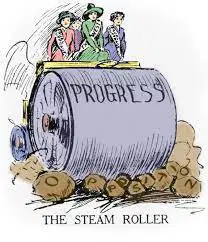
What was one way the role of women in society changed during the 1920s?
They were granted the right to attend public schools.
They were allowed to own property.
They were allowed increased participation in the political process.
They were granted the right to serve in military combat units.

The image supports which statement about US society during the early 1900s?
New technologies made daily life easier for consumers.
Consumers resisted change in favor of traditional products.
Harmful economic cycles caused consumers to resist new technology.
The manufacture of new products encouraged consumers to stay home.

Which action by the federal government was one cause of the Great Depression?
Failing to decrease the reserve requirement.
Refusing to regulate the stock market.
Abolishing the use of the gold standard.
Eliminating tariffs on foreign trade.

How did the Great Depression affect American society?
The price of agricultural goods decreased, causing an increase in demand for farm labor.
manufacturing wages increased, causing businesses to conceded to labor union demands.
Demand for luxury goods increased, causing overproduction in manufacturing.
Businesses were forced to close, causing widespread unemployment.

What is the purpose of the Securities and Exchange Commission?
To encourage business practices that promote minority employment.
To maintain fair markets and increase investor confidence in financial institutions.
To encourage business policies that protect the environment.
To ensure worker safety and protect the public from hazardous products.

How does the Federal Deposit Insurance Corporation (FDIC) continue to affect US citizens?
By regulating loans made to investors who buy stocks on margin.
By changing interest rates to prevent people from paying higher prices for goods.
By providing financial assistance to elderly people who are retired.
By protecting the savings of bank customers during an economic crisis.

How did the new program described in the poster affect the role of the federal government?
It provided the federal government with a role in administering a retirement fund for workers.
It limited the federal government's power to enforce minimum wage requirements.
It provided the federal government with a role in managing workers' bank accounts.
It limited the federal government's power to assist workers in manufacturing plants.

Which statement correctly summarizes the reason for this speech?
Axis violations of international law caused the United States to h old criminal trials.
German expansion in Western Europe caused the United States to assist France.
Japanese aggression in the Pacific caused the United States to declare war.
Allied defeats on the battlefield caused the united States to develop new weapons.

Which nationalities would this notice be referring to during World War II?
Polish, Romanian, Russian.
Mexican, Spanish, Portuguese.
Irish, Israeli, Turkish.
German, Italian, Japanese.

How did the BATTLE OF MIDWAY alter the course of the war in the Pacific during World War II?
By stopping the Japanese attack on Pearl harbor.
By halting the progress of Japanese expansion.
By preventing the continued use of Japanese kamikaze planes.
By defending the Philippines from Japanese conquest.

This photograph is an example of -
US citizens contributing to the war effort.
The effects of trade sanctions on enemy nations.
US citizens attempting to follow new dietary guidelines.
The effects of allowing farmland to go unused while farmers were at war.

Which US action was the MOST direct and immediate response to the Soviet blockade of West Berlin?
Airlifting supplies to the people in West Berlin.
Creating the North Atlantic Treaty Organization.
Withdrawing military forces from West Berlin.
Providing financial support to help rebuild European nations.

Which concern directly contributed to US involvement in the Korean and Vietnam War?
Containing the spread of communism.
Improving political relations with China.
Deterring the use of nuclear weapons.
Resisting the rise of fascism in Asia.

Which statement describes how the GI BILL affected the United States during the 1950's?
The act allowed members of minority groups to join the armed forces because it desegregated the military.
The financial regulations in the act protected the deposits of bank customers.
The educational benefits included in the act helped provide training to military veterans.
The act provided employment opportunities for women because it made discrimination in the workplace illegal.

How did the United States respond to the launch of Sputnik in 1957 by the Soviet Union?
By increasing health care benefits and pensions for the military.
By implementing the Marshall Plan.
By increasing funding for math and science education.
By joining the North Atlantic Treaty Organization.

What was one effect of rock and roll music on US society during the 1950s?
Fewer musicians gave live musical performances.
People were exposed more diverse musical styles.
Music stores sold fewer musical instruments.
Many religious groups actively supported the new musical culture.

Why did the government implement a draft during the Vietnam War?
To monitor ethnic groups for espionage activities.
To fund the war by authorizing the sale of government bonds.
To regulate freedom of expression at antiwar demonstrations.
To provide the military with additional man power.

How did the GULF OF TONKIN RESOLUTION affect the relationship between the executive and legislative branches of government?
By reducing the ability of the House of Representatives to approve military funding requested by the president.
By giving the president the power to fight a war without getting a formal declaration from Congress.
By allowing Congress to supersede the president's role as commander in chief.
By reducing the power of the president to bypass the Senate's treaty-making powers.

Why did Congress pass the War Powers Resolution?
Congress wanted to expand its power to provide funding to the military.
Congress wanted to limit the president's power to send US troops into armed conflicts.
Congress wanted to regain control over its treaty-making powers.
Congress wanted to give the president the power to make battlefield decisions.

In the 1960s, which action of the Black Panthers was MOST DIFFERENT from the philosophy of Dr. Martin Luther King, Jr.?
Writing a ten-point platform that demanded decent housing.
Using armed patrols to protect neighborhoods.
Operating the Free Breakfast for Children Program.
Creating "survival" programs that included medical and legal aid.

What is one way the Civil Rights Movement impacted the United States?
By increasing diversity in the workplace.
By leading to the creation of a national health care system.
By increasing the globalization of the economy.
By leading to the passage of antitrust laws.

- 15th Amendment
- 19th Amendment
- 24th Amendment
- 26th Amendment
What was one reason why these amendments were added to the Constitution?
To guarantee due process of law.
To expand the authority of the states over the federal government.
To limit the freedom of expression.
To expand the rights of individuals to participate in the government.

What was the purpose of President Nixon's goal of DETENTE?
To negotiate the withdrawal of US and Chinese soldiers from Korea.
To create a military's alliance with China against the Soviet Union.
To create an agreement limiting Chinese and soviet development of nuclear weapons.
To normalize relations between the US, China and the Soviet Union.

How did the US government work to change this situation?
By encouraging the development of alternative forms of fuel.
By increasing the speed limit on interstate highways.
By decreasing funding for electrical power stations.
By discouraging exploration for fossil fuels.

What do the Teapot Dome Scandal, Watergate Scandal, Iran-Contra Affair and Monica Scandal all have in common?
They reduced government regulation of the economy.
They led to an increase in the size of the executive branch.
They reduced public confidence in the federal government.
They led the president to increase the use of the veto power.

Which statement describes one reason the year 2008 was significant?
First Lady Hillary Clinton testified before Congress on health care reform.
Barack Obama was the 1st African American to be elected President.
Ross Perot was the 1st third party candidate to win a presidential debate.
President George W. Bush announced a war on terrorism.

Which of the following would be a response to the terrorist attacks on September 11th, 2001?
Imposed economic sanctions on Israel.
Provided humanitarian support to Iran.
Conducted military operations in Afghanistan.
Declared war against Pakistan.

What is a PRIMARY reason why Hurricane Katrina caused major destruction to New Orleans in 2005?
Levees surrounding the city collapsed under pressure from floodwaters.
Crude oil from offshore drilling platforms sparked fires across the city.
Citywide pavement prevented floodwaters from soaking into the ground.
Mass evacuations left the city without enough volunteers to build a seawall.

The USA Patriot Act has caused conflict between -
Individual rights and the authority of the government to maintain national security.
Equal protection under the law and protection of minorities against discrimination.
Economic stability and increased government spending on military readiness.
Promotion of free-trade policies and protections for workers in domestic industries.

What is one example of how space exploration and technology have improved the quality of life in the US?
By reducing dependence on robotics for performing surgery.
By developing shields to protect homes from meteorites.
By reducing dependence on solar cells and biofuels for energy.
By developing satellites to send communication signals.

