
 Worksheets
Civil War and Reconstruction Test Review
Total questions: 35
Worksheet time: 9hrs 45mins

These headlines refer to which Supreme Court Case?
(p150 or p152)
Marbury v. Madision
McCulloch v. Maryland
Dred Scott v. Sandford
Worcester v. Georgia
This excerpt is from the Gettysburg Address.
Select the idea from this speech that would help lead to the ratification of the 13th amendment.
(p160 or p162)
Lexington: Revolutionary War :: (a) : Civil War.
(p155 - 156)

Which outcome best completes this diagram?
(p149)
American Revoluiton
War of 1812
French and Indian War
Civil War
Ulysses S. Grant: Union Army :: (a) : Confederate Army
(p158)

What was the fundamental question addressed in each of these congressional acts?
(p150 or p151-152)
Should the U.S. expand westward?
Should states be allowed to nullify federal laws?
Should slave labor be allowed in new states?
Should states be able to secede from the Union?
How did President Lincoln succeed in permanently abolishing slavery?
(p160 or p162)
By ordering the use of popular sovereignty to decide the issue of slavery
By encouraging an armed rebellion of slaves in the South
By promoting the passage of ratification of the Thirteenth Amendment
By helping abolitionists fund the Underground Railroad
Which of the following had the greatest impact on the outcome of the Civil War?
(p154)
Economic differences between the Union and the Confederacy
The amount of military training given to Union forces and Confederacy forces
Religious differences between the Union and the Confederacy
The alignment of foreign allies with the Union or with the Confederacy
How did the Freedmen’s Bureau most assist in the reconstruction of the South?
(p159 or p161)
By dividing large plantations and redistributing the property to former slaves
By creating a militia to help enforce the voting rights of former slaves
By offering legal assistance and public schooling to former slaves
By petitioning the government to offer money to former slaves

This painting shows General Robert E. Lee surrendering to General Ulysses S. Grant.
Where did the events shown in this painting occur?
(p155-156)
A private home in Appomattox County, Virginia
The U.S. Capitol building
A public church near Ford’s Theatre
The Governor’s mansion in Richmond, Virginia
What was the goal of the Reconstruction Acts of 1867?
(p159 or p161)
To restore the Democratic Party to power in the South
To rebuild the plantation economy of the South
To protect the rights of African Americans in the South
To encourage former slaves to leave the South
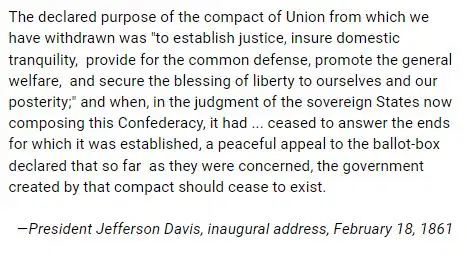
How did President Abraham Lincoln react to the idea expressed in Jefferson Davis's inaugural address?
(p157)
Lincoln stated that the argument by the South to leave the Union was unjustified.
Lincoln called on the U.S. Supreme Court to make a ruling on the legality of secession.
Lincoln believed the reasoning to leave the Union was protected by the Constitution.
Lincoln prepared to amend the Constitution in order to appease the Southern states.
Which constitutional issue contributed to sectional conflict before the Civil War?
(p149)
Disagreement over the boundaries of the Oregon Territory
Growing support for limiting female suffrage and immigration
The limits on free speech and press included in the Alien and Sedition Acts
Debate over the expansion of slavery into the West

To whom was Abraham Lincoln addressing in the Emancipation Proclamation?
(p157)
northern abolitionists
southern slaveholders
southern merchants
northern secessionists
Match the following Events of the Civil War
(p155-156)
Firing on Ft. Sumter
Instigated the beginning of the Civil War
Battle of Antietam
Bloodiest one day battle in American History
Battle of Gettysburg
Turning point of the Civil War for the Union
Siege of Vicksburg
Union gained control of the Mississippi River
Which statement BEST describes the importance of the Battle of Vicksburg?
(p155-156)
The Confederacy lost control of the Mississippi River.
It was the opening engagement of the Civil War in the South.
It was described as the bloodiest fighting of the Civil War.
The Confederacy captured military supplies from the North.
How did sharecropping affect farmers in the South during Reconstruction?
(p159 or p161)
By introducing new technology for growing food
By expanding the region's dependence on corn production
By making landowners buy supplies from the government
By keeping renters in debt to landlords

Which era is represented by this photograph?
The early republic
The Age of Jackson
Westward expansion
Civil War
What was one effect of the Fifteenth Amendment?
(p160 or p161)
Immigrants faced less discrimination.
Black voters helped bring the Republican Party to power in the South.
Electors selected the president and vice president on separate ballots.
American Indian tribal land was divided into individual plots.
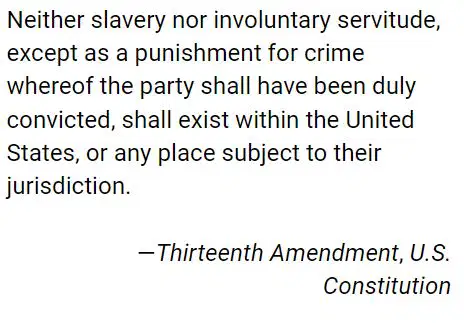
What was an IMMEDIATE effect of this amendment?
(p159-160)
Many plantation owners attempted to recapture former slaves.
Many plantation owners were forced to give land to former slaves.
Many former slaves became sharecroppers to earn a living.
Many former slaves were awarded money by former Confederate leaders.
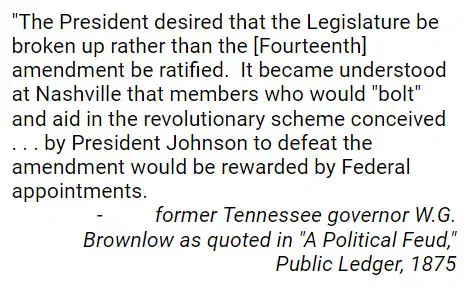
Based on the excerpt and your knowledge of U.S. history, which outcome was President Johnson trying to prevent?
(p160 or p161)
The abolition of slavery within the country and in all territories under government control
Granting citizenship and equal protection under the law to all persons born in the country
The use of government resources to protect the rights of citizens to practice any religion of their choice
Protecting the rights of individuals to bear arms and assemble in peaceful protest
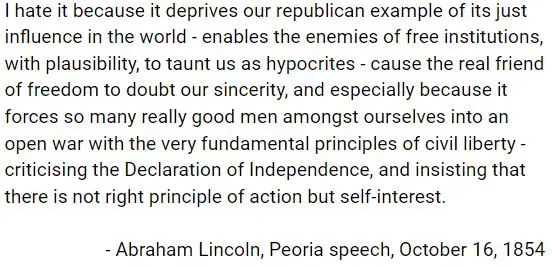
Based on the excerpt and your knowledge of U.S. history, which cause of sectionalism did Lincoln "hate"?
(p157)
The spread of slavery
Northern manufacturing
Western expansion
The enforcement of tariffs
What were TWO outcomes of the Compromise of 1850?
Select TWO correct answers.
(p150- 151)
California was admitted into the union as a free state.
A parallel was designated as the boundary between free and slave states.
Southern state legislators failed to get a new fugitive-slave law passed.
New territories were given the power to decide the issue of slavery.
The Florida territory was purchased from Spain and admitted as a free state.
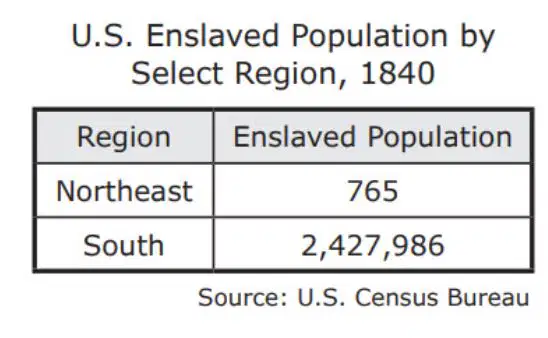
Which statement describes a factor that MOST contributed to the population difference shown in the table?
The South had a society that relied on wage labor.
The South had an economy that relied on cotton.
The South had a variety of natural resources.
The South had an abundance of large cities.

Which event is MOST associated with the change in American life shown in this sketch?
(p160-p161)
The adoption of the Great Compromise
The establishment of a two-party political system
The ratification of the Fourteenth Amendment
The election of more qualified judges

Which action prompted the newspaper’s claim that John Brown’s raid “advanced the cause of disunion”?
(p150)
Some Northerners were willing to defend the South’s right to continue slavery.
Some Southerners were willing to take up arms to protest high tariffs.
Some abolitionists thought violence was necessary to end slavery.
Some people in territories needed to defend their right to popular sovereignty.
Which era involved legislation enacted by the Radical Republicans?
(p159-160)
Civil War
Reconstruction
Early republic
Antebellum

Which issue do the events in these headlines have in common?
(p153)
Expansion of slavery
States’ rights
Taxation without representation
Popular sovereignty
Which statement describes the roles of George McClellan and Ulysses S. Grant during the Civil War?
(p158)
They were Confederate generals who captured Fort Sumter.
They were Union generals who commanded the Army of the Potomac.
They were Confederate generals who surrendered at the Battle of Vicksburg.
They were Union generals who committed war crimes at the Battle of Gettysburg.
Which statement explains an effect of the Missouri Compromise?
(p150 -151)
The compromise maintained the balance between the number of free states and slave states in the Senate.
The compromise allowed slaves to be counted toward a state’s population for representation in Congress.
The compromise enabled Southerners to pursue fugitive slaves into the North.
The compromise ended the slave trade in Washington, D.C.
Which statement describes how the passage of the Kansas-Nebraska Act of 1854 increased sectionalism?
(p150 or p152)
It allowed slavery to expand into the territories.
It gave tax cuts to manufacturers who relocated to the territories.
It allowed slaves who escaped to the territories to purchase their freedom.
It granted homesteads to immigrants who settled in the territories.
Which breakthrough did Hiram Rhodes Revels accomplish during Reconstruction?
(p160)
He became the first African American to publish literature.
He became the first African American to build wealth as a carpetbagger.
He became the first African American to win a seat in the U.S. Congress.
He became the first African American soldier to serve in an integrated Union Army unit.
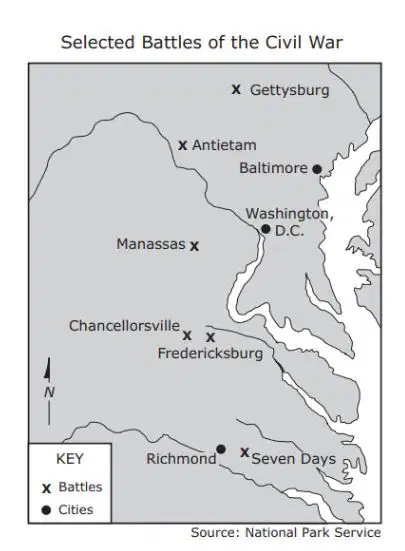
What made the battles at Antietam and Gettysburg different from the other battles illustrated on this map?
(p155 - 156)
They were victories for the Confederacy.
They were battles fought in Union territory.
They were attempts to keep Virginia in the Union.
They were battles defending the Confederate capital.
Which human geographic factor helped the Union win the Civil War?
(p154)
A network of railroads in the North allowed Union soldiers to be moved quickly over long distances.
The Oregon Trail allowed Union military supplies to be moved quickly to the West.
Northern farms started producing cotton used to make Union military uniforms.
Canals in the Midwest allowed food for Union soldiers to be moved quickly to the front lines.
Which condition did both slaves and free blacks in the United States experience in the antebellum period?
Both groups were allowed to testify in court.
Both groups were able to vote in elections.
Both groups were forced to pay taxes.
Both groups were denied citizenship rights.

