
 Worksheets
Sensor Temperature
Total questions: 32
Worksheet time: 16mins
What is the purpose of a temperature sensor?
To detect amount of heat energy
To measure humidity levels
To detect changes in light intensity
To measure air pressure
What are the two types of temperature sensors?
Contact and non-contact
Current and Voltage
Frequency and amplitude
enclosed and non-enclosed
What type of sensor is used when physical contact with the object under test is needed?
Pressure sensor
Contact temperature sensor
Flow sensor
Infra-red Sensor
What method do contact temperature sensors use to monitor changes in temperature?
Radiation
Convection
Conduction
Induction
What are typical applications for contact temperature sensors?
Environmental monitoring
Patient healthcare monitoring
Quality performance checks
Food processing ovens
What method do non-contact temperature sensors use to sense changes in temperature?
Conduction
Induction
Radiation
Convection
What are typical applications for non-contact temperature sensors?
Patient healthcare monitoring
Environmental monitoring
Quality performance checks
Food processing ovens
What is the difference between the output of an analogue and a digital temperature sensor?
An analogue sensor outputs continuous values while a digital sensor outputs discrete values
An analogue sensor outputs discrete values while a digital sensor outputs continuous values
Both types of sensors output continuous values
Both types of sensors output discrete values
What is a thermocouple?
A type of actuator
A type of contact temperature sensor
A type of sensor used for measuring pressure
A type of sensor used for measuring light intensity
Why are thermocouples popular as temperature sensors?
Because they are complex
Because they are difficult to use
Because they have slow response time
Because they are simple and have fast response time
What is the temperature range that can be measured using a thermocouple?
-100oC to 500oC
-200oC to 1000oC
-500oC to 2000oC
-200oC to well over 2000oC
What are the two junctions in a thermocouple made of?
Two metals of the same type
Two metals of different types
Two non-metallic materials
One metallic and one non-metallic material
Which junction in a thermocouple is the measuring point?
Cold junction
Hot junction
Both junctions
Neither junction
What is the purpose of the reference point in a thermocouple?
To measure the temperature at the reference point
To maintain a constant temperature
To amplify the output voltage
To provide power to the thermocouple
What type of signal conditioning is needed when using a thermocouple sensor?
Filtering
Modulation
Amplification
Demodulation
Why is signal conditioning necessary when using a thermocouple sensor?
Because the output voltage of the sensor is too large
Because the output voltage of the sensor is too small
Because the sensor does not generate any voltage
Because the sensor generates too much noise
What type of sensor is a thermistor?
Contact type
Non-contact type
Both contact and non-contact
None of the above
What does the term "thermistor" mean?
Thermal sensor
Thermally sensitive resistor
Temperature conductor
None of the above
How does the resistance of a NTC thermistor change with temperature?
It remains constant
It increases
It decreases
It varies randomly
What is the advantage of using a thermistor as a temperature sensor?
Low cost
Small size
Quick response time to temperature changes
High power handling capacity
What is the disadvantage of using a thermistor as a temperature sensor?
Low accuracy
Low sensitivity
Fragile construction
High power consumption
What is the temperature coefficient of resistance for an NTC thermistor?
Positive
Negative
Zero
Variable
What is the temperature coefficient of resistance for a PTC thermistor?
Positive
Negative
Zero
Variable
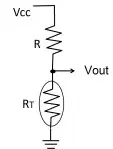
If Vcc = 10V and R = 4700 Ω, determine RT when Vout = 6V.
7050ohm
705ohm
6300ohm
7300ohm
What does RTD stand for?
Relative Temperature Device
Resistance Temperature Detector
Remote Temperature Detector
Relative Temperature Detector
Which of the following best describes an RTD?
Non-contact type of sensor
Contact type of sensor
Hybrid type of sensor
None of the above
How is an RTD made?
A. By winding conducting metals into a coil
B. By depositing a thin film of metal onto a ceramic base material
Both A and B
None of the above
What type of coefficient does an RTD have?
Negative temperature coefficient
Positive temperature coefficient
No temperature coefficient
Both positive and negative temperature coefficient
How does the resistance of an RTD change with temperature?
It decreases with an increase in temperature
It increases with an increase in temperature
It remains constant with temperature changes
None of the above
Compared to thermistors, what is an advantage of using an RTD?
It has better thermal sensitivity
It is more cost-effective
It is smaller in size
It has higher power consumption
What is a disadvantage of using an RTD?
It has poor thermal sensitivity
It is less accurate in sensing temperature changes
It is less reliable than thermistors
It requires a higher voltage to produce an output
What is required for an RTD to produce an output voltage?
A change in frequency
An electrical current flowing through it
A magnetic field
None of the above

