
 Worksheets
Category 1 Review
Total questions: 15
Worksheet time: 8mins
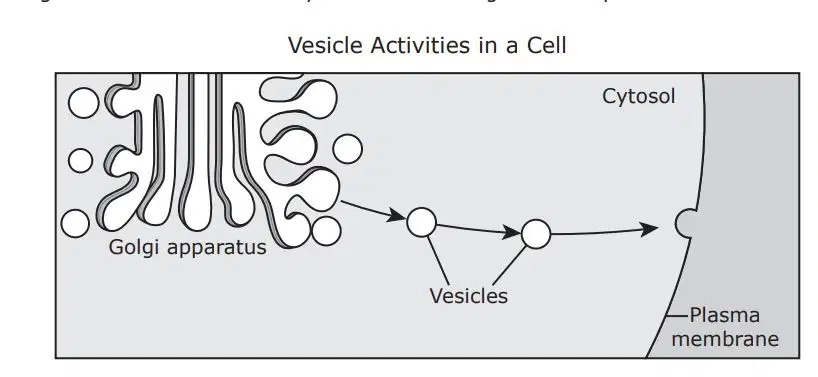
4(B) Which statement best explains the function of the vesicles?
Delivering packaged materials to the Golgi apparatus for protein synthesis
Exchanging genetic information between the Golgi apparatuses of separate cells
Extracting portions of the Golgi apparatus to be regenerated for growth within the cell
Transporting packaged molecules from the Golgi apparatus to be released out of the cell
In the 1880s, Louis Pasteur developed a method of weakening viruses. The weakened viruses could be injected into healthy individuals. How is this method effective in fighting viral diseases?
The immune system develops antibodies in response to the weakened viruses.
The weakened viruses attach to unaffected viruses in the host and interrupt the viral reproductive cycle.
The rate of genetic mutation in the host is decreased due to the introduction of weakened viruses.
Weakened viruses are unable to enter the host organism.
5(A) The activities in the cell cycle occur during specific phases. In which phase of the cell cycle is DNA replicated?
Mitosis
G1 Phase
G2 Phase
S Phase
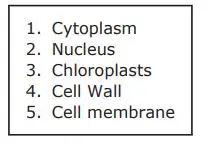
5(B)Which of the components could be observed using a microscope in a prepared slide of leaf epidermal cells but not in a prepared slide of human cheek cells?
Components 2 and 3 only
Components 3 and 4 only
Components 1, 2, and 3 only
Components 1, 5 only
4 (B) When mammals get an infection, their internal body temperature often rises 2 to 3 degrees Celsius. The body gets the energy it needs to react to an infection by —
increasing the rate of cellular division
decreasing the rate of glucose movement into the cell
increasing the rate of cellular respiration in mitochondria
decreasing the rate at which carbon dioxide is removed from the cell
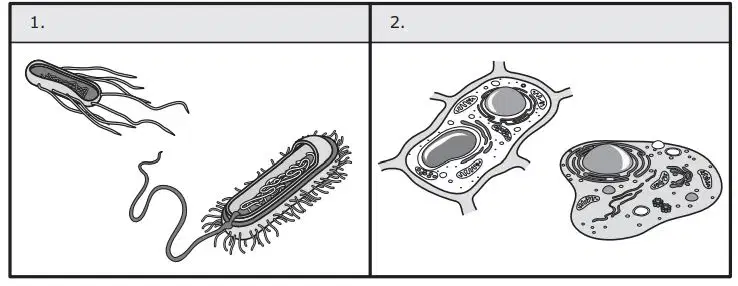
4(A) Which table headings should the student use for the two groups?
1. Animal Cells 2. Plant Cells
1. Prokaryotic Cells 2. Eukaryotic Cells
1. Mobile Cells 2. Motile Cells
1. Fungal Cells 2. Bacterial Cells

5 (A) This model of the cell cycle includes two arrows that each represent a process in the cycle. What do the two arrows represent?
Arrow 1 represents prophase, and Arrow 2 represents interphase.
Arrow 1 represents mitosis, and Arrow 2 represents meiosis.
Arrow 1 represents interphase, and Arrow 2 represents mitosis.
Arrow 1 represents meiosis, and Arrow 2 represents prophase.
4(C) Which of these describes a difference between viruses and cells?
Cells contain protein, and viruses contain only carbohydrates.
Viruses have flagella, and cells have only cilia.
Cells reproduce independently, and viruses require a host to reproduce.
Viruses have membranes made of proteins, and cells have membranes made of nucleic acid.
5 (C) What is the role of mRNA in expressing specialized structures?
Making energy available for cellular activities.
Creating bonds to form biomolecules.
Producing sugars that assist with replication.
Providing information to form proteins.
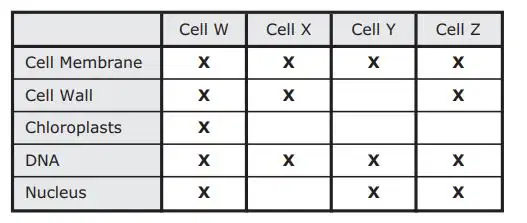
4 (A)Students use a microscope to look for structures present in four different cells. The students placed an X for each structure that was viewed for each cell on the table shown. Which cell that was viewed is most likely a prokaryote?
W
X
Y
Z
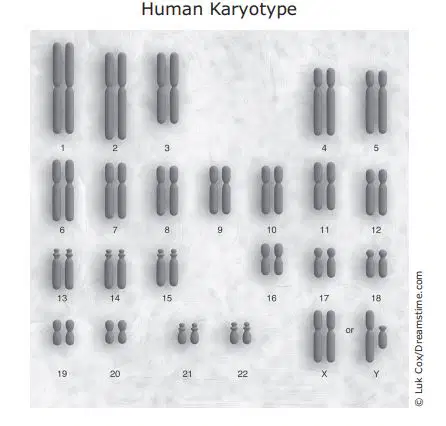
5 (A) The karyotype, or chromosomal profile, for humans is shown. A karyotype can be used to investigate genetic disorders. The chemical colchicine is used in the production of karyotypes. Colchicine prevents spindle fibers from forming during the cell cycle. What is a result of preventing spindle fibers from forming?
The cell cycle skips G phase and repeats G phase.
Mitotic division is skipped, and the cell cycle proceeds to cytokinesis.
Mitotic division stops in metaphase and cannot proceed to anaphase.
The cell cycle skips S phase and proceeds to G phase
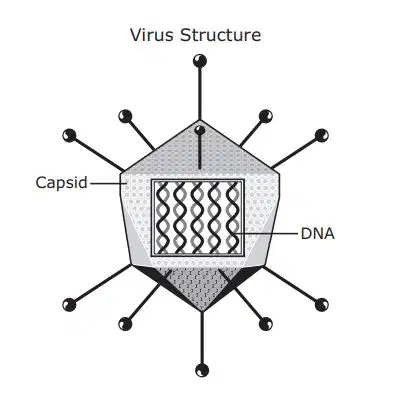
4 (C) A student produces a labeled drawing of a virus for a presentation. The student states that the capsid has a function similar to the nuclear membrane found in animal cells. Which of these describes the similar functions of capsids and nuclear membranes?
Both transport proteins throughout the structures.
Both provide energy for activities in the structures.
Both protect genetic information for the structures.
Both code for the proteins needed for reproduction of the structures.
5 (C) When cells lose their ability to regulate the cell cycle, they can divide at an accelerated rate and form a mass of cells. This mass of cells is referred to as —
A tumor
An embryo
A gland
An organ
4 (B) In a study of physical endurance, researchers observed significant increases in the heart rates and breathing rates of participants immediately after they engaged in strenuous exercise. Which statement best explains the increase in the heart rate and the breathing rate during exercise?
The water concentration in the blood increases.
Body cells require increased oxygen as energy is expended.
Muscle cells increase in temperature and require fluid to reduce the temperature.
An increase in muscle activity causes increases in glucose levels in red blood cells.
4(c) In 1898 Friedrich Loeffler and Paul Frosch found evidence that the cause of the highly contagious hoof-and-mouth disease in livestock was a microscopic infectious particle. It was discovered that this particle requires a host cell to reproduce. Which pathogen is most likely responsible for causing hoof-and-mouth disease in livestock?
A bacterium, because it is contagious
A fungus, because it infects livestock
A protist, because it is microscopic
A virus, because it requires a host cell to reproduce

