
 Worksheets
AP Bio: Unit 7 (CED)
Total questions: 25
Worksheet time: 18mins

Based on the figure, which organism is most closely related to the polar bear?
Black Bear
European Brown Bear
Western North American Brown Bear
Asian Brown Bear
If the frequency of dominant phenotype is 0.36, what is the frequency of the dominant allele?
0.2
0.48
0.6
0.8
What does p stand for?
Dominant allele
Recessive allele
Homozygous dominant
Homozygous recessive
Heterozygous
If there are 400 red flowers, 200 pink flowers, and 100 white flowers. Solve for the frequency of the recessive allele.
0.28
0.14
0.38
0.42
What factors would increase the frequency of a genotype in a population over time?
Increased reproduction rates in a population
Selective pressures that make the trait favorable
Genetic drift
Mutations in the population
Why would the presence of a particular genotype or phenotype decrease in a population over time?
Due to increased competition
Reproductive isolation
Changes in the environment that now make the trait less favorable
Gene flow
What is artificial selection?
When humans selectively breed organisms together to select for traits most desirable to us
When a new species has formed
When new organisms migrate into an area and introduce new genes
When organisms are separated from other members of their population due to new geographic barriers
What is the founder effect?
When survivors of a natural disaster repopulate the environment
When a small population breaks off of an existing population
Changes in the genetic makeup of a population over time
The migration of organisms between two similar populations
In mice brown fur (B) is dominant over white fur (b). Scientists observed a population of 2000 mice, and found the frequency of the B allele to be 0.7. 10 years later the scientists revisited the population and found the frequency of the B allele to be 0.4.
What could explain the decrease in the frequency of the B allele over the 10 years?
Gene flow that introduced new organisms into the population
New selective pressures that make white fur more favorable
A drought that made the landscape brown and dusty
A mutation that made the b allele dominant
What are prezygotic barriers to reproduction?
Any barrier that reproductively isolates species
Barriers that prevent the production of a fertilized egg
When the offspring of two organisms are sterile
Barriers that prevent a zygote from developing into a viable offspring
Darwin’s finches on the Galapagos Islands were separated by what kind of reproductive barrier?
Temporal isolation
Behavioral isolation
Geographic isolation
Gamete isolation
Darwin observed that most organisms produce
more offspring than will survive to adulthood
only 1 offspring
only a few offspring
only as many offspring as they can care for

Occurs when one extreme phenotype is selected.
Example: Individuals may be tall, med, or short
Only the short ones survive
Directional selection
Stabilizing selection
Disruptive selection
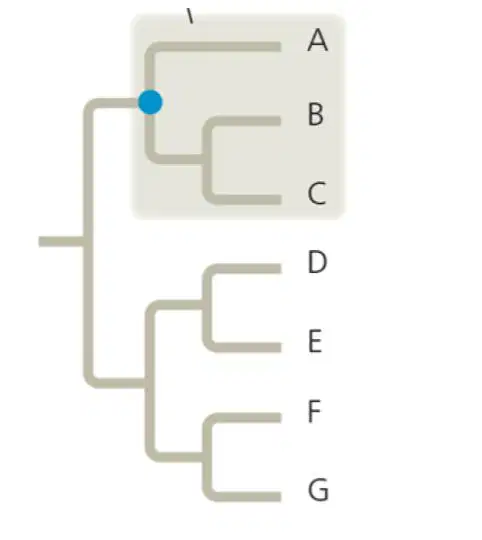
A ____ group includes an ancestral taxon and all its decendants
monophyletic
paraphyletic
polyphyletic
If there are conflicts among characters, use the principle of ___ (simplest answer)
parsimony
synapomorphy
basal taxa
sister taxa

Characteristics that are similar between 2 species that share a common ancestor
Homologous structures
Analogous Structures
Vestigial structures
What word describes an inherited trait that helps an organism survive in its environment?
natural selection
mutation
camouflage
adaptation
If an organism has the best adaptation for an environment, what tends to happen?
The will leave more offspring that are less suited for that environment.
They will decrease in population size over many generations.
They will leave more offspring that are better suited for the environment.
They will not be able to out-compete other organisms for resources.
Which of the following BEST describes natural selection?
Traits that are genetically dominant will always show up no matter what the environment is like.
Those traits that best help an organism survive in its environment will more likely be passed on than those that don’t.
Which traits get passed on is completely random and all traits have an equal chance for survival regardless of the environment.
Traits for organisms can be manipulated and selected by humans by breeding those organisms with desired traits together.
If researchers find that 90% of a rabbit population is white in color and 10% is brown, what can you assume about the environment?
The environment is probably snowy (or at least light colored).
The food available in the environment is darker colored, making the rabbits not desirable.
The environment is probably very rocky and dirt covered.
The predators in this environment hunt at night, when the white rabbits blend in the best.
What can fossils tell us about past organisms?
Age of the organisms.
How variations have changed over time.
How the environment affected certain species.
All options given.
How can embryology provide evidence for evolution?
Organisms start off very different from the beginning, showing their environmental adaptations.
Only very closely related organisms tend to have similarities in early development.
Similarities in early stages of development between very different organisms show common ancestry.
This shows that if an organism is not 'fit' for an environment, it will not even develop past the embryo stage.
A small number of lizards from a mainland population have been deposited on four isolated islands because of the effects of a rare strong storm.
Which of the following best predicts the outcome of these lizards reproducing for many generations on the islands?
Courtship rituals specific to each island lizard species prevent the lizards from interbreeding.
Speciation results from bottleneck events that happened before the ancestral species reached the islands.
The different species that currently exist are the result of hybridization between lizards from different islands.
The isolation prevents gene flow; thus, the lizards on different islands experience prezygotic isolation.

