
 Worksheets
World Malaria Day
Total questions: 21
Worksheet time: 10mins
Which of the following is the 1st recommended vaccine by WHO for P. falciparum in sub-Saharan Africa and other regions
R21 /Matrix - M
RTS, S/AS01 (RTS, S)
Pf SPZ
Spf66
Following are the modes of transmission for Malaria
Aedes mosquito, blood transmission
Culex Mosquito, vertical transmission
Anopheles mosquito, blood transmission
Mansonia Mosquito, vertical transmission
Hemozoin pigment can be visualized by
Electron Microscope
Phase Contrast Microscope
Fluorescent Microscope
Dark Ground Microscope
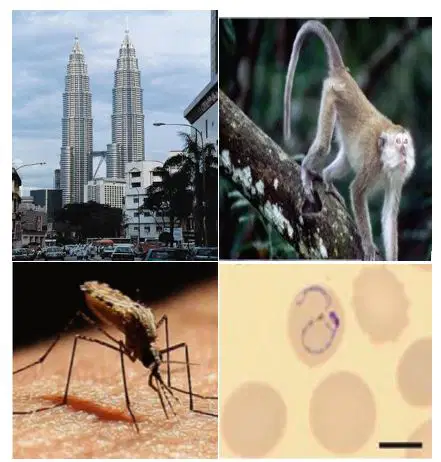
Identify the species using the images
(a)
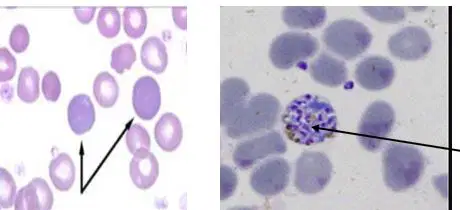
Identify the cell & parasite affecting it
Reticulocyte RBC - Plasmodium malariae
Young RBC – Plasmodium falciparum
Reticulocyte – Plasmodium vivax
Mature RBC – Plasmodium knowlesi
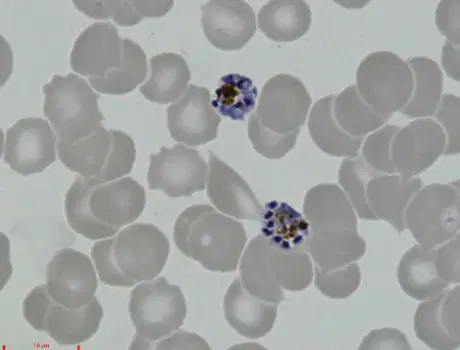
A 40-year male presented to medicine OPD with a history of recurrent fever every other day with a headache, malaise, and body aches. He also gives a history of travel to South America 2 months back. Routine lab investigations were done.
A thin blood smear was done as shown in the image.
Identify the stage of development of the parasite and the name of the parasite.
Gametocyte – Plasmodium malariae
Merozoite – Plasmodium ovale
Trophozoite – Plasmodium falciparum
Schizont – Plasmodium vivax

Name the noble laureate
Alphonse Laveran
Stanley B. Prusiner
Robert Koch
Ronald Ross
Following are the differential diagnosis for malaria
(Multiple options can be correct)

i

ii


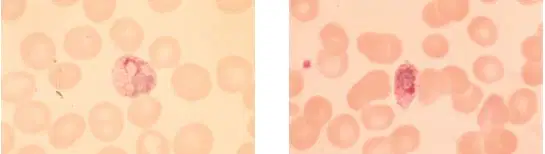
Erythrocyte enlargement and Schuffner dots are commonly seen in
Plasmodium knowlesi
Plasmodium malariae
Plasmodium falciparum
Plasmodium ovale

Rapid diagnostic test (RDT) for malaria is based on the detection of
PfEMP1 & LDH
HRP – 2 & LDH
ICAM – 1 & HRP – 2
ELAM1 & HRP – 2
Which is the 1st country to approve a new malaria vaccine
Zimbabwe
Tanzania
Ghana
South Africa
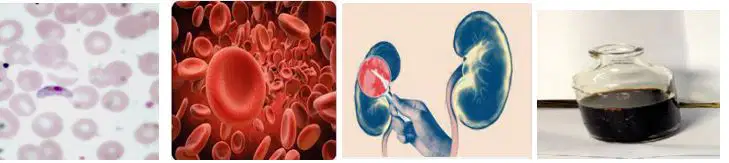
Identify the complication caused by this parasite
(a)
Which of the following is not a differential diagnosis for massive splenomegaly
Malaria
Babesia
Leishmaniasis
Echinococcus
Mefloquine should not be used in persons with
Prolonged QT interval
Pregnancy
Nephrotic syndrome
Hepatitis
Which of the following country is WHO-certified malaria free?
China
Sri Lanka
Bhutan
Indonesia
Among the population living in malaria epidemic region, which of the following age group is eligible to take malarial vaccine?
Infants born to women who had clinical malaria during pregnancy
Children aged from 5 months to 10 years
Adults with co-morbidities
Above 60 years
INCORRECT about chronic malaria:
Long term malarial infection in semi-immune individuals
Patients present with fever paroxysm
Hyper reactive malarial splenomegaly is seen
Common cause of maternal complications
Which is the highest malaria burden state in India
Orissa
Bihar
Jharkhand
West Bengal
Which of the following is the causative agent of the disease which was treated using malariotherapy (fever therapy) in the 20th century?


Which of the following fever pattern is NOT typically seen in malarial fever?


Intrinsic Resistance to malaria is seen in EXCEPT:
Hemochromatosis
Duffy-negative
Ovalocytosis
Thalassemia

