wayground logo

Free Printable Worksheets

Font size

S
M
L
XL
Worksheets

China Lesson 2 Review HMH

Total questions: 46

Worksheet time: 24mins

Name
Class
Date
1.

What was the mandate of heaven?

a)

Everyone goes to heaven

b)

Only upper class people went to heaven

c)

Heaven gave power to the king

d)

You must do good work to go to heaven

2.

Who were lords?

a)

People of high rank

b)

Farmers with small farms

c)

Servants of the King

d)

People who protected the villages

3.

Who was the most influential teacher in Chinese history?

a)

Shi Huangdi

b)

Confucious

c)

Yu the Great

d)

Laozi

4.

Which belief system was based on strict laws?

a)

Confusianism

b)

Daoism

c)

Legalism

5.

What is a synonym for morals?

a)

Corruption

b)

Dishonest

c)

Fake

d)

Ethics

6.

Who was the most influential Daoist teacher?

a)

Shi Huangdi

b)

Confucious

c)

Yu the Great

d)

Laozi

7.

Which belief system supported family order?

a)

Confucianism

b)

Daoism

c)

Legalism

8.

Who were peasants?

a)

Slaves

b)

People of high rank

c)

Farmers

d)

Servants

9.

Confucius and Laozi introduced belief systems to restore order after which dynasty began to fall?

a)

Qin

b)

Han

c)

Shang

d)

Zhou

10.

Which belief system wanted the government to stay out of people's lives?

a)

Confucianism

b)

Daoism

c)

Legalism

11.

Which belief system believed that people were bad by nature and needed to be controlled?

a)

Confucianism

b)

Daoism

c)

Legalism

12.

Which belief system believed that the Chinese needed to return to ethics?

a)

Confucianism

b)

Daoism

c)

Legalism

13.

Which belief system was put into practice first in ancient China?

a)

Confucianism

b)

Daoism

c)

Legalism

14.

Which belief system believed that people should let things flow naturally?

a)

Confucianism

b)

Daoism

c)

Legalism

15.

The ideas of Confucianism were compiled into a book called what?

a)

War and Peace

b)

The Analects

c)

Being and Time

d)

Beyond Good and Evil

16.

"All family members should be loyal to each other" is a belief of which system?

a)

Confucianism

b)

Daoism

c)

Legalism

17.

"A guilty person's relatives and neighbors should also be punished" is a belief of which system?

a)

Confucianism

b)

Daoism

c)

Legalism

18.

"The universe is a balance of opposites" is a belief of which system?

a)

Confucianism

b)

Daoism

c)

Legalism

19.

What text was written by Laozi?

a)

The Analects

b)

Silent Spring

c)

The Way and Its Power

d)

Nature

20.

Which belief system dealt only with government and social control?

a)

Confucianism

b)

Daoism

c)

Legalism

21.
The Dao is best described as ______
a)
the goodness in men’s hearts.
b)
the way a leader should rule.
c)
the origin of all things and the existence of all things.
d)
the opposite of Confucianism.
22.
The Dao means _______
a)
the Center.
b)
the Middle.
c)
the Way.
d)
the Path.
23.
The yin and yang are ______
a)
the two temples of Laozi.
b)
the sun and the stars.
c)
things that are the same and must be kept together at all times.
d)
two polar forces in all things that must be kept in balance.
24.

Confucianism and Daoism emerged during the ______________ Period in ancient China.

a)

Peace and Harmony

b)

Important Art

c)

Warring States

d)

Mao Zedong

25.

Who is considered to be the founder of Daoism?

a)

Confucius

b)

Lao Tzu

c)

Sun Tzu

d)

Mao Zedong

26.

Daoists believe the government should _________________________ in peoples' lives.

a)

bring harmony

b)

make changes

c)

be important

d)

not interfere

27.

There is a big emphasis on _______________ in Daoist beliefs.

a)

balance

b)

zen

c)

meditation

d)

yoga

28.

Confucius and Laozi introduced belief systems to restore order after which dynasty began to fall?

a)

Qin

b)

Han

c)

Shang

d)

Zhou

29.

"The universe is a balance of opposites" is a belief of which system?

a)

Confucianism

b)

Daoism

c)

Legalism

30.
What did Confucius teach
a)
money
b)
beliefs
c)
how to live
d)
health
31.
What did people do after Confucius died
a)
his students gathered a collection of his sayings after he died
b)
his students gathered a collection of his body 
c)
they cried for weeks
d)
nobody 
32.
Confucius's ideas were put into a book called....
a)
The Analects
b)
The Quran
c)
The Bible
d)
The Buddha
33.
Many of Confucius' teachings focused on persuading rulers to _____________.
a)
reform
b)
eat
c)
teach
d)
leave
34.
What continent is Ancient China found on
a)
North America
b)
Europe
c)
Asia
d)
Africa
35.
Why did Confucius travel across China?
a)
To get away from war
b)
To find a new leader who followed his ideas
c)
To spread his moral and ethical ideas
d)
To get away from his wife
36.
True/False - Confucianism has influenced modern Chinese society.
a)
True
b)
False
37.

Who was Confucius? (Select all that apply)

a)

teacher

b)

philosopher

c)

priest

d)

scholar

38.

During which era in time did Confucius live?

a)

The Golden Age

b)

Period of Warring States

c)

Shang Dynasty

d)

Age of Enlightenment

39.
What were the time periods in ancient China broken up into?
a)
Dynasties
b)
Decades
c)
Cycles
d)
Kingdoms
40.
According to the Mandate of Heaven, a ruler would stay in power as long as he...?
a)
Obeys the priests
b)
controlled an army
c)
governed justly and truly
d)
conquered new territories
41.
The right of a Chinese Dynasty to rule with the blessings of the Gods is called...?
a)
The Mandate of Heaven
b)
The Dynastic Cycle
c)
The Heavenly Commandments
d)
The Oracle Bones
42.
The Mandate of Heaven
a)
justified the changing of dynasties
b)
justified rebelling against the ruling family
c)
justified waging war against neighboring societies
d)
justified putting down rebellions with swift violence
43.
Along what river did China's earliest civilizations develop?
a)
Huang He (Yellow)
b)
Indus
c)
Yangtze
d)
Nile
44.
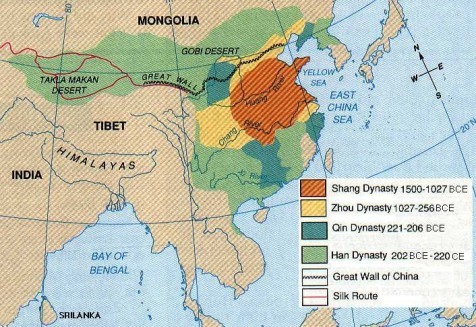
How was Chinese civilization affected by mountains and deserts?
a)
They became wealthy.
b)
They were isolated from other civilizations.
c)
They made it easier to travel.
d)
They made China easy to be attacked.
45.
How did the Zhou king control his large empire?
a)
He killed all nobles.
b)
He set up a vast spy network.
c)
He set up a huge bureaucracy.
d)
He placed family members in charge of regions.
46.
What occurred durn the end of the Zhou dynasty?
a)
Warlords fought throughout China.
b)
Crop production decreased.
c)
Cities declined in importance.
d)
Weak states conquered stronger ones.