
Font size
S
M
L
XL
 Worksheets
6th grade Science Review
Total questions: 25
Worksheet time: 13mins
Name
Class
Date
1.
Choose the TWO correct answers that describe how the ocean can affect weather and climate.
a)
It absorbs large quantities of heat.
b)
Its surface reflects heat back into the atmosphere.
c)
Its currents move heat from the equator to the poles.
d)
It causes circulation in the atmosphere by absorbing heat from the air.
2.
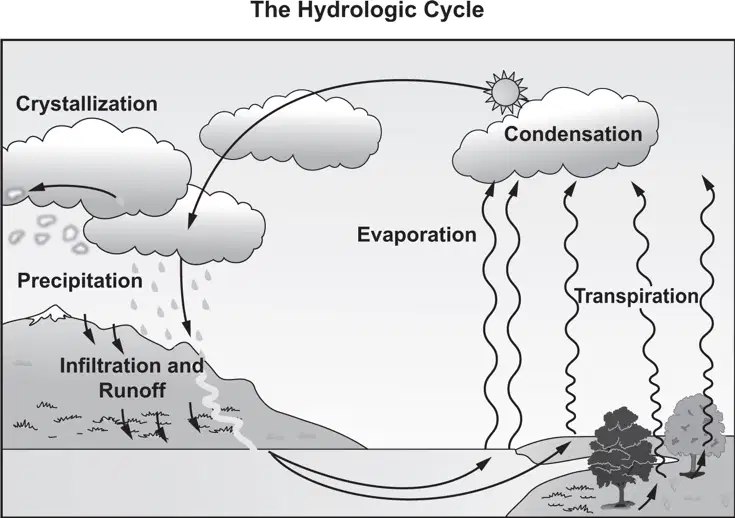
The diagram shows the process of the water cycle. Choose the correct change of state for condensation.
a)
liquid to gas
b)
liquid to solid
c)
gas to liquid
3.

The diagram shows the process of the water cycle. Choose the correct change of state for crystallization.
a)
liquid to gas
b)
liquid to solid
c)
gas to liquid
4.
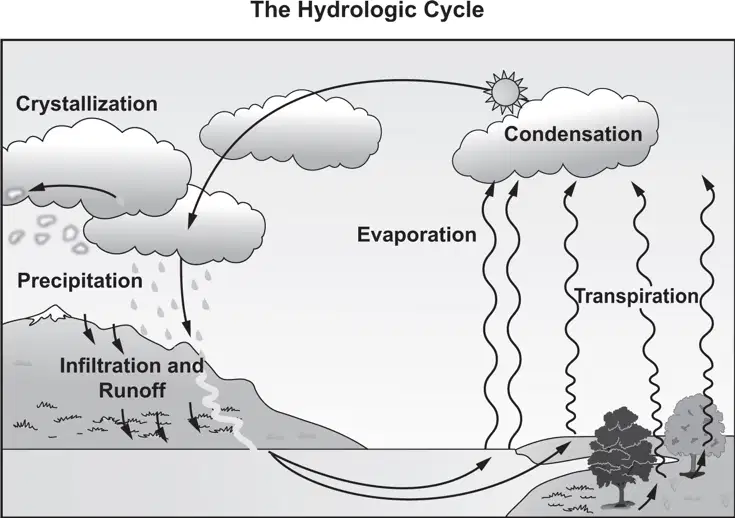
The diagram shows the process of the water cycle. Choose the correct change of state for evaporation.
a)
liquid to gas
b)
liquid to solid
c)
gas to liquid
5.

The diagram shows the process of the water cycle. Choose the correct change of state for transpiration.
a)
liquid to gas
b)
liquid to solid
c)
gas to liquid
6.
Water in the atmosphere can change state from solid to liquid to vapor and back depending on temperature and pressure. Choose the TWO options that describe evaporation
a)
blade of grass is colder than the surrounding air
b)
warm, moist air rises and cools
c)
the sun rises and warms the atmosphere
d)
air flowing in from the ocean encounters a mountain
e)
puddle absorbs heat from the pavement below it
7.
Normally, a low-pressure system is located over the western Pacific Ocean. During anEl Niño year, the low-pressure system moves to the eastern Pacific Ocean causing the main oceanic current to switch direction. Then the upwelling of nutrient-rich water decreases. Which characteristic is an indicator that an El Niño event is occurring?
a)
decrease in length of winter season
b)
decrease in temperatures at the poles
c)
increase in winds that blow Pacific Ocean currents
d)
increase in ocean temperatures in the eastern Pacific Ocean
8.
Which of these best explains why the lake-effect snow generally stops in February?
a)
Ice layers are covering the lake.
b)
Air movements across the lake change direction.
c)
Land temperatures around the lake become colder.
d)
Air temperatures become warmer than lake temperatures.
9.
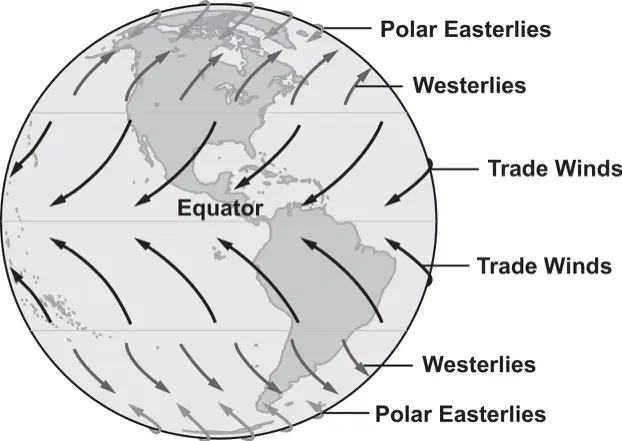
Trade winds are surface winds that blow over the tropical ocean near the equator. Trade winds drive ocean currents in this region, moving warm water in an east-to-west direction, as shown in the picture. Every few years, some of the trade winds that blow directly over the ocean weaken. What changes would be most likely to occur next?
a)
Increasing ocean temperatures cause current speeds to increase.
b)
Ocean temperatures near the equator grow cooler and current speeds increase.
c)
Ocean temperatures near the equator grow cooler, causing heavy rainfall worldwide.
d)
The area of warm surface water near the equator increases in size and ocean currents slow or stop.
10.

The picture shows the flow of moist air from the ocean, over a mountain range, and toward the plains. Which area is it MOST likely to rain?
a)
Over the ocean
b)
The left side on the mountain
c)
The right side on the mountain
d)
Over the plains
11.
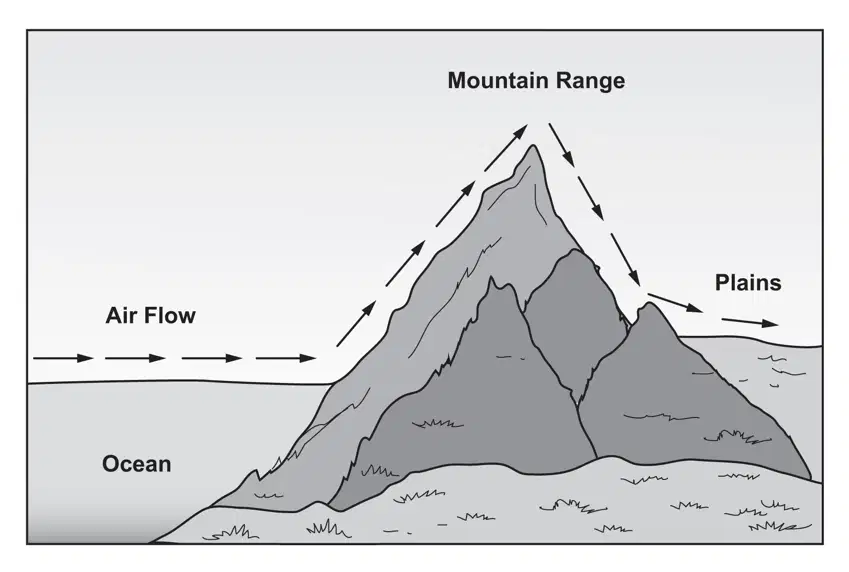
The picture shows the flow of moist air from the ocean, over a mountain range, and toward the plains. Which area is it LEAST likely to rain?
a)
Over the ocean
b)
The left side on the mountain
c)
The right side on the mountain
d)
Over the plains
12.
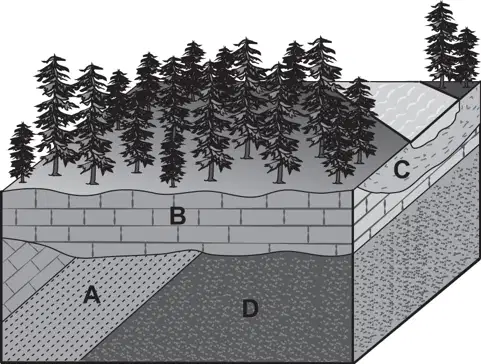
The diagram shows a cross section of land in a forest area. Which statement explains which labeled layer in the diagram is the newest layer?
a)
layer A because it is tilted, is over layer D, and is cut by layer B
b)
layer B because it cuts across layers A and D and is cut into by layer C
c)
layer C because it cuts into layer B and is not cut by any other layers
d)
layer D because it is tilted, is cut by layer B, and is the bottom layer
13.
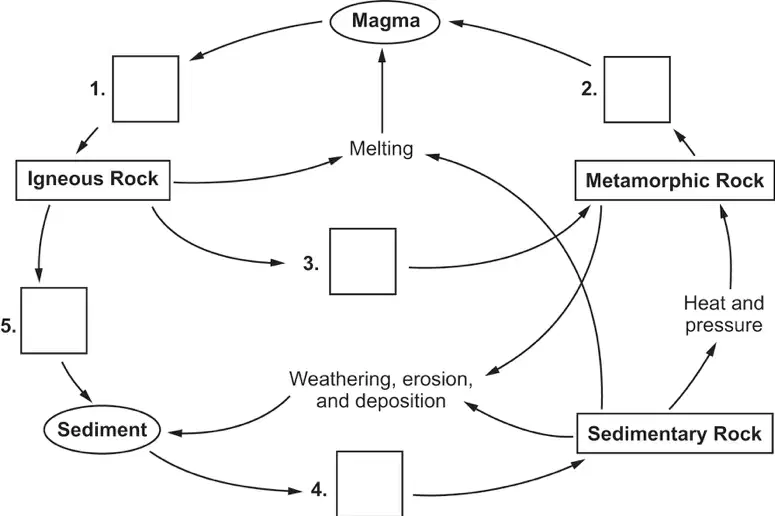
An incomplete diagram of the rock cycle is shown. Choose the process to correctly describe rock transformation in Box 1.
a)
Melting
b)
Heat and pressure
c)
Cooling and solidification
d)
Compaction and cementation
e)
Weathering, erosion, and deposition
14.
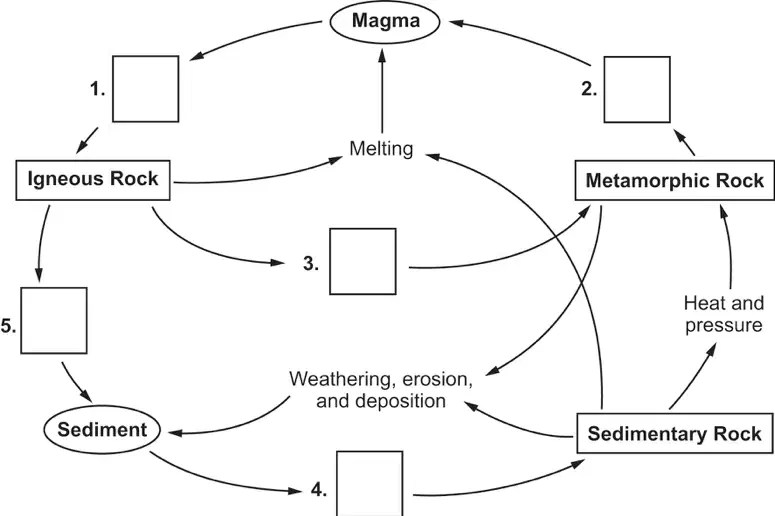
An incomplete diagram of the rock cycle is shown. Choose the process to correctly describe rock transformation in Box 2.
a)
Melting
b)
Heat and pressure
c)
Cooling and solidification
d)
Compaction and cementation
e)
Weathering, erosion, and deposition
15.
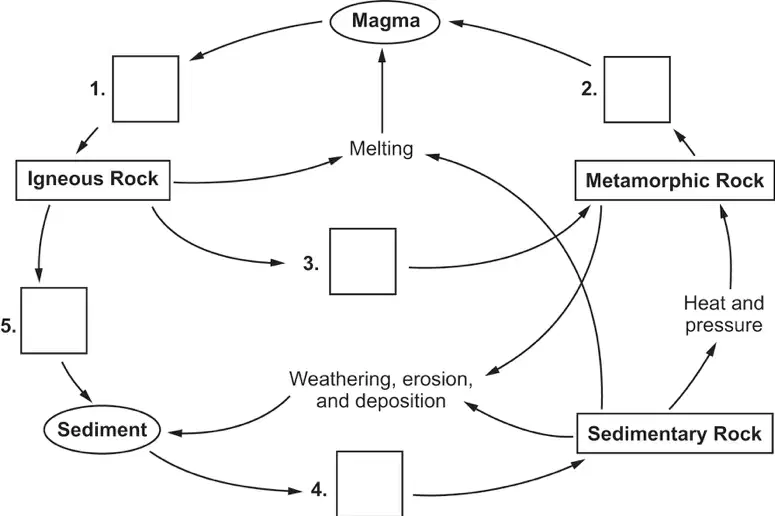
An incomplete diagram of the rock cycle is shown. Choose the process to correctly describe rock transformation in Box 3.
a)
Melting
b)
Heat and pressure
c)
Cooling and solidification
d)
Compaction and cementation
e)
Weathering, erosion, and deposition
16.
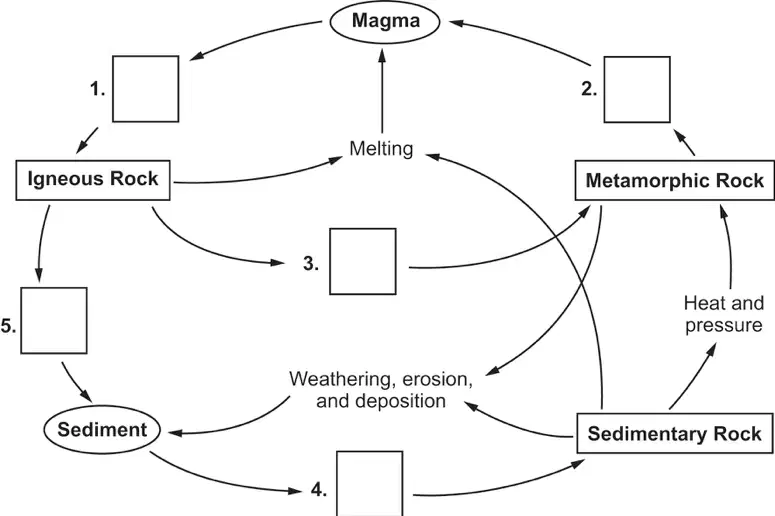
An incomplete diagram of the rock cycle is shown. Choose the process to correctly describe rock transformation in Box 4.
a)
Melting
b)
Heat and pressure
c)
Cooling and solidification
d)
Compaction and cementation
e)
Weathering, erosion, and deposition
17.
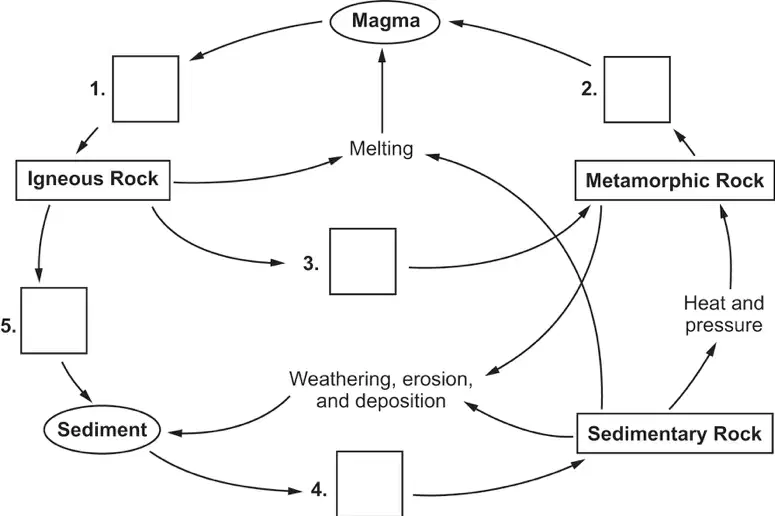
An incomplete diagram of the rock cycle is shown. Choose the process to correctly describe rock transformation in Box 5.
a)
Melting
b)
Heat and pressure
c)
Cooling and solidification
d)
Compaction and cementation
e)
Weathering, erosion, and deposition
18.
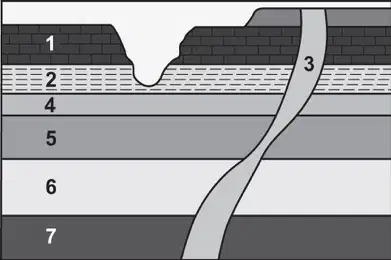
This image shows a cross-section of rock layers. Which rock layer is the OLDEST?
a)
layer 7
b)
layer 1
c)
layer 2
d)
layer 3
e)
layer 4
19.

This image shows a cross-section of rock layers. Which rock layer is the YOUNGEST?
a)
layer 3
b)
layer 1
c)
layer 2
d)
layer 4
e)
layer 5
20.
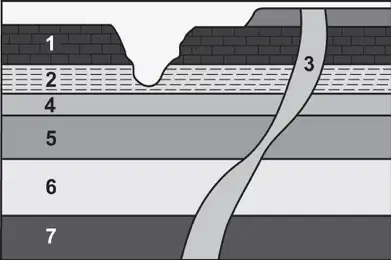
This image shows a cross-section of rock layers. Which rock layers have signs of water erosion? (can be more than one answer)
a)
layer 1
b)
layer 2
c)
layer 3
d)
layer 4
e)
layer 5
21.
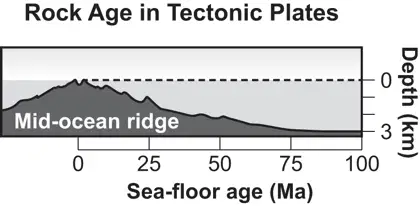
In the early 1900s, Alfred Wegener proposed that continents were not stationary but they moved slowly over time; however, there was a question of how the continents moved. Samples of rock from the ocean floor were collected and the age of the rock samples was determined. The graph shows the pattern of ages of rock in an ocean floor in millions of years (Ma). What do these data suggest about how continents move?
a)
The data show that continents rise and fall in the ocean floor.
b)
The data show that continents are sliding across the ocean floor.
c)
The data show that continents move by pushing through the ocean floor.
d)
The data show that continents move as the sizes and shapes of oceans change.
22.
Which statement explains why sound cannot travel across the space between two planets?
a)
Sound waves need oxygen to move.
b)
Sound waves need a medium to move.
c)
The temperatures in space are too cold.
d)
The distances between planets are too great.
23.
A wave has these characteristics: It does not require a medium to travel, Wave displacement is perpendicular to the direction of travel. Which type of wave is being described?
a)
water wave
b)
sound wave
c)
seismic wave
d)
electromagnetic wave
24.
Check the TWO statements that describe the qualities needed for glasses that would make everything appear green to the eye.
a)
transmit green light only
b)
absorb all light except green light
c)
absorb green light only
d)
transmit all light except green light
e)
reflect green light and absorb all other light
25.
A designer wants to produce a visual effect and needs rays of visible light to strike a surface and bounce off of that same surface going in one direction. Choose the two answers that each of the material properties that could be used to produce this light effect.
a)
black material
b)
rough surface
c)
smooth surface
d)
opaque material
e)
transparent material
Reset

