
 Worksheets
Unit 11 Progress Checks
Total questions: 27
Worksheet time: 14mins
Name
Class
Date
1.
1. What are the names of the two major political parties in the United States today?
a)
Democratic and Republican
b)
Democratic and Libertarian
c)
Socialist and Republican
d)
Socialist and Libertarian
2.
2. How do modern Democrats and Republicans view taxation?
a)
Democrats tend to favor tax increases to support new social programs more than Republicans
b)
Republicans tend to favor tax increases to support new social programs more than Democrats.
c)
Democrats tend to favor tax decreases, while Republicans tend to favor keeping tax rates the same.
d)
Republicans tend to favor tax increases, while Democrats tend to favor keeping tax rates the same
3.
3. Which spending increase would the Democratic Party likely support?
a)
homeland security
b)
space exploration
c)
education
d)
military
4.

4. The conversation below is part of a political discussion. Which party's candidates are these voters most likely to support?
a)
Democratic
b)
Green
c)
Republican
d)
Socialist
5.

5. The chart below shows the differences in two political parties' platforms. Which of the following completes the chart?
a)
Republican Party
b)
Democrat Party
c)
Communist Party
d)
Green Party
6.
1. What type of political party system does the United States have?
a)
One-Party System
b)
Two-Party System
c)
Three-Party System
d)
Four-Party System
7.
2. After serving as a U.S. Senator, Laura decided to run for governor of Florida. Liz, Laura’s opponent, claims in court that Laura is not qualified to run. A judge rules in Liz’s favor. What was the basis for the lawsuit?
a)
Laura has never owned land in Florida.
b)
Laura is not a Florida resident.
c)
Laura is not yet 40 years old.
d)
Laura has never voted.
8.
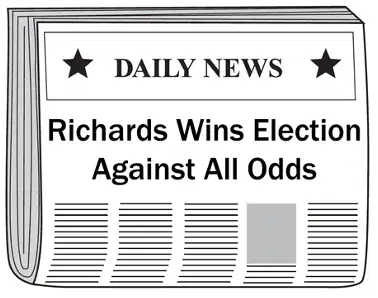
3. The newspaper headline below describes a government process. Why might this have been a difficult election for Richards to win?
a)
Richards is a homeowner.
b)
Richards is a party leader.
c)
Richards has less political experience than his opponent.
d)
Richards has less employment experience than his opponent.
9.
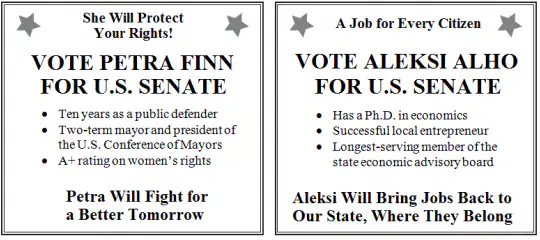
4. The political campaign posters below are for two candidates running for the U.S. Senate. According to the information on the posters, which individual would be more likely to vote for Aleksi Alho?
a)
A voter concerned about leadership experience
b)
A voter concerned about women’s rights
c)
A voter concerned about protecting the rights of the accused
d)
A voter concerned about rising unemployment in the state
10.
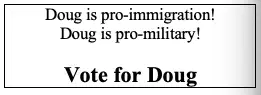
5. The poster below is from a recent election. Based on the poster, what conclusion can be drawn about the candidate?
a)
Doug is running for judge.
b)
Doug is running for mayor.
c)
Doug is running for president.
d)
Doug is running for city council.
11.
1. Who do lobbyists represent in their attempts to influence government?
a)
military officers
b)
elected officials
c)
interest groups
d)
circuit judges
12.

2. The table below shows lobbying methods and their associated costs and time required. Lela wants to show her district’s representative in Congress that there is a lot of popular support of an upcoming bill. She has drawn up a chart of lobbying methods. She wants to lobby indirectly, but she does not have much money, and her deadline is a month from now. Which are her best options?
a)
An online petition and letters to citizens
b)
Calling citizens by phone and letters to citizens
c)
Emailing the representative and an online petition
d)
Group rally event and emailing the representative
13.
3. Which example represents the media acting as watchdog?
a)
A journalist discovers that an office holder held a hearing.
b)
A journalist discovers that an office holder accepted a bribe.
c)
A journalist discovers that an office holder decided to retire.
d)
A journalist discovers that an office holder voted against a bill.
14.
4. How might a political action committee influence government?
a)
send a letter to a U.S. Senator’s supporters
b)
contribute money to a U.S. Senate campaign
c)
write a letter to a newspaper about a U.S. Senator
d)
contribute money to a charity in a U.S. Senator’s state
15.
5. James Madison wrote that “liberty is to faction what air is to fire.” After reading this, Jack points out that the Founders would have wanted more restrictions on lobbyists, special-interest groups, and media influencing the government. What would be a good counterargument?
a)
Elected officials are better able to measure public opinion if there are no interfering factions
b)
Lobbyists will balance one another in government influence if they are subject to fewer laws.
c)
Political ads, despite their biases, are best able to inform citizens when there are no regulations.
d)
The media, despite its biases, are best able to monitor the government when they are free.
16.
1. Which option presents a clear point of view?
a)
bias
b)
metaphor
c)
propaganda
d)
symbolism
17.
2. Which source would give the most accurate information about the views held by an incumbent (candidate hoping to be re-elected) running for Congress?
a)
special interest group ratings of that Congress member
b)
a television commercial sponsored by a political party
c)
the voting record of the candidate while in Congress
d)
flyers sent through the mail by the candidate
18.

3. The passage below is from a U.S. Supreme Court decision. Based on the passage, what is a goal of the FCC regulation?
a)
to limit bias in political communication
b)
to promote bias in political communication
c)
to limit symbolism in political communication
d)
to promote symbolism in political communication
19.
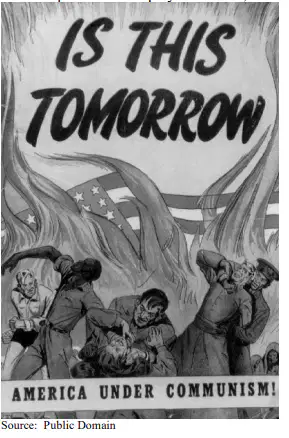
4. This poster was displayed in 1947, at the beginning of the Cold War. How can the information on this poster best be categorized?
a)
Advertisement
b)
Entertainment
c)
Factual
d)
Propaganda
20.

5. The poster below was displayed in 1876. What is the primary goal of this propaganda poster?
a)
To encourage people to move to government lands
b)
To discourage people from moving to government lands
c)
To encourage people to move to California
d)
To discourage people from moving to California
21.
1. Which option represents a way that multiple perspectives are reflected in political participation?
a)
public meetings
b)
press conference
c)
legislative sessions
d)
State of the Union address
22.
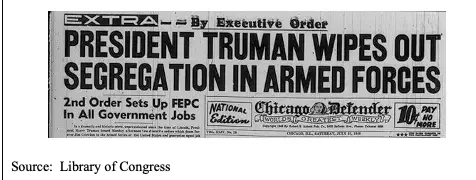
2. The headline below describes an event in U.S. history. Which public policy view is reflected in the headline?
a)
racial discrimination
b)
racial prejudice
c)
racial tolerance
d)
racial equality
23.
3. Which option reflects a long term policy goal?
a)
collecting canned food to give to the poor
b)
collecting signatures to run for public office
c)
collecting soap and shampoo to send overseas
d)
collecting signatures to put an amendment on the ballot
24.
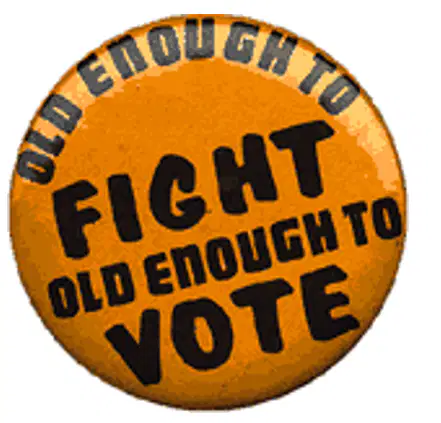
4. Below is a button worn by a citizen. Which public policy perspective reflects the views of the citizen wearing the button?
a)
youth literarcy
b)
youth suffrage
c)
youth education
d)
youth employment
25.

5. Below are views related to education. Which conclusion can be drawn from these views?
a)
Political conflict is a threat to strong societies.
b)
Civic participation should be learned at home.
c)
Political conflict should be reduced through legislation.
d)
Civic involvement is important to building strong societies.
26.
1. In which case did the U.S. Supreme Court rule that the Florida Supreme Court’s plan for recounting ballots violated the Equal Protection Clause of the Fourteenth Amendment?
a)
Hazelwood v. Kuhlmeier
b)
Gideon v. Wainwright
c)
U.S. v. Nixon
d)
Bush v. Gore
27.
2. What was the outcome of the U.S. Supreme Court's decision in Bush v. Gore.
a)
A recount of votes in Florida was stopped and George W. Bush became the next President.
b)
The U.S. Supreme Court confirmed the ruling of the Supreme Court of Florida to conduct a recount.
c)
The U.S. Supreme Court used the results of the popular vote in place of the Electoral College.
d)
The U.S. Supreme Court ordered a new election to be held in Florida.
100 %

