
Font size
 Worksheets
Exam 2 100 questions NBOARD
Total questions: 100
Worksheet time: 52mins
107. What sterilization technique uses oxidation to sterilize dental instruments?
a. Autoclave
b. Unsaturated chemical vapor
c. Dry Heat
d. Ultrasonic
108. A patient that has a mild systemic disease and may or may not have special considerations in regards to his or her dental management, would be considered what type of ASA Classification?
a. I
b. II
c. III
d. IV
109. When a tooth loses tooth structure due to a chemical agent:
a. Attrition
b. Abrasion
c. Hypoplasia
d. Erosion
110. What is the vertical overlap of the maxillary and mandibular incisors considered?
a. Overjet
b. Overbite
c. Crossbite
d. Openbite
111. What is the dominant bacterium in the initial plaque stage?
a. Gram positive streptococcus
b. Gram negative streptococcus
c. Spirochetes
d. Gram negative rods
112. At what pH is a root demineralized?
a. 4.5-5.5
b. 5.5-5.9
c. 6.0-6.7
d. 6.5-7.4
113. Tobacco is considered what type of stain?
a. Intrinsic
b. Extrinsic
c. Exogenous
d. Endogenous
114. Which of the following conditions would respond to therapeutic diagnosis?
a. Bone cyst
b. Angular cheilitis
c. Fordyce granules
d. Paget disease
115. A dense, nonmineralized complex mass of bacteria that forms a gel like matrix:
a. Acquired pellicle
b. Biofilm
c. Demineralization
d. Plaque
116. Which of the following is not a major component of saliva that helps protect against dental caries?
a. Calcium
b. Phosphate
c. Iron
d. Fluoride
117. Which nerve innervates the tooth pulp on the mandible?
a. Mental
b. Long Buccal
c. Posterior Superior Alveolar
d. Inferior Alveolar
118. Which of the following cranial nerves is not a sensory nerve?
a. Trochlear
b. Olfactory
c. Optic
d. Vestibulocochlear
119. Which of the following is not a major salivary gland?
a. Submandibular
b. Sublingual
c. Parotid
d. Wharton
121. Drugs with a high-first past effect have a smaller oral to parental dose ratio.
a. True
b. False, they have a larger parental dose ratio.
c. False, they have the same parental dose ratio.
d. False, drugs do not have a high-first past effect.
122. What is the study of how a drug is absorbed, distributed, metabolized and excreted by the body?
a. Pharmacology
b. Pharmacokinetics
c. Pharmacodynamics
d. Pharmaceuticals
123. Liver disease or previous or current substance abuse may impair the metabolism of a drug.
a. True
b. False, only current substance use affects the metabolism of a drug.
c. False, only previous substance abuse affects the metabolism of a drug.
d. False, liver disease does not affect the metabolism of a drug
124. The _______ stage of development is when the first signs of an arrangement of cells occur.
a. Bell
b. Cap
c. Bud
d. Embryotic
125. Which of the following is not a type of tissue found in the body?
a. Connective
b. Endoplasmic
c. Muscle
d. Nerve
126. All of the following are part of the gingival fiber group except:
a. Interradicular
b. Dentogingival
c. Alveologingival
d. Circumferential
127. This vitamin is the catalyst for synthesis of blood clotting:
a. Vitamin A
b. Vitamin E
c. Vitamin D
d. Vitamin K
128. A deficiency in Vitamin B3 (Niacin) can lead to what disease?
a. Pellagra
b. Scurvy
c. Enamel Mottling
d. Sickle Cell Anemia
129. Which of the following is not considered a form of calcium?
a. Cheese
b. Peas
c. Tofu
d. Kale
130. What palpation method is used during an extra oral exam that uses the finger and thumbs of both hands?
a. Bilateral palpation
b. Digital palpation
c. Bidigital palpation
d. Bimanual palpation
131. Subluxation is when the condyle of the temporal mandibular joint glides beyond the eminence preventing the jaw from closing. Subluxation can be caused by long dental procedures.
a. Both statements are true
b. Both statements are false
c. First statement is true. Second statement is false
d. First statement is false. Second statement is true.
132. Periodontal disease can be more severe in patients that smoke when they are deficient in this vitamin:
a. Vitamin A
b. Vitamin B3
c. Vitamin B6
d. Vitamin C
133. What happens when the globular process fails to fuse with the maxillary process during the first trimester of pregnancy?
a. Cleft Lip
b. Cleft Palate
c. Cleft Nasal
d. Cleft Mandible
134. Cementum contains collagen fibers. In teeth, Sharpey’s fibers are the terminal ends of the principal fibers that insert into the cementum and into the periosteum of the avelor bone.
a. Both statements are true.
b. Both statements are false
c. First statement is true. Second statement is false
d. First statement is false. Second statement is true.
135. What plane divides the body into left and right halves?
a. Axial
b. Parasagittal
c. Sagittal
d. Transverse
136. What is the smallest permanent tooth in the mouth?
a. Mandibular central incisors
b. Maxillary canine tooth
c. Mandibular lateral incisor
d. Maxillary lateral incisor
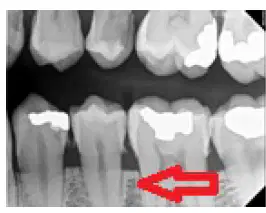
137. What is the arrow pointing to?
a. Lamina dura
b. Cancellous bone
c. Periodontal ligament
d. Cementum
138. During swallowing, the esophageal phase is under voluntary neuromuscular control. The pharyngeal phase is under involuntary neuromuscular control.
a. Both statements are true.
b. Both statements are false.
c. First statement is true. Second statement is false
d. First statement is false. Second statement is true
139. Which two organs are endocrine glands?
a. Kidney
b. Ovaries
c. Thyroid
d. Ureters
140. A psuedopocket is produced by edematous gingival tissue. The junction epithelium does not migrate when there is psuedopocketing.
a. Both statements are true.
b. Both statements are false.
c. First statement is true. Second statement is false
d. First statement is false. Second statement is true
141. A patient with a Class I occlusion would have a facial profile that is mesognathic. Mesognathic is considered to be a normal profile.
a. Both statements are true.
b. Both statements are false.
c. First statement is true. Second statement is false.
d. First statement is false. Second statement is true
142. What information source determines the general health of the patient?
a. Clinical interview with the patient
b. Medical history form
c. Dental health history form
d. Letter from patient’s primary care physician
143. A patient leaves the medication portion of her health history form blank. Upon being seated the hygienist reviews the form with her and asks if she takes any medications or supplements. The patient states that she takes birth control pills but she did not list them on the medication portion because it is irrelevant to her dental treatment. The hygienist informs her that it should be included, because birth control pills _________.
a. may interact with local anesthetic agents
b. may become less effective if given antibiotics
c. could cause gingival overgrowth
d. change the oral flora
144. Medical history forms should be updated:
a. Annually
b. Biannually
c. Every 3 years
d. At each visit
145. A healthy adult’s pulse rate should be between ______ beats per minute
a. 120-160
b. 80-130
c. 50-120
d. 60-100
146. Which two of the following are reasons that require antibiotic premedication?
a. Systemic lupus erythematosis
b. Joint replacement less than 2 years ago
c. Joint replacement up to 5 years ago
d. Type II diabetes
147. Which of the following is NOT an essential part of an initial extraoral examination?
a. Palpation of the masseter and temporalis muscles
b. Inspection of the lips for pigmentations
c. Inspection of the ventral surfaces of the tongue
d. Inspection for facial symmetry
148. Which of the following conditions are inspected upon examination of the parotid gland? Select all answers that apply.
a. Hardness
b. Mobility
c. Swelling
d. Enlargement
149. Which lymph nodes are assessed through palpitation with the patient’s head tilted forward?
a. Deep cervical
b. Accessory
c. Auricular
d. Occipital
150. Which of the following appearances in gingiva indicates a disease condition?
a. Loss of gingival stippling
b. Pigmentation of gingiva
c. Pink, stippled gingiva
d. Firm, knife-edged papilla
151. What area should be palpated to determine if a blockage of sialoliths is present?
a. Torus
b. Wharton’s duct
c. Ranulad.
d. Exostosis
152. Which two locations in the mouth are high-risk areas for oral cancer?
a. Dorsal surface of tongue
b. Ventral surface of tongue
c. Lateral surface of tongue
d. Buccal mucosa
153. What condition of the mouth is caused by the Epstein-Barr virus?
a. Hairy leukoplakia
b. Black hairy tongue
c. Macroglossia
d. Median rhomboid glossitis
155. Which two of the following endogenous intrinsic stains exhibit white lesions?
a. Tetracycline
b. Amoxicillin
c. Fluorosis
d. Trauma
156. Which type of restorative overhang comprises 1/3 to 1/2 of the interproximal embrasure space of a tooth?
a. Type I
b. Type II
c. Type III
d. Type IV
157. Which of the following is NOT a caries risk factor?
a. Xerostomia
b. Radiation therapy
c. Low income
d. Fewer than 15 teeth
158. Which two of the following are signs of chronic gingival inflammation?
a. Tough, fibrous gingiva
b. Soft, spongy gingiva
c. Blunted interdental papilla
d. Swollen interdental papilla
159. During a periodontal screening and reporting (PSR), the deepest measurement in one quadrant extends only onto the first clear band of the periodontal probe, with calculus present and bleeding upon probing. What would the proper PSR score be for this quadrant?
a. 0
b. 1
c. 2
d. 3
160. Which classification of tooth mobility exists when the tooth is depressible?
a. Class III
b. Class II
c. Class V
d. Class IV
161. Which plaque score indicates gross soft debris within gingival pockets and/or margins?
a. 0
b. 3
c. 2
d. 4
162. Which classification of furcation involvement indicates through and through involvement of bone loss between the roots, with an opening covered by the gingiva?
a. Class IV
b. Class II
c. Class III
d. Class I
163. What is the vibration felt in the tooth during occlusion?
a. Fremitus
b. Tribismus
c. Furcation
d. Percussion
164. Which of the following is not a factor that affects the setting of gypsum products?
a. Temperature of water
b. Exposure to light
c. Amount of water used
d. Humidity
165. What is the level of marginal gingiva apical to the cementoenamel junction that can be measured with a periodontal probe?
a. Clinical attachment level
b. Recession
c. Gingival pocket
d. Periodontal pocket
166. Which bacteria is the main etiological cause for the initiation of coronal lesions?
a. Staphylococcus
b. Lactobacilli
c. Streptococcus mutans
d. Sucrose
167. In regards to radiation wavelengths, select the two appropriate answers regarding wave penetration.
a. Longer wavelengths are less frequent and produce less penetrating x-rays
b. Shorter wavelengths are more frequent and produce more penetrating x-rays
c. Longer wavelengths are more frequent and produce more penetrating x-rays
d. Shorter wavelengths are less frequent and produce less penetrating x-rays
168. When an x-ray photon intermingles with water and oxygen molecules in body tissue, the result is ____________.
a. Compton effect
b. Photoelectric effect
c. Scatter radiation
d. Free radicals
169. What is the safest area to stand in relation to a primary x-ray beam about to be exposed on a patient?
a. 4 feet away at a 90-degree angle from the beam
b. 5 feet away at a 180-degree angle from the beam
c. 6 feet away at a 90-135-degree angle from the beam
d. 3 feet away at a 90-135-degree angle from the beam
170. What is the maximum permissible dose of radiation that a dental professional should receive per year?
a. 0.5 rem
b. 0.05 rem
c. 5.0 rem
d. 5.0 Sv
171. What is the lethal dose of radiation that would cause death in 50% of the population within 30 days?
a. 2.0 Sv
b. 20.0 rem
c. LD 30/50
d. LD 50/30
172. Which portion of the x-ray tubehead performs collimation?
a. PID
b. Aluminum filter
c. Focusing cup
d. Target
173. Regulations and federal law restrict the size of PID and tubehead devices. Which of the following options is NOT accurate?
a. Aluminum filters must be no less than 1.5 mm thick for exposures below 70kVp
b. Circular tubeheads must be no less than 2 3/4” in diameter
c. Rectangular tubeheads must be no less than 1 3/8 by 1 3/4” in diameter
d. PID lengths must be no less than 6”
174. _____________ would result in a better contrast of grey shades in the final radiograph.
a. Decreasing mA
b. Increasing exposure time
c. Increasing kVp
d. Increasing mA
175. What radiology technique places the x-ray beam perpendicular to the imaginary line between the tooth and the film?
a. Bisecting technique
b. Parallel technique
c. XCP technique
d. None of the above
176. What angulation is important to direct between interproximal areas of the teeth so as not to cause overlapping images on the film?
a. Horizontal
b. Vertical
c. Bisecting
d. Paralleling
177. When attempting to locate the position of a foreign substance or pathology, an x-ray film is taken and then retaken at a _______ change toward the mesial. If the object moves distally on the film, then the object is located on the _______ side of the teeth.
a. 40-degree; buccal
b. 40-degree; lingual
c. 20-degree; buccal
d. 20-degree; lingual
178. A _________ object to film distance and ________ source to film distance decreases magnification of the image.
a. Shorter; Shorter
b. Longer; Longer
c. Shorter; Longer
d. Longer; Shorter
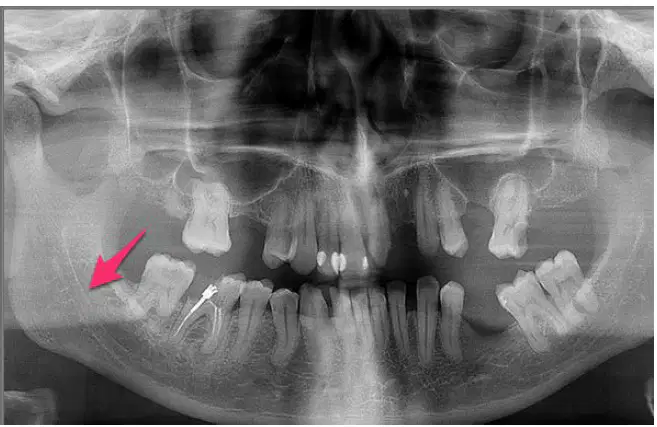
179. Identify the radiolucency extending through the mandible.
a. Hylohyoid ridge
b. Mandibular canal
c. External oblique ridge
d. Inferior border of mandible
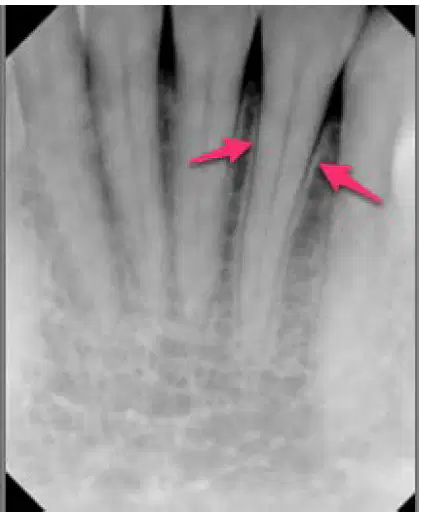
180. Identify the radiopaque area.
a. Cementum
b. PDL
c. Lamina Dura
d. CEJ
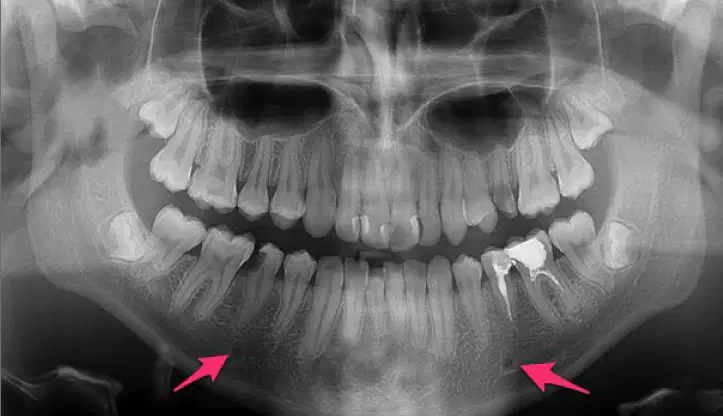
181. Identify the bilateral radiolucencies
a. Hyperostotic bone
b. Alveolar crest
c. Trabecular bone
d. Mental foramen
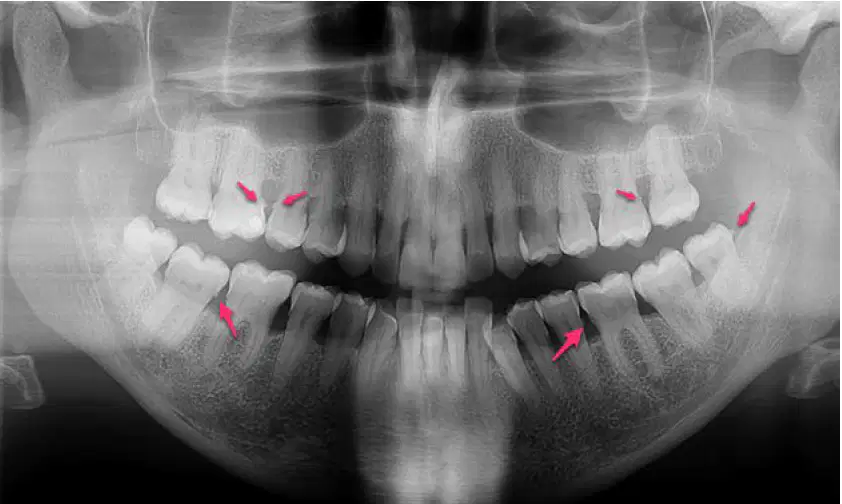
182. Identify the localized interproximal radiopacities:
a. Subgingival calculus
b. Alveolar crest
c. Cervical burnout
d. Cementoenamel junction
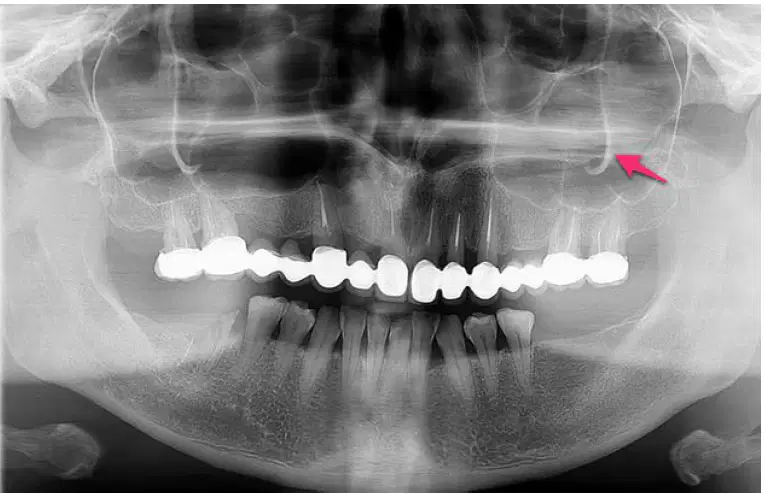
183. Identify the radiopaque structure.
a. Maxillary nasal sinus border
b. Zygomatic arch
c. Nasal sinus
d. Ghost of jewelry worn during x-ray exposure
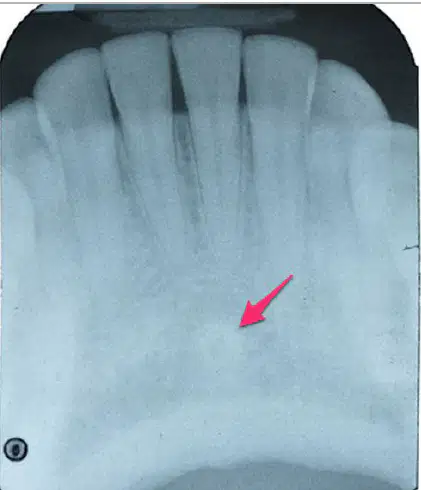
184. Identify the anatomical structure:
a. Anterior foramen
b. Lingual foramen
c. Apical foramen
d. Trabecular bone
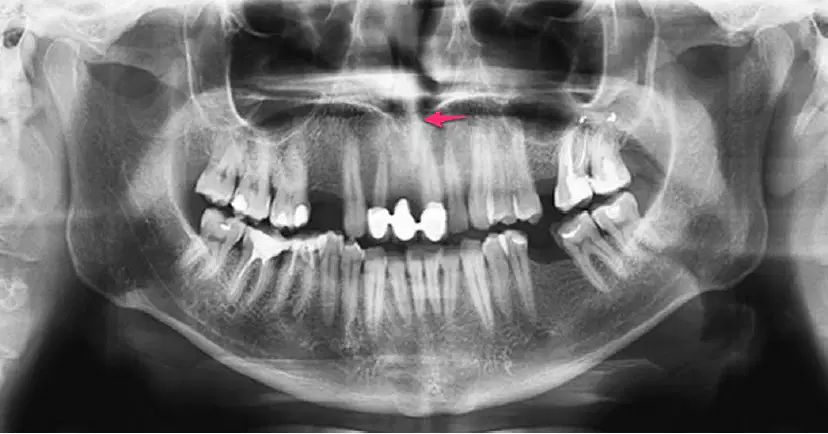
185. Identify the following radiopaque anatomical structure:
a. Median suture
b. Nasopalatine foramen
c. Anterior nasal spine
d. Superior foramina
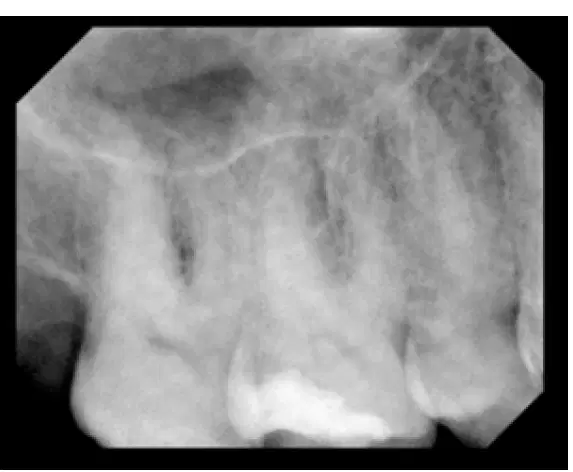
186. Which of the following statements is NOT accurate regarding the following radiograph?
a. The film was placed into the mouth backward
b. Inaccurate horizontal angulation was used
c. The film is mounted upside down
d. The film is positioned at the proper posterior position for a molar PA
188. Which of the following conditions would be a contraindication for Nitrous Oxide use in a patient?
a. Cerebral palsy
b. Strong gag reflex
c. Cardiovascular disease
d. Multiple sclerosis
189. What injection will anesthetize the upper central incisors and canines?
a. Infraorbital nerve
b. Anterior superior alveolar nerve
c. Middle superior alveolar nerve
d. Greater palatine
190. Which injection would anesthetize the palatal tissue of maxillary anterior teeth?
a. Nasopalatine
b. Greater palatine
c. Infiltration
d. Lingual block
191. Local anesthetic causes cell permeability to decrease, preventing ______ from entering into the nerve cell.
a. chloride
b. calcium
c. sodium
d. potassium
192. What systemic condition will result in pale mucosa, angular cheilosis and glossitis?
a. Hemophelia
b. Leukemia
c. Sickle-cell disease
d. Anemia
193. When treating a patient with a new cardiac pacemaker, which of the following precautions should be taken?
a. Avoid the use of piezoelectric scalers
b. Avoid the use of magnetostrictive ultrasonic scalers
c. Avoid the use of all electronic scalers
d. None of the above
194. Which condition would be treated with calcium channel blockers, causing possible gingiva hyperplasia?
a. Muscular Dystrophy
b. Anemia
c. Cardiovascular disease
d. Diabetes
195. Which benign cancer originates in the epithelium?
a. Papilloma
b. Carcinoma
c. Sarcoma
d. Lipoma
196. What should be done prior to administering a breath to the unconscious patient that is not breathing?
a. Check the airway for obstruction
b. Listen for a breath
c. Check for circulation
d. Administer chest compressions
197. A patient experiences anaphylaxis during a dental procedure. Which of the following is NOT an appropriate care method for this patient?
a. Terminate the treatment and activate EMS
b. Administer epinephrine
c. Place the patient in an upright position
d. Place the patient in a supine position
198. A diabetic patient arrives having just taken their insulin, but only ate a very light lunch due to having a dental procedure scheduled. During the appointment the patient begins experiencing headache and shakiness. What should the practitioner do?
a. Administer nitrous oxide
b. Wait until the patient feels better to continue the treatment
c. Ask the patient to take more insulin
d. Have the patient drink a soda
199. A patient who reclines in the chair for treatment soon begins to convulse and loses consciousness. What should the practitioner do first?
a. Sit the patient up
b. Place a prop in the mouth to prevent laceration of the tongue
c. Remove equipment from within reach of the patient
d. Activate EMS
200. Which of the following bodily fluids is not considered to be a contamination source?
a. Urine
b. Saliva
c. Sweat
d. None of the above. All are considered sources of contamination.
201. Face masks should be changed:
a. Whenever visibly soiled
b. At least twice per day
c. As often as gloves are changed
d. After each patient
202. What type of solution is shown to break down latex in gloves?
a. Alcohol-based hand sanitizer
b. Antimicrobial soap
c. Petroleum based creams
d. Lotion
203. Which type of sterilization machine is able to perform a complete sterilization cycle in less than 10 minutes?
a. Statims
b. Chemical vapor
c. Steam autoclave
d. Cold sterilization
204. When presenting a treatment plan to a patient, which of the following is NOT appropriate for the dental hygienist to do upon assessing the patient?
a. Explain risks associated with not completing the treatment
b. Present a dental hygiene treatment plan and inform the patient of how many appointments are needed
c. Prioritize patient’s periodontal health needs
d. Present a restorative treatment plan and inform the patient of how many appointments are needed
205. A patient is informed of their dental treatment plan. The plan is then signed by the dentist, hygienist and patient. This document becomes a part of the patient’s permanent file and is called __________________.
a. Informed consent
b. Documented consent
c. Treatment plan
d. Treatment agreement
206. Which of the following is an essential part of a patient’s needs assessment documented by the dental hygienist?
a. General assessment
b. Periodontal assessment
c. Dentition assessment
d. All of the above
207. Factors that determine the prognosis of a completed dental hygiene treatment plan may NOT be influenced by:
a. Quality of existing restorations
b. Malocclusion
c. The patient’s financial situation
d. Degree of attachment loss
208. Notes regarding the treatment plan, if documented in the margin of a patient’s file, should be written in _______.
a. Pencil
b. Blue ink
c. Typed
d. Whited out and then documented in the body of the chart with ink.
209. A new patient scheduled for a comprehensive exam and prophylaxis states on her medical history form that she has undergone a knee replacement in the last six months. She has not recently spoken with her primary care physician or surgeon. Which of the following would be an appropriate part of the care plan?
a. Perform the exam and then a prophylaxis if there is a low plaque index
b. Perform the exam and then reschedule the prophylaxis to allow for antibiotic premedication
c. Do not perform any exam and reschedule the patient to allow for antibiotic premedication
d. Call her primary care physician to see if it is ok to perform a prophylaxis

