
 Worksheets
Hydrosphere Test Review
Total questions: 30
Worksheet time: 15mins
Name
Class
Date
1.
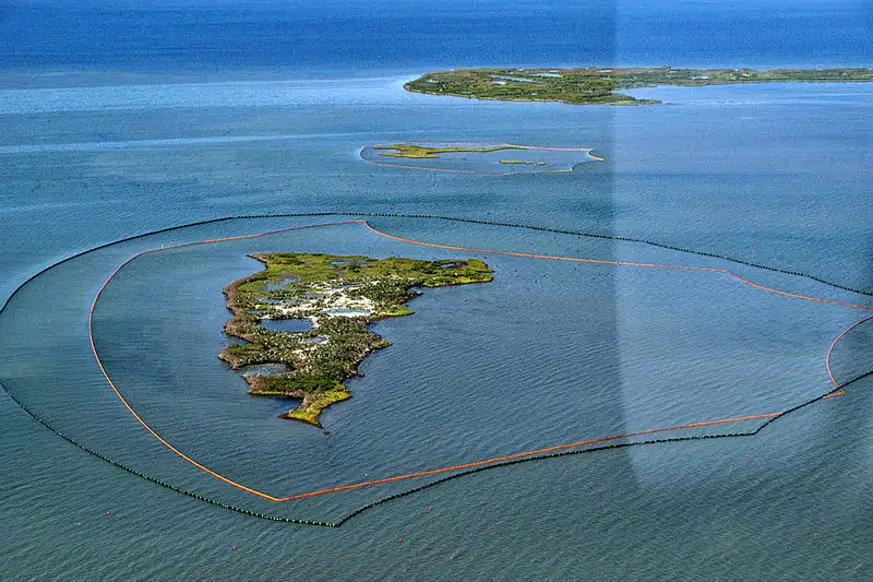
Which method of oil spill clean up is shown in this picture?
a)
Sorbents
b)
Disperants
c)
Skimmers
d)
Booms
2.
What is the main cause of coral bleaching?
a)
Ocean temperatures dropping drastically
b)
Overfishing of populations living in the coral
c)
Ocean temperatures rising by 2 degrees C
d)
Humans taking coral from the ocean
3.

What is a key characteristic of the recovery zone on an oxygen sag curve?
a)
All species of fish have left the area
b)
The dissolved oxygen is at its lowest point
c)
The biodiversity is the same as the clean zone
d)
The dissolved oxygen levels are increasing from the septic zone
4.
Which of these is a benefit provided to the environment by wetlands?
a)
Causes more erosion
b)
increase decomposition rates
c)
Filters pollutants out of waterways
d)
Recreational areas for activities such as kayaking
5.

What type of wetland is shown in this image?
a)
Non-tidal marsh "Prairie Pothole"
b)
Fen
c)
Bog
d)
Swamp
6.
The source of most irrigation and drinking water is
a)
flowing surface water such as streams and rivers
b)
surface water reservoirs such as lakes and ponds
c)
the ocean
d)
underground
7.
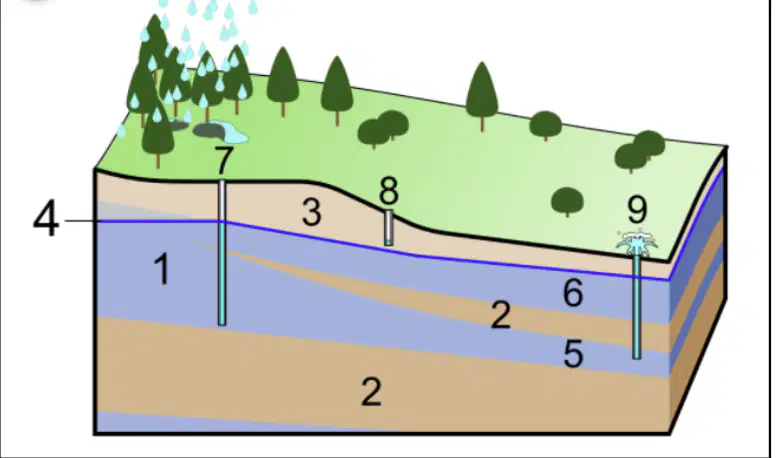
In the image below, which number is an example of a confined aquifer?
a)
2
b)
5
c)
6
d)
9
8.
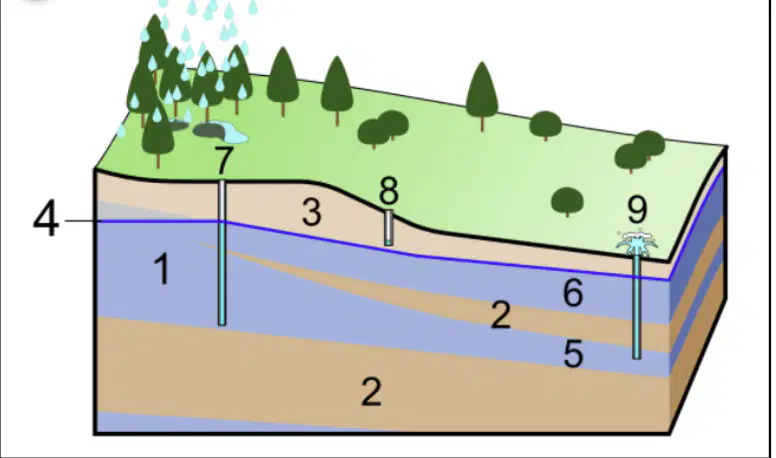
In the image below, which number is an example of an aquitard?
a)
2
b)
3
c)
8
d)
9
9.
Which of these is NOT true about water?
a)
water expands as a solid
b)
water is a nonpolar molecule
c)
water has a neutral pH
d)
water has a high specific heat
10.
Which process brings water into the ground?
a)
transpiration
b)
condensation
c)
infiltration
d)
evaporation
11.

In the picture below, what is represented by letter B?
a)
infiltration
b)
runoff
c)
groundwater
d)
transpiration
12.
Which of the following is NOT true of headwaters?
a)
The water is usually cold.
b)
The water usually flows quickly.
c)
The water contains a wide variety of organisms.
d)
The water usually has little sediment.
13.
The area in which freshwater meets saltwater is called
a)
an estuary.
b)
a watershed.
c)
a headwater.
d)
a waterfall.
14.
Which is NOT true about aquifers?
a)
confined aquifers recharge slowly
b)
an aquifer consists of a layer of permeable rock and the water in its pores
c)
artesian wells cannot be drilled directly into an aquifer due to tremendous water pressure
d)
water in an unconfined aquifer cannot be recharged
15.
When groundwater is pumped from aquifers, it can leave dissolved salts behind on the surface of the soil. This process is known as
a)
evapotranspiration
b)
salinization
c)
artesian welling
d)
recharging
16.
Saltwater biomes have around _____% salinity, while freshwater biomes have around .1%.
a)
3
b)
13
c)
30
d)
50
17.
The amount of saltwater on the earth’s surface is vastly larger than the amount of freshwater.
a)
True
b)
False
18.
The location in which freshwater and saltwater mix at the mouth of a river is known as a(n)
a)
intertidal zone
b)
productivity zone
c)
euphotic zone
d)
estuary
19.
In terrestrial biomes, the factor limiting photosynthesis is __________, whereas in marine biomes, it is __________.
a)
light, oxygen
b)
carbon dioxide, light
c)
light, nutrients
d)
nutrients, carbon dioxide
20.
Which of the following is NOT a characteristic of an organism living in the intertidal zone?
a)
the ability to be submerged under water
b)
the ability to photosynthesize with little sunlight
c)
the ability to securely attach to a substrate
d)
the ability to tolerate desiccation (drying out)
21.
The portion of the ocean where sunlight is able to penetrate the water is known as
a)
intertidal zone
b)
productivity zone
c)
euphotic zone
d)
estuary
22.
Which of the following is NOT a condition that would be found in an area of high marine productivity?
a)
Strong thermoclines
b)
High levels of nutrients
c)
Upwelling
d)
High amounts of phytoplankton
23.
Which of the following is NOT a benefit that can be gained from aquaculture?
a)
Stable income for fishermen
b)
Fewer diseases for fish
c)
Reduced fuel consumption for commercial fishing vessels
d)
Requires less aquatic area to yield the same catch
24.
____________ are used to redistribute oil after an oil spill, but they often cause oil to sink to the bottom, affecting aquatic habitats.
a)
Sorbents
b)
Booms
c)
Dispersants
d)
Skimmers
25.
A nuclear power plant discharges thermal pollution into a nearby water supply. How will this affect the water quality in this area?
a)
the dissolved oxygen in the water will increase
b)
the dissolved oxygen in the water will decrease
c)
the pH of the water will increase
d)
the pH of the water will decrease
26.
What type of pollution includes POPs?
a)
biological pollution
b)
nutrient pollution
c)
chemical pollution
d)
sediment pollution
27.
Which trophic level would be most susceptible to biomagnification of POPs?
a)
producers
b)
primary consumers
c)
secondary consumers
d)
tertiary consumers
28.
Which of the following is NOT a possible result of microplastic pollution in an aquatic ecosystem?
a)
The organisms get less nutrition
b)
The organisms get caught in the plastic pollution
c)
The organisms get endocrine disorders
d)
The organisms may have offspring with birth defects
29.
The anoxic soils in wetlands allow them to be ___________ sinks.
a)
carbon
b)
nitrogen
c)
photosynthetic
d)
mitigation
30.
Which type of pollution could cause higher turbidity in a stream?
a)
chemical
b)
biological
c)
thermal
d)
sediment
100 %

