
 Worksheets
Atomic Structure
Total questions: 25
Worksheet time: 13mins
Name
Class
Date
1.
Can the number of protons in an element ever change?
a)
No, protons and neutrons are bound together in atomic nuclei, and neither can change.
b)
Yes, isotopes of the same element have different numbers of protons.
c)
No, if the number of protons changes, the element changes.
d)
Yes, when different elements bond, they can share or transfer protons.
2.
The atomic number of an element is determined by its number of _______.
a)
protons
b)
isotopes
c)
electrons
d)
neutrons
3.
A student was investigating the identity of the following element. The element has 5 valence electrons, shows properties of metals and nonmetals, and has 33 protons in the nucleus of the atom. What is the identity of the element that the student is studying?
a)
silicon
b)
tellurium
c)
chromium
d)
arsenic
4.
Magnesium is important for many processes in the body. It has protons 12. What charge does Mg form when creating a chemical bond?
a)
+2
b)
-2
c)
+1
d)
-1
5.
Carbon is an element that is found everywhere on earth. It is found in fossil fuels, charcoal and even diamonds. Carbon is a nonmetal that has 6 protons and 6 electrons. What oxidation number would represent C?
a)
+3
b)
-3
c)
+5
d)
+/-4 or no charge
6.
Argon is a colorless odorless gas. Argon is an inert gas that is commonly used in industry to create dry working environments for chemical reactions to take place. What charge does Ar make?
a)
+3
b)
-3
c)
+5
d)
No charge
7.
An atom has 33 protons, 41 neutrons, and 36 electrons. What is the correct description of the atom?
a)
an atom with an atomic mass of 33
b)
an ion with a net charge of 3+
c)
an ion with a net charge of 3-
d)
an atom with an atomic mass of 36
8.
An isotope of an unknown element has 17 neutrons and a mass number of 32. What is the symbol of this isotope?
a)
A
b)
B
c)
C
d)
D
9.
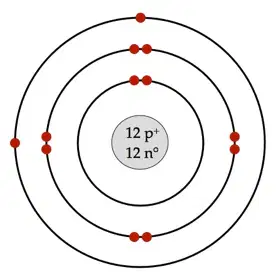
What is the element and the mass of the Bohr Diagram?
a)
Chromium; 24
b)
Magnesium; 36
c)
Magnesium; 12
d)
Magnesium; 24
10.
The periodic table is created to organized elements based on their chemicals and physical properties. Some groups are more reactive than others. Which of the following properties is true for any period within the periodic table?
a)
The number of electron shells increases from right to left.
b)
The number of electrons increase from left to right.
c)
All the elements have empty electrons energy shells.
d)
All of the elements are alkali metals.
11.

The diagrams show a sulfur ion and a chlorine ion. What is the main difference between these two ions?
a)
The number of atomic orbitals is different.
b)
Then number of neutrons is different.
c)
The number of protons is different.
d)
There is no difference between the two ions.
12.

Looking at the image. What is the average atomic mass of the element listed in this diagram?
a)
6
b)
12.011
c)
C
d)
Carbon
13.
Which family of elements contains a full outer shell of electrons?
a)
transition metals
b)
lanthanides
c)
noble gases
d)
halogens
14.
Helium is placed in group 18 on the periodic table because ___.
a)
it has a valence of eight.
b)
it is a metal.
c)
it has a full outer shell of electrons.
d)
it is highly reactive.
15.
Most main group elements found with in the same family on the periodic table tend to have____.
a)
the same chemical activity.
b)
the same number of valence electrons.
c)
the same atomic radius
d)
the same electron affinity.
16.
What predominant feature characterizes noble gases?
a)
They are very unstable elements.
b)
They have low ionization energy.
c)
They are the least reactive (most stable) elements.
d)
They all have the same atomic radius.
17.

Fluorine is an element that forms Fluoride. Fluoride is added to toothpaste to aid in protecting teeth. An atom of fluorine has the atomic number 9, and its mass number is 19 amu. Which of the following shows a neutral atom of fluorine?
a)
W
b)
X
c)
Y
d)
Z
18.
Lithium is a low density metal used in rechargeable batteries. Which isotope of lithium has 3 neutrons?
a)
Li-7
b)
Lithium-6
c)
Option 3
d)
Option 4
19.
Gold is one of the most dense metals. It is a great conductor of heat and electricity. The atomic mass of gold (Au) is 198, and the atomic number of gold is 79. How many neutrons does a neutral atom of gold contain?
a)
119
b)
99
c)
198
d)
79
20.
A neutral atom always contains the same number of _____.
a)
protons and electrons.
b)
electrons and neutrons.
c)
protons and neutrons.
d)
protons, electrons, and neutrons.
21.
Hydrogen is one of the most abundant elements on our planet. It can be found in water, organic compounds, and other molecular compounds. Which of the following is most likely to be a reason why the element hydrogen is placed in group I of the periodic table?
a)
Hydrogen can form both ionic and covalent bonds.
b)
Hydrogen is a non-metal.
c)
Hydrogen has only one electron in its outer shell.
d)
Hydrogen can form a diatomic molecule.
22.
Oxygen is a reactive element, that makes up 21% of the air we breathe. It is necessary for most living organisms to consume in order to carry out cellular respiration. How many valence electrons does a neutral atom of oxygen have?
a)
4
b)
6
c)
8
d)
2
23.
Which of the following subatomic particles is neutral (i.e., has no charge)?
a)
neutron
b)
proton
c)
nucleus
d)
electron
24.
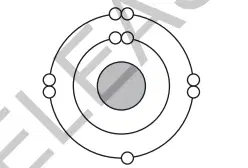
Fluorine is an element that forms Fluoride. Fluoride is added to toothpaste to aid in protecting teeth. This is a neutral atom of fluorine-19. Which best describes the structure of fluorine-19?
a)
2 electrons in the first energy level; 7 electrons in the second energy level
b)
2 electrons in the first energy level; 8 electrons in the second energy level
c)
9 protons and 9 neutrons in the nucleus
d)
10 protons and 9 neutrons in the nucleus
25.

Electron dot diagrams show the valence electrons of an element and how it bonds. Using the diagram below, what element could this electron dot diagram represent?
a)
Lithium
b)
Oxygen
c)
Argon
d)
Helium
100 %

