
 Worksheets
10.A Intro to Ecology
Total questions: 20
Worksheet time: 11mins
Name
Class
Date
1.
Which of the following is a biotic factor that limits the carrying capacity of animal species?
a)
amount of sunlight
b)
availability of food
c)
temperature
d)
availability of space
2.
An ecosystem experiences a rapid increase in the algae population as a result of lawn fertilizer entering the system through storm drains. The food chain below is part of the ecosystem.
Algae--> Minnows--> Salmon--> Bear
When the algae and other plants die, they cause the bacterial population to explode. The bacteria exhaust the supply of dissolved oxygen needed by animals living in the water. What will happen to the minnow population?
a)
It will first decline, then grow.
b)
It will be unaffected by the change.
c)
It will soon start to grow.
d)
It will soon start to decline.
3.
The organisms within an established ecosystem interact and form relationships with each other over time. This interdependence allows ecosystems to remain relatively stable for hundreds and sometimes thousands of years.
Which of the following would likely decrease the population size of an established plant species? (Choose all that apply)
a)
an extended drought
b)
a sudden change in climate
c)
an increase in available nutrients
d)
introduction of a non-native species
4.
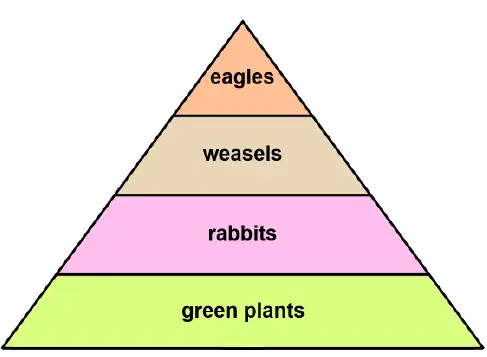
The ecological pyramid below shows the organisms found in each trophic level of a simplified ecosystem.
The amount of energy at each trophic level in an ecosystem decreases as it moves through the ecosystem. Typically, only about 10 percent of the energy at one trophic level is transferred to the next level.
In the ecosystem modeled, 100,000 kcal of energy are contained within green plants, determine the amounts of energy available to the weasels.
a)
100,000
b)
10,000
c)
1,000
d)
10
5.
Which of the following resources can be in limited supply in an ecosystem? (choose all that apply)
a)
food
b)
sunlight
c)
water
d)
oxygen
e)
shelter
6.
Almost no species ever reaches its biotic potential—the population size that the species could produce if all individuals survived and produced offspring. Anything that prevents the species from reaching its biotic potential is called a ...
a)
symbiote.
b)
producer
c)
capacity limiter
d)
limiting factor
7.
Which of the following statements is true of all organisms in every environment?
a)
They are able to produce their own food.
b)
They avoid interaction as much as possible.
c)
They must consume other organisms for energy.
d)
They must compete for essential resources.
8.
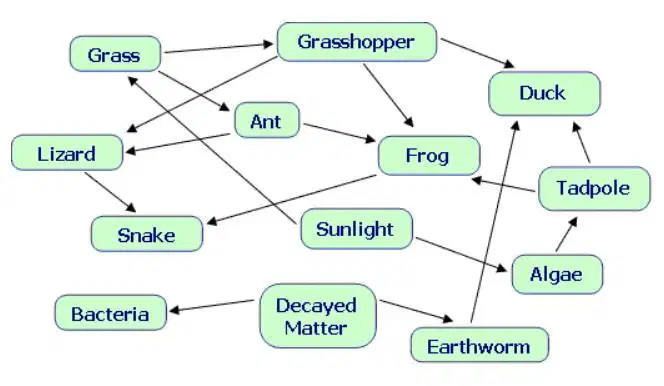
Which organism(s) in the food web below gets energy by eating other organisms? (Choose all that apply
a)
Lizard
b)
ant
c)
snake
d)
bacteria
e)
frog
9.
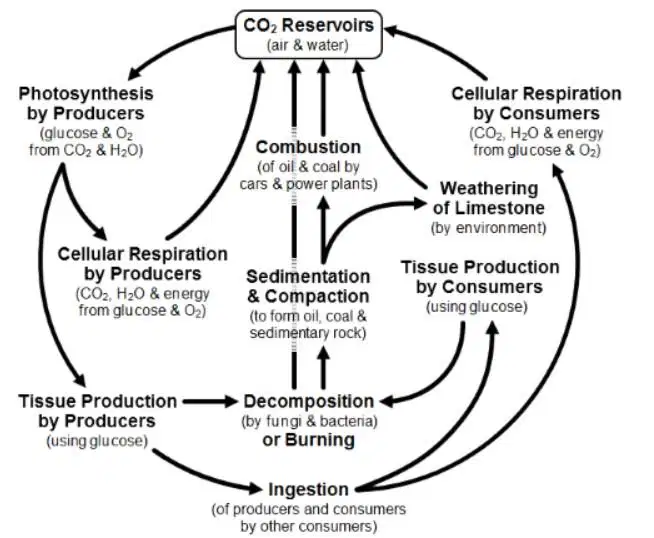
Based on the information in the diagram, which of the following processes removes carbon dioxide from the air or water? (Choose all that apply)
a)
weathering of limestone
b)
decomposition of plants and animals
c)
photosynthesis
d)
combustion of coal and oil
10.
Stable ecosystems can be altered, either rapidly or slowly, through which of the following events? (Choose all that apply)
a)
human activities
b)
natural disasters
c)
climate change
11.
A food chain is a model that represents how energy and matter are transferred through an ecosystem.
Typically, a food chain has five or fewer links because...
a)
humans are the top predators and are always the fifth link.
b)
no organism exists that eats more than five types of food.
c)
the amount of energy available decreases with the addition of each link.
d)
there are only three categories of organism—producers, consumers, and decomposers.
12.
What organism (ultimately) is at the END of every food chain?
a)
sunlight
b)
plants
c)
carnivores
d)
decomposers
13.
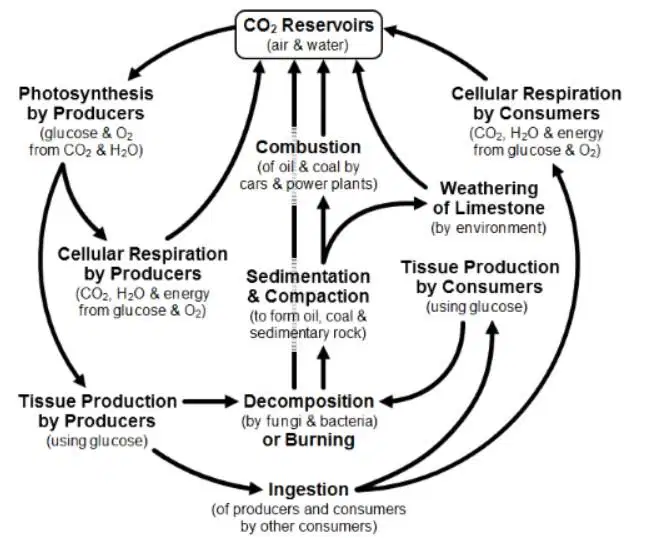
Based on the information in the diagram, which of the following processes returns carbon dioxide to the air or water? (Choose all that apply)
a)
cellular respiration
b)
decomposition of plants and animals
c)
combustion of coal and oil
d)
photosynthesis
14.
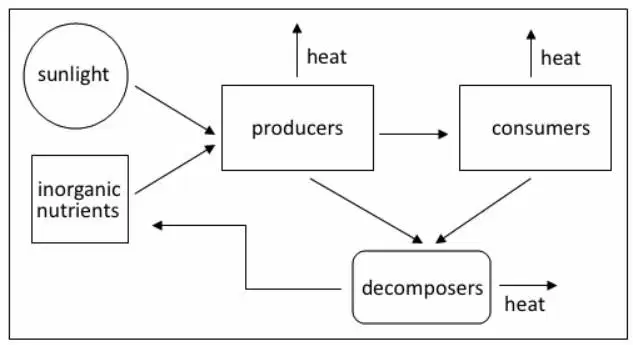
According to the diagram, only a percentage of the energy at one trophic level is transferred to the next trophic level. What happens to the remainder of the energy?
a)
Some of it is lost to the atmosphere as heat.
b)
It is all consumed by decomposers.
c)
It is all consumed by organisms within the trophic levels.
d)
Some of it is recycled back to the Sun.
15.
Lichens make good pioneer species because they secrete acid that breaks down rock.
a)
True
b)
False
16.
The statement "the cowbird can tolerate a wide range of temperatures" characterizes the birds habitat.
a)
True
b)
False
17.
Primary succession is the most rapid form of succession because soil is already present.
a)
True
b)
False
18.
Some birds are known as honey-guides because humans follow them to beehives. When the humans take the honey, the birds eat the bees. What term below best describes this type of relationship?
a)
Mutualism
b)
Commensalism
c)
parasitism
d)
symbiosis
19.
Organisms with overlapping niches probably have which type of relationship?
a)
Mutualism
b)
Commensalism
c)
Parasitism
d)
Competitive
20.

What is the distinction between a range of tolerance and a limiting factor?
a)
Limiting factors are biotic or abioitc things that limit growth, range of tolerance defines the limiting factors in which an organism can survive.
b)
The Range of tolerances are biotic or abioitc things that limit growth, limiting factors defines the factors in which an organism can survive.
c)
They define the same idea
d)
Both refer to the growth of species populations, limiting factors are only biotic factors, range of tolerance defines abiotic factors
100 %

