wayground logo

Free Printable Worksheets

Font size

S
M
L
XL
Worksheets

SCIENCE 7 - 3rd Quarter Exam

Total questions: 59

Worksheet time: 30mins

Name
Class
Date
1.
1. A car travels along a straight line from point A to point B. Which of the following is a scalar quantity that describes the car's motion?
a)
displacement
b)
velocity
c)
acceleration
d)
distance
2.
2. A ball is thrown vertically upwards. Which of the following is a vector quantity that describes the ball's motion?
a)

speed

b)

acceleration

c)

time

d)

displacement

3.
3. A particle moves in a circular path. Which of the following is a scalar quantity that describes the particle's motion?
a)
Velocity
b)
Acceleration
c)
Speed
d)
Displacement
4.
4. An object moves with a constant velocity. Which of the following is true?
a)
The object is speeding up.
b)
The object is slowing down.
c)
The object moves fast.
d)
The object moves slow.
e)
The object does not move at all.
5.
5. During Typhoon Yolanda, the wind was blowing at a speed of 315 km/h. Which of the following is a vector quantity that describes the typhoon?
a)
Temperature
b)
Speed
c)
Velocity
d)
Momentum
6.
6. A car is moving east at an average speed of 60 km/h. Which of the following describes the velocity of the car?
a)
60 km/h East
b)
60 km/h
c)
60
d)
East
7.
7. Why is motion relative?
a)
Because the direction of motion is always changing.
b)
Because motion is always measured with respect to a reference point.
c)
Because the magnitude of motion varies depending on the reference point.
d)
Because motion is always measured in two or three dimensions.
8.
8. Mark traveled the shortest possible path within 9 minutes. However, Tram took a longer path but reached the destination in only 5 minutes. What can be concluded from this?
a)
The distance Mark took to the destination is equal to the displacement.
b)
Mark and Tram covered the same distance but had different displacements.
c)
Mark and Tram had the same distance and displacement.
d)
It is impossible to determine the distance and displacement without more information.
9.
9. When you are inside a car and a car is moving at a speed of 60 km/h, are you in motion? a. Yes, you are in motion relative to the car. b. No, you are not in motion relative to the car. c. Yes, you are in motion relative to the road. d. No, you are not in motion relative to the road.
a)
b and c
b)
a
c)
c
d)
b
e)
a and c
10.
10. A person walks 4 km north, then turns and walks 6 km south. What is their total distance traveled and what is their displacement?
a)
Total distance is 2 km, displacement is 10 km south
b)
Total distance is 10 km, displacement is 2 km south
c)
Total distance is 6 km, displacement is 4 km south
d)
Total distance is 10 km, displacement is 10 km south
11.

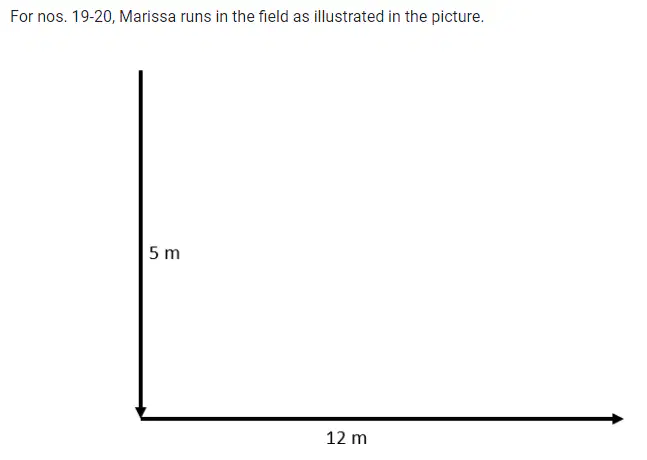
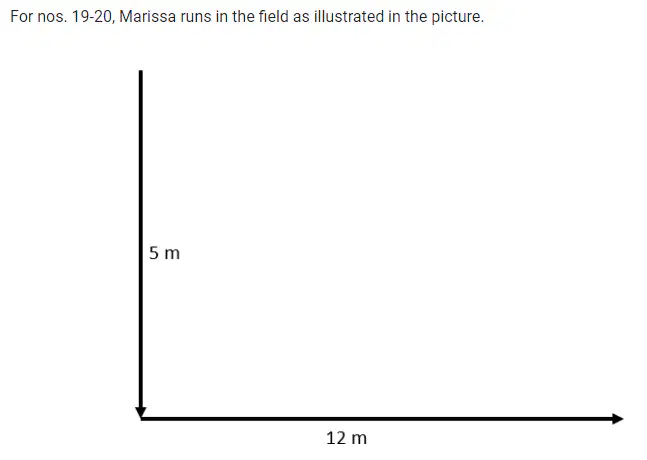
11. Distance

(a)  

12.

12. Displacement

(a)  

13.

13. Distance

(a)  

14.

14. Displacement

(a)  

15.

15. Distance

(a)  

16.

16. Displacement

(a)  

17.

17. Distance

(a)  

18.

18. Displacement

(a)  

19.

19. Distance

(a)  

20.

20. Displacement

(a)  

21.
21. What is the relationship between force, mass, and acceleration according to Newton's Second Law of Motion?
a)
m = Fa
b)
F = ma
c)
a = F/m
d)
a = mF
22.
22. According to Newton's First Law of Motion, what happens to a moving object when the net force acting on it is zero?
a)
The object remains at rest.
b)
The object continues moving with constant velocity.
c)
The object accelerates.
d)
The object decelerates.
23.
23. According to Newton's Third Law of Motion, how are the magnitudes of the action and reaction forces related?
a)
The magnitudes of the action and reaction forces are equal.
b)
The magnitude of the action force is greater than the magnitude of the reaction force.
c)
The magnitude of the reaction force is greater than the magnitude of the action force.
d)
The magnitudes of the action and reaction forces are not related.
24.
24. A car is moving at a constant speed on a straight road. When the driver suddenly applies the brakes, the car slows down. Which Newtonian law is best described?
a)
First Law
b)
Second Law
c)
Third Law
25.
25. A person is pushing a heavy box along a rough surface. According to Newton's Second Law of Motion, what happens to the acceleration of the box if the person increases the force they are applying?
a)
The acceleration of the box decreases.
b)
The acceleration of the box increases.
c)
The acceleration of the box remains the same.
d)
The box begins to move in the opposite direction.
26.
26. What is the standard unit of speed?
a)
Dyne
b)
m/s
c)
km/h
d)
km/s
27.

27. A cyclist rides a distance of 25 km in 1 hour and 30 minutes. What is his average speed?

(a)  

28.

28. A train covers a distance of 600 km in 8 hours. What is its average speed?

(a)  

29.

29. A car travels a distance of 6000 km with an average speed of 60 km/h. How long did it take to complete the journey?

(a)  

30.

30. A car travels a distance of 240 km in 3 hours. What is its speed?

(a)  

31.
31. A cyclist travels a distance of 20 km in 1 hour. What is his average speed in m/s?
a)
5 m/s
b)
20 m/s
c)
5.6 m/s
d)
0.1 m/s
32.

32. Suppose Cagayan is to the north of Isabela. A truck travels from Cagayan to Isabela with an average speed of 60 km/h in the first hour while for its second hour it traveled an average speed of 80 km/h. What is its average velocity?

(a)  
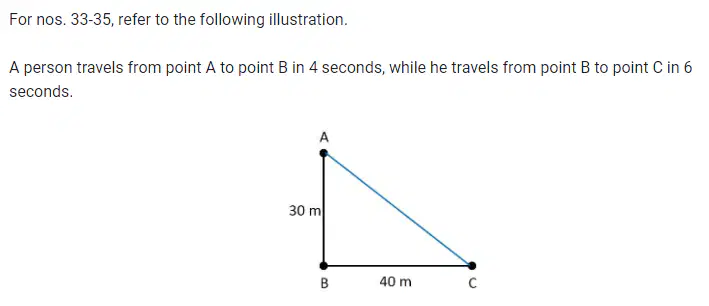
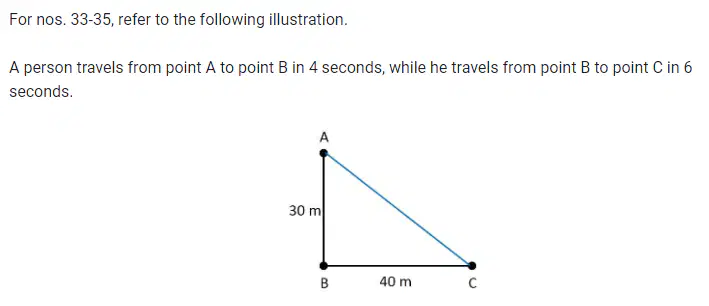
33.

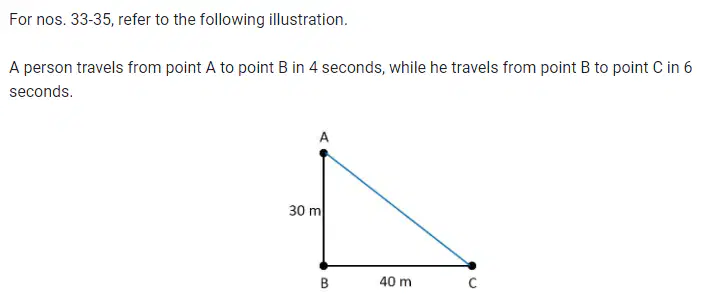
33. Find the average speed.

(a)  

34.

34. Find the average velocity.

(a)  

35.

35. Find the instantaneous speed at t = 4 s.

(a)  
36.
36. A cyclist starts from rest and reaches a velocity of 10 m/s in 5 seconds. What is the cyclist's acceleration?
a)
0.5 m/s^2
b)
1 m/s^2
c)
2 m/s^2
d)
5 m/s^2
37.
37. A train is traveling at a velocity of 20 m/s. It comes to a stop in 40 seconds. What is the train's acceleration?
a)
-0.5 m/s^2
b)
-0.25 m/s^2
c)
0 m/s^2
d)
0.5 m/s^2
38.
38. What is Earth's acceleration due to gravity?
a)
0.5 m/s^2
b)
3.14 m/s^2
c)
11 m/s^2
d)
9.8 m/s^2
39.
39. An object moves with a constant acceleration of 2 m/s^2. If it starts from rest, how much time will it take for the object to reach a velocity of 10 m/s?
a)
2.5 seconds
b)
5 seconds
c)
10 seconds
d)
20 seconds
40.
40. A rocket accelerates from rest at a rate of 20 m/s^2 for 10 seconds. What is its final velocity?
a)
200 m/s
b)
300 m/s
c)
400 m/s
d)
500 m/s
41.

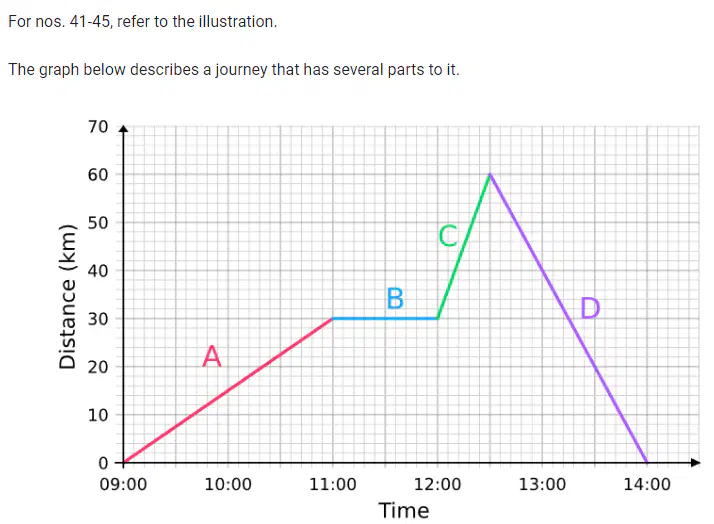
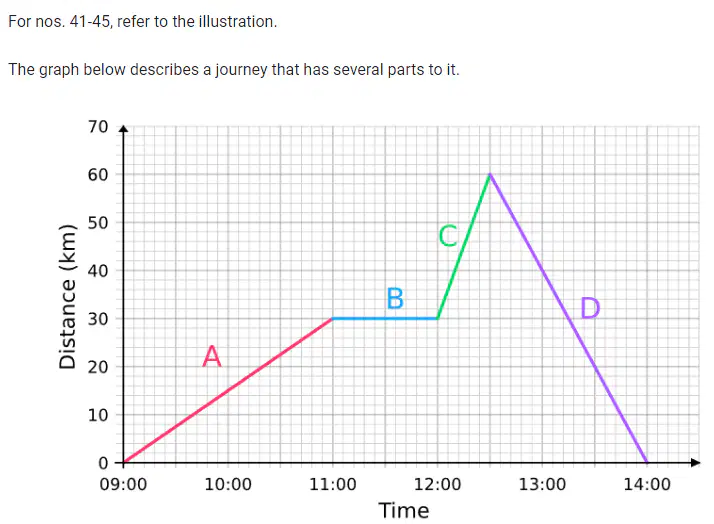
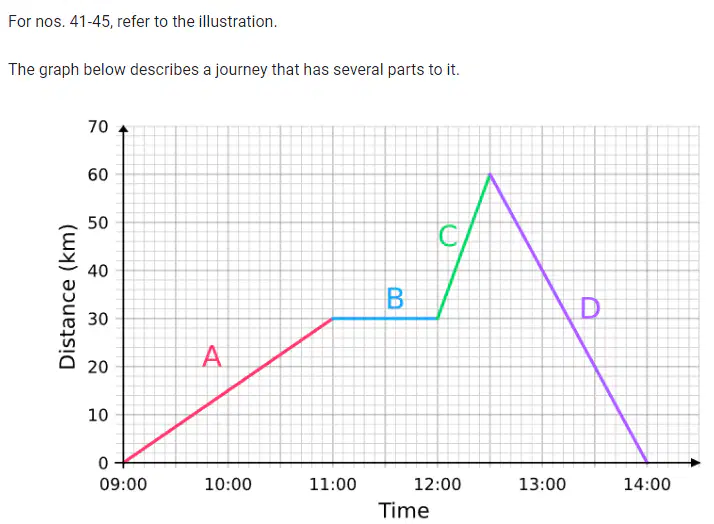
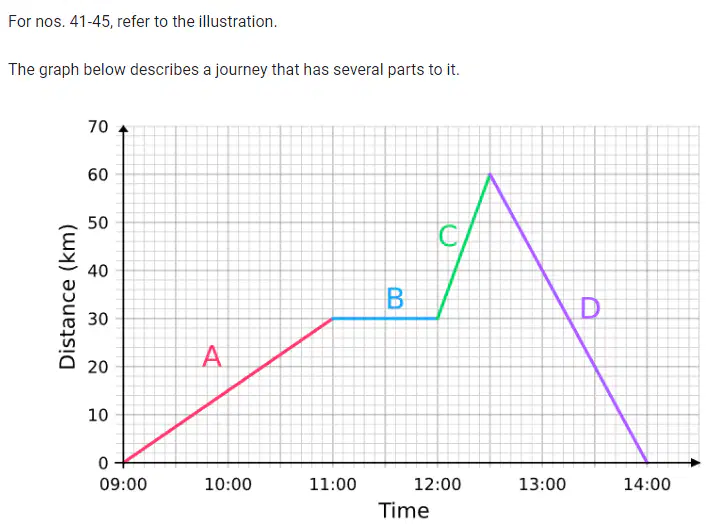
41. Calculate average speed of D.

(a)  
42.
42. At which part of the graph did the person moved fastest?
a)

A

b)

B

c)

C

d)

D

43.
43. Describe acceleration of the person at part C.
a)

Accelerating

b)

Decelerating

c)

No acceleration

44.
44. Describe the speed of the person at part B.
a)

at constant non-zero speed

b)

at rest

c)

speed is increasing

d)

speed is decreasing

45.

45. Suppose that at 11:00, the person has reached the average speed of part A. Assuming that the person is at rest at 9:00 and is uniformly accelerating until 11:00, calculate acceleration of part A.

(a)  
46.
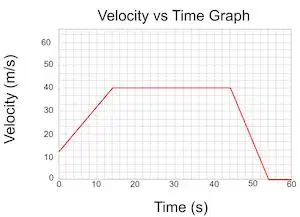
46. At t = 50 s, the object is _____.
a)
accelerating
b)
decelerating
c)
at constant velocity
d)
at rest
47.

47. Sound propagates in these three mediums. List down the three of them. Example: oxygen, carbon, nitrogen

(a)  

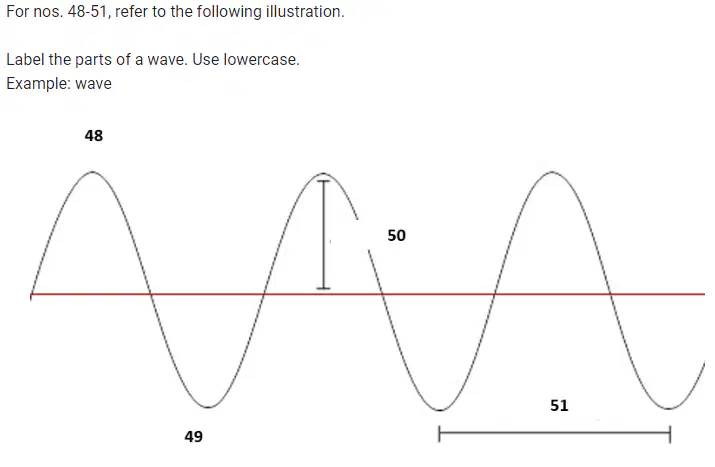
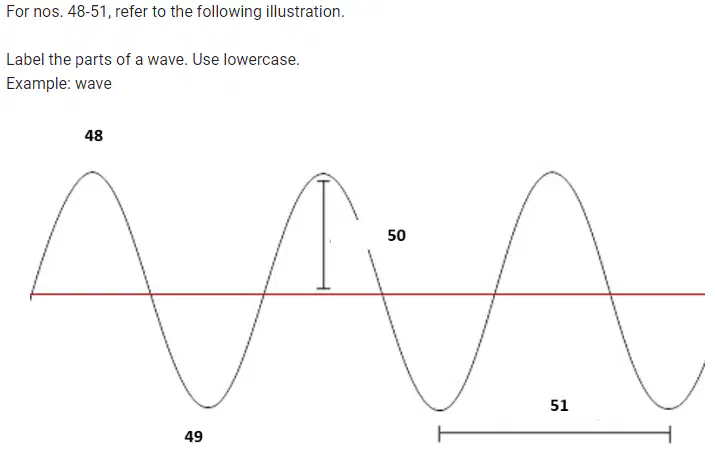
48.

48.

(a)  

49.

49.

(a)  

50.

50.

(a)  

51.

51.

(a)  

52.
52. Light can travel through vacuum environment. Therefore, its energy waves are considered _______.
a)
mechanical
b)
electromagnetic
53.
53. The P-waves of an earthquake are considered ______________ waves.
a)
longitudinal
b)
transverse
c)
surface
54.
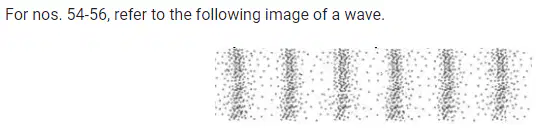
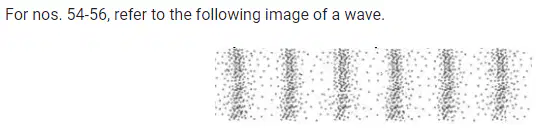
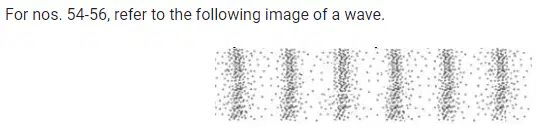
54. Identify the type of wave.
a)

electromagnetic

b)

surface

c)

transverse

d)

longitudinal

55.
55. Areas with concentrated particles (blackened particles) are considered ____________.
a)

wavelength

b)

compression

c)

rarefaction

d)

amplitude

56.
56. On the other hand, areas with less concentration of particles (gaps between the areas of concentration) are considered ____________.
a)

wavelength

b)

compression

c)

rarefaction

d)

amplitude

57.
57. Matter that waves are traveling through is called a ___________.
a)
medium
b)
electromagnetism
c)
wavelength
d)
energy
58.
58. Frequency — number of waves passing by a specific point per second. TRUE or FALSE?
a)
True
b)
False
59.
59. What is amplitude?
a)
The distance from the highest point of a wave to the lowest point
b)
The number of waves that pass a certain point in one second
c)
The time it takes for a wave to complete one cycle
d)
The height of a wave's crest from its resting position