
 Worksheets
Evolution of programming languages
Total questions: 57
Worksheet time: 29mins
Translator which is used to convert codes of assembly language into machine language is known as?
Attempter
Assembler
Debugger
Compiler
The low level language that uses machine code is called?
Assembly language
Machine language
Pascal
C + +
How many classes of programming languages exist?
4
3
2
5
How many generation of programming languages are there?
2
3
4
5
A set of instructions that tell a computer how to perform a specific task is a...
Computer Program
Algorithm
Machine Code
Binary Code
Which of the following is not a high level programming language?
Assembly
C++
Java
Python
Which of the following is not an advantage of using a low level language?
Makes more efficient use of primary memory.
Tailor a program to a specific piece of hardware.
To perform a task very quickly.
To enable the program to be run on multiple platforms.
What is the name for the software used to convert high level language into machine code?
Assembler
Interpreter
Compiler
Translator

What does binary code mean?
a coding system using the binary digits 0 and 1.
a coding system using the binary digits 1-10
1000100100
code.org
Java, Python, PHP, and C++ are examples of
low level languages
medium level languages
Graphic arts languages
high level languages
Which of the following best defines the term programming?
Creating a calendar of events.
Writing instructions for a digital tool
A list of activities like clubs and special events at a school.
Putting the solution to a problem into a language that a computer can understand.
Which of the following lists the evolution of programming languages in the correct order?
Procedural, non-procedural, object oriented, machine, assembler
machine, assembler, procedural, non-procedural, object oriented
machine, procedural, assembler, non-procedural, object oriented
machine, assembler, object oriented, procedural, non-procedural
Which generation of computer languages used the LOAD, ADD and STORE codes?
First
Second
Third
Fourth
A program that can execute high-level language programs.
Compiler
Interpreter
Sensor
Circuitry
Natural Languages are machine dependent.
True
False
Which of the following is not a programming language ?
Pascal
Microsoft Office
Java
C++
COBOL is an example of?
4GL
3GL
5GL
2GL
A name given to computer programs that tell (instruct) the hardware how to work.
Program
Command
User response
Software
Which programming languages are classified as high level languages?
BASIC, COBOL
Fortran, Machine code
C, ADD
Assembly languages
COBOL is an acronym for…………
Common Business Oriented Language
Computer Business Oriented Language
Common Business Operated Language
Common Business Organized Language
Which level of a programming language is Machine Code?
Low
High
Which level of a programming language is Assembly Code?
Low
High
Which level would create the fastest code to execute?
Low
Assembly
High
Which level would create the easiest code for humans to understand?
Low
Assembly
High
Python is an example of a High Level programming language
True
False

Which generation?
Machine Code - Low
Assembly Code - Low
High Level
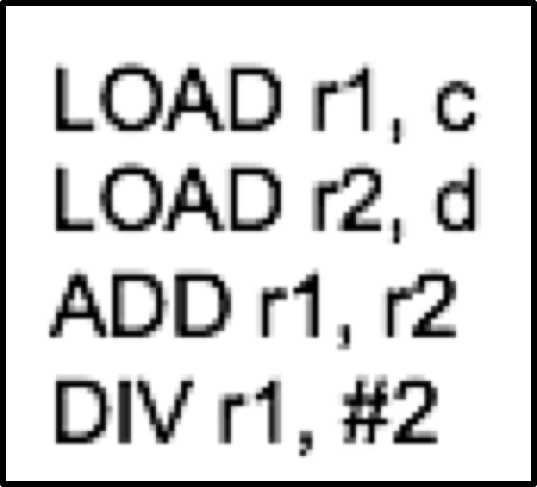
Which generation?
Machine Code - Low
Assembly Code - Low
High Level

Which generation?
Machine Code - Low
Assembly Code - Low
High Level
Binary is the only language a computer can understand
True
False
Computers must translate everything into binary
True
False
High Level Code is easier for humans to understand as it is written in English
True
False

What type of languages are shown in the picture.
High level language
Low level language
The only Language understood by a computer.
Machine Language
Assembly Language
High-level Language
Fourth-Generation Language
(a) are the rules governing the formation of statements in a Programming language.

What does the above code depicts?
Binary code
Mnemonic code

1. Who of the following is known as father of modern day computers?
Charles Babbage
Blaise Pascal
Jon Von Neumann
Jon Von Pascal

2. Which of the following is full form of ENIAC?
Electrical Number Integrator and Convertor
Electrical Numerical Integrator and Calculator
Electrical Numerical Inverter and Calculator
Electrical Number Integrator and Calculator

3. Which of the following are bulky, slow and suffered with heat and maintenance problems?
Transistors
Radios
Vacuum tubes
Integrated Circuits

4. Third generation computers used which of the following technologies?
Transistors
Very Large Integrated Circuits
Vacuum tubes
Integrated Circuits

5. Which of the following computers are costly and can process billions of instructions per second?
Supercomputers
Laptop Computers
Hybrid Computers
All of the above

7. Java, C and COBOL are examples of which of the levels of languages?
Assembly
Higher level
Machine level
User level

8. Which of the following generations of programming languages reduce programming effort by just specifying “what to do” instead of “how to do”?
First
Second
Third
Fourth

9. Which of the following language generation use artificial intelligence techniques for problem solving and meeting their goal?
Second
Third
Fourth
Fifth

10. Operating system is an example of which of the following type of software.
Application
System
Business
User created

14. What do you call a computer that uses linear combinations of voltage amplitude (or currents or frequencies or phases) instead of digits?
a. Digital
b. Analog
c. Hybrid
d. All of the above

13. What do you call a computer that operates on binary digits 0 and 1?
a. Digital
b. Analog
c. Hybrid
d. All of the above

