
 Worksheets
GP12
Total questions: 50
Worksheet time: 1hrs 5mins
Which of the following types of charging would create an opposite charge, without contact, and is considered temporary since electrons do not transfer between objects?
Induction
Friction
Conduction
Grounding
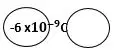
Two similar metal spheres are side by side. One has a charge of -6 x 10⁻⁹ C and the other is neutral. After contact and separation, what is the charge on the sphere that was initially neutral?
-6 x 10⁻⁹
-3 x 10⁻⁹
+6 x 10⁻⁹
+3 x 10⁻⁹
You use a positively charged PVC pipe to charge an initially neutral metal sphere by conduction. During conduction the sphere becomes __________.
negative
positive
neutral
zero
Two like charges (+) and (+) will _________.
attract
repel
attract and repel
either attract or repel
Which is NOT true about electrostatic interactions?
like charges repel
unlike charges attract
any charged object repel on a neutral object
any charged object can attract a neutral object
What is the unit of electric charge?
Ohms
Coulomb
Newton
N/ m2
The following are materials that does not allow current to pass through, EXCEPT:
cloth
steel
glass
rubber
Charging of objects could happen through
i. friction ii. induction iii. Conduction
i and ii only
ii and iii only
i and iii only
i, ii, iii
Which type of circuit use branches to allow current to pass through more than one path?
series
parallel
open
closed
Who developed the Kirchhoff’s Rule?
Guztav Kirchhoff
Justav Kirchhoff
Gustav Kirchhoff
Juztav Kirchhoff
When you bring a neutrally charged body A near a strongly negative body B, its positive charges will be drawn near B and the negative charges will be pushed to the other side. This resulting condition polarizes the body and forms a ________.
bipole
flux
dipole
field
In using electric field lines, positive charges are drawn ______.
outward
inmost
inward
inside
Which is the energy transferred to or from an object via the application of force along a displacement?
Potential Energy
Gravitational Energy
Mechanical Energy
Work
What is the electric potential from a source charge of 5 nC if a test charge will be placed 10cm from it?
Formula: V = rk∣Q∣
449.5 V
4.50 V
4495 V
44.95V
A point charge has a charge of 8 µC. At what distance from the point charge is the electrical potential 6 V?
Formula: r = Vk∣Q∣
11.99m
11986.67 m
1.20 x 10¹⁶ m
1.20x 10¹⁹
Which electric component impedes the continuous passage of electric current and stores it until it is discharged at a latter time?
diode
transistor
capacitor
resistor
Which type of capacitor where its capacitance varies directly with its length?
parallel plate
cylindrical
spherical
triangular
Which circuit have gap(s) where current cannot flow thus, electric current cannot be delivered to the load where it is needed?
open circuit
closed circuit
electric circuit
electric current
What is the capacitance if the value of charge stored is 1.5 nC and the voltage supplied is 3 V?
Formula: C = VQ
0.5 F
2 F
2 x 10⁹ F
500 x 10−12 F
Which type of capacitor where its capacitance varies directly with its overall radius?
parallel plate
cylindrical
spherical
triangular
Which diagrams used to make it easy to draw circuits?
Fish bone
Schematic
Concept
Structure
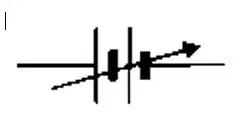
What electrical component is shown in the picture?
Power Pack
Single Cell
Battery
Switch-Open
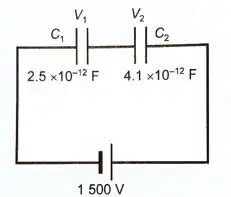
What is the total capacitance (Ctotal)?
1.55nF
1.55pF
1.55µF
1.55mF
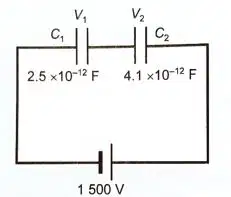
What is the total voltage?
500 V
1000 V
1500 V
750 V
If the total capacitance is 2pF and the total voltage is 200V, what is the total charge?
Formula: Q = CV
400nC
400µC
400mC
400pC
The following are the factors that affect the resistance of a conductor, EXCEPT:
The resistivity of the material
The total length of the conductor
The cross-sectional area of the inductor
The temperature of the conductor
Calculate the time needed to produce a charge of 100 C and 20A.
Formula: t = IQ
5 mins
5 hrs
5 seconds
5
Which are units of Current (I)?
i. Ampere (A) ii. Coulomb per second (C/s) iii. Ohm-meter
i and ii
i and iii
i only
i, ii, iii
Which is an intrinsic property of material that describes how it resists the electric current flowing through it?
electrical resistivity
electrical conductivity
electrical capacitance
electrical current
What is the unit of Electromotive Force (EMF)?
Newton
Volts
S/m
Ω-m
Which Kirchhoff’s rule is expressed as the sum of current which is equal to zero?
Junction Rule
Point Rule
Loop Rule
Both A and B
Which Kirchhoff’s rule states that as a charge goes around the loop and returns to its starting point, the sum of the changes of its potential energy is equal to zero?
Point Rule
Loop Rule
Junction Rule
Kirchhoff’s 1st Law
A conductor has an area of 5mm2. How many meters of this material are needed to yield a resistance of 1Ω? The resistivity of the conductor is 2.65 x 10⁻⁸ Ω-m.
Formula: L = ρRA
188679.25 m
1886792.45 m
18867924.53 m
188679245.28 m
A 20meter length of cable has a cross-sectional area of and a resistance of 50 m2 and a resistance of 5ohms. Calculate the conductivity of the cable.
Formula: σ = RAL
0.0016 S/m
0.08 S/m
0.5 S/m
2 S/m
Which is the “push” given to the electric charges for them to flow from the source to the components of the circuit?
Potential Energy
Gravitational Force
Electromotive Force
Kinetic Energy
Which electric component limits the flow of current passing through the circuit?
diode
transistor
capacitor
resistor
In equation form, Ohm’s Law is stated as?
V = RI
V = RI
V = IR
V = QI
Which device is used to measures electrical resistance?
Voltmeter
Ammeter
electric meter
Ohmmeter
Who found lodestones that can attract pieces of iron?
Ancient Greeks
Native Americans
Romans
Persians
How does magnetic poles interact with one another?
Like poles and unlike poles repel each other
Like poles repel and unlike ones attract each other
Like poles and unlike poles attract each other
Like poles attract each other and unlike ones repel
Magnets can be demagnetized by the following, EXCEPT:
pounding
exposed to alternating current
burning
breaking into smaller pieces
If you cut a magnet into pieces:
each piece will have a north pole and a south pole
some pieces will have a north pole only
some pieces will have a south pole only
some pieces will have two north poles
A point charge Q1 = 1 nC is at origin. How far should the second point charge of 10 nC be placed to have electric potential energy of 2 J?
Formula: r = Uk∣Q1Q2∣
4.50 x 10⁻²⁰ m
4.50 x 10⁻⁸ m
4.50 x 10⁻²⁸ m
4.50 x 10⁻² m
What is the electrostatic force of attraction between a -20 x 10−6 C charge and a 30 x 10−6 C charge if they are separated by a distance of 5 meters?
Formula: F = r2k∣Q1Q2∣
-0.21N
21.576 x 10⁻²⁰ N
0.21N
-21.576 x 10⁻²⁰ N
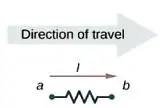
Based on the figure, the assumed direction of loop is the same with the direction of current, what would be its voltage or potential?
positive potential
negative potential
either positive or negative
neither positive nor negative
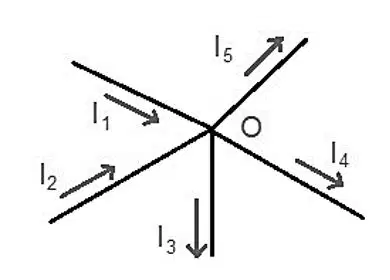
I1 = 3mA, I2 = -5mA, I4 = 6mA, I5 = -2mA, what is the value of I3?
-6mA
6mA
2mA
-2mA
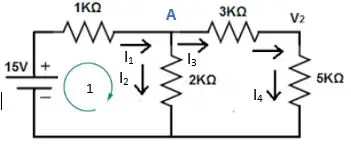
Using Kirchhoff’s Current Law, what is the total current in the circuit at point A?
I1 + I2 = I3 + I4
I1 + I2 + I3 + I4
I1 - I2 + I3 + I4 = 0
I1 = I2 + I3 + I4
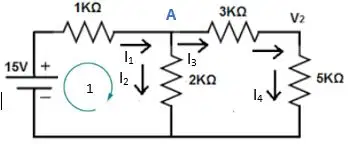
Using Kirchhoff’s Voltage Law, what is the equation to compute for the value of current, I at loop 1?
15V – 1KΩI1 - 2KΩ I2 = 0
15V + 1KΩI1 + 2KΩ I2 = 0
-15V – 1KΩI1 - 2KΩ I2 = 0
-15V + 1KΩI1 + 2KΩ I2 = 0
What is the electric flux of E = 1000N/C where A = 20 m2 and Ɵ = 30⁰?
Formula: ϕ = EAcosθ
346410.16 Nm2/C
17320.51 Nm2/C
1732.05 Nm2/C
34641.16 Nm2/C
Where will you expose a demagnetized magnet so that it can be magnetized again?
another magnet with a strong magnetic field
cold place
alternating current
heat

