
 Worksheets
Science Review 1
Total questions: 27
Worksheet time: 15mins
Which of the following is a destructive force?
The wind creating a rock face
A glacier melting into a lake
An earthquake shaking the ground
A river cutting a valley into rock
A glacier moving through a mountain and carving out a valley is...
Erosion
Deposition
Weathering
A sandstorm creating sand dunes on the beach is...
Erosion
Deposition
Weathering
Cooled lava creating an island is...
Erosion
Deposition
Weathering
Strong waves turning rocks into pebbles is...
Erosion
Deposition
Weathering
Which of the following phenomena is a typical example of weathering?
Volcanos erupt spewing lava
Wind carries sand particles.
Ice breaks large rocks into smaller rocks
Plants grow in the cracks of rocks
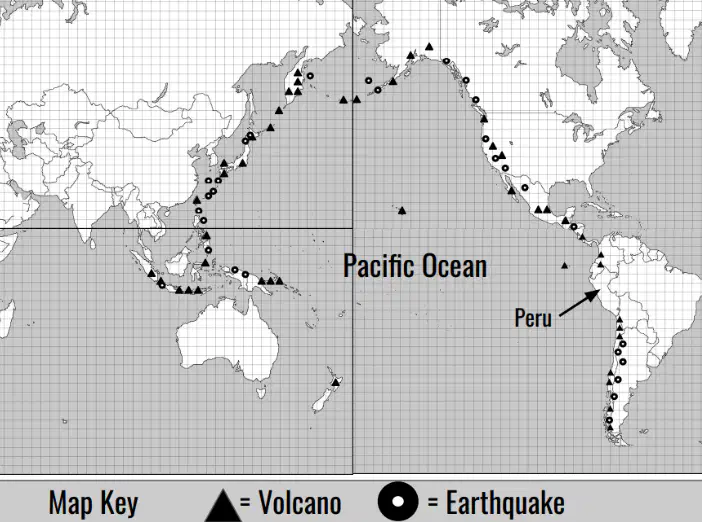
Isabella lives in Peru. Based on the map, which of the following is likely to occur where Isabella lives?
A volcanic eruption
An earthquake
Both a volcanic eruption and an earthquake
A tornado
Which of the following tools best helps scientists measure statistics about an earthquake?
Seismograph
Weather satellite
Compass
Telescope
Which of the following is a diagram of convergent plates?


Which of the following is a diagram of divergent plates?
Which of the following natural disasters has the ability to create new land?
Earthquakes
Tornados
Floods
Volcanos
Deposition of new sediment could change the depth of...
A lake
A parking lot
A home
A forest
Which force is responsible for creating the Grand Canyon?
Earthquake
Erosion
Tornado
Volcano
What type of energy causes earthquakes to occur?
Energy released when tectonic plates move
Energy from a hurricane or tornado
Energy that builds up inside a volcanic mountain
Energy being released when erosion occurs
Which of the following can help prevent erosion?
Adding rocks
Building walls
Increasing water flow
Planting plants (especially grass)
Which of the following explains why rocks in a river may be rounded and smooth?
The rocks have been exposed to extreme temperatures.
Strong winds have changed the shape of the rocks.
The river has weathered the rocks over time.
The rocks have been exposed to chemical reactions.
Which of the following has the capability to fill up a balloon?
A liquid
A solid
A vacuum
A gas
Which of the following are liquids?
Rocks and wood
Milk and gasoline
Apples and oranges
Clouds and fog
Which of the following are solids?
Clouds and trees
Cars and coffee
Water and steam
Rocks and shoes
Which of the following are gases?
Oxygen and sand
Helium and oxygen
Wood and stone
Copper and iron
Which of the following is a chemical reaction?
Cutting up a piece of tape
Burning a piece of paper
Melting an ice cube
Freezing a puddle of water
Laila uses an acid to make some dirty coins look shiny and new. After the chemical change, the coins will probably...
Be a different color
Have a different color
Weigh more than before
Weigh less than before
Which of the following is a physical change?
A car's bumper getting rusty
Baking a pie
Fruit rotting
Tearing wrapping paper
Evaporation happens when the sun ___________ water and turns it into water vapor.
Melts
Takes away
Heats up
Freezes
When two room-temperature liquids are mixed together and they become hot, what is happening?
A physical change
A chemical reaction
Evaporation
The molecules are rearranging
Which of the following occurs when heat is added?
Water boils
Ice freezes
Water vapor condenses
Water melts
Georgia Milestones for Science will probably be...
Easy, regardless of how hard I try.
Impossible, no matter how much effort I give.
Challenging, and ultimately I will fail.
Difficult, but possible for a hard worker like me!

