
 Worksheets
Hoa la canh
Total questions: 31
Worksheet time: 1hrs 2mins
How many basic principles are mentioned with regards to a project management?
1
2
3
4
The proposal can act as a checklist of expected outcomes that can be a __________ guide a funded project.
Complete
Basic
Detailed
A project director is the only person who is in charge of writing and submitting progress reports.
True
False
The project will have effects in more areas than you initially anticipated.
True
False
What does “Unique” means in “Project management” mean?
Projects involve implementing something that has not been done before
Projects related to something that already planned
Projects are something related to no special or distinctive feature
Projects are the work of duplicating something that already been done.
We should employ both learning strategy and coping strategy when your project encounters challenges
True
False
Taking part in workshops, seminars, and other educational events to learn about others' technical and practical experience. What is type of learning strategy?
Collaborative learning strategy
informal learning strategy
Incidental learning strategy
formal learning strategy
Team members combine their individual and collective experience to generate a unique insight that cannot be produced by a single team member working alone. What is type of learning strategy?
Collaborative learning strategy
informal learning strategy
Incidental learning strategy
formal learning strategy
What are the challenges of hiring staff?
A. Only assessing knowledge qualifications
B. Assessing both mental and experiential qualities
C. Assessing high intelligence and curiosity
D. Assessing technical knowledge
What are the trade-offs when hiring staff for a project?
A. There are no trade-offs
B. Trade-offs only occur when hiring technical positions
C. Trade-offs only occur when hiring support positions
D. Trade-offs occur when balancing knowledge qualifications with generalist qualifications
What is the minimum number of participants required to create an organizational structure for a project?
1
2
3
4
What is a possible characteristic of a flat organizational structure for a project?
Many intermediaries among project staff
A complex approach for idea management
Few intermediaries among project staff
A large number of personnel organized around functions
Which of the following aspects should the project CEO NOT consider when deciding on an organizational approach?
The number of personnel on the project
The availability of technology for data management
The dissemination of findings
The gender of personnel
What is the benefit of revisiting initial structural decisions for a project?
It allows for reflection on past successes and failures
It enables the project to persist over large stretches of time
It helps maximize individual contributions from the start
It eliminates the need for rapid adjustments
Which of the following statements best describes a project as an organizational entity?
Projects are part of a larger organization but do not have a clear structure
Projects are separate from any larger organization and do not need an organizational structure
Projects require a micro-organizational structure that can adapt to change
Projects are static entities that do not need to consider individual contributions
Staff are assigned tasks solely based on their strengths
True
False
What are the resources considered in the development of project budgets?
Time, money, and communication
Time, talent, and communication
Money, talent, and communication
Time, money, and talent
How often is revising the assignment of specific tasks a usual norm for sponsored project management?
Monthly
Every 3 months
Once a year
Every two weeks
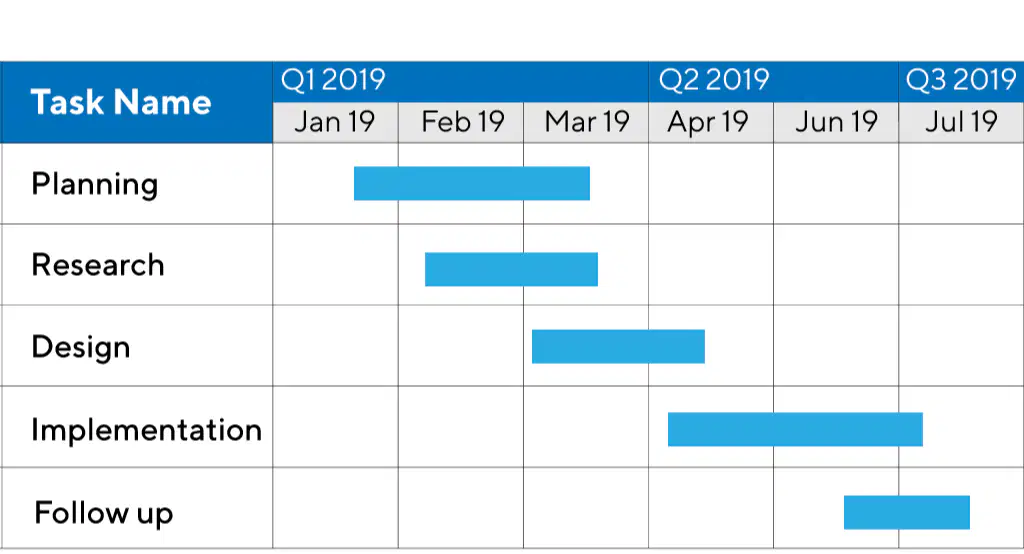
What type of diagram is this?
Pie chart
Dataflow diagram
Bar Chart
Gantt chart
What is a Gantt chart?
A map of how you will complete a project
A table that shows what each task looks like
A timeline that is used as a project management tool to illustrate how the project will run
Why do we need to move staff around for a project?
Decrease in productivity
Reallocation to keep the project progressing overall
Shift in company values
Loss of employees
When should changes be made during a project?
When faced with challenges that require a different approach
At the beginning of the project
At the end of the project
Only when errors have occurred
Should changes be made if initial hunches for a project prove to be successful?
Cannot be determined
Depends on the size of the project
No
Yes
What should we do before making a midcourse correction?
Pick a random corrective measure
Ignore stakeholder involvement
Fully communicate it to major project stakeholders
Execute it secretly without any announcement
What is a program officer's role?
Assess project risks relating to your project
Develop project timelines
Approve project expenses
Offer suggestions on organization, allocation of effort, and experience of other projects
What should be done from the start of a project to keep the program officer informed?
Delay communication until completion
Check in voluntarily on progress
Meet only when faced with problems
Postpone meetings until the next phase
Why is it important for a PI to maintain a healthy and meaningful dialogue with the funder?
To convey major decisions easily and discuss them comfortably
To avoid any communication with the funder
To reduce project efforts
To increase project cost with more resources
What is the purpose of progress reports?
To inform only the PI about the progress
To inform all parties involved about the progress and aid in the successful completion of the initiative.
To inform only the funder about the progress
To inform only the project team about the progress
Who is responsible for understanding all expenditures and commitments made by their organization?
Internal Auditors
CEOs
Accountants
Managers
What can help make managing this responsibility easier?
Increasing the number of commitments made
Ignoring the responsibility completely
A good accountant or internal auditor
Outsourcing the responsibility
What is the purpose of linking overall fiscal and managerial responsibility to timely reports?
To increase expenditures and commitments
To understand limits on time and funding commitment
To avoid fiscal responsibility altogether
To make financial reporting more complicated

