wayground logo

Free Printable Worksheets

Font size

S
M
L
XL
Worksheets

Ultimate Fall Review US HISTORY

Total questions: 117

Worksheet time: 2hrs 2mins

Name
Class
Date
1.
Who fought in the French and Indian War?
a)
French vs. Indians
b)
British vs. French
c)
British vs. French and Indians
d)
Indians vs. British
2.
What were the 2 main reasons for the French and Indian War?
a)
Control of land and trade with Native Americans
b)
Land and Slaves
c)
Gold
d)
Claim to land in Europe
3.
Who was the King of England during this time?
a)
King Ferdinand and Queen Isabella
b)
King Henry VIII
c)
Queen Elizabeth
d)
King George III
4.
Why do you suppose the Indians helped the French?
a)
The French forced them to fight because the Indians were enslaved by them.
b)
The British attacked the Indians first, and the French decided to help the Indians.
c)
The French and Indians cooperated with one another often; traded with one another and taught each other many techniques for survival.
d)
The French were fighting the Indians in the war.... The Indians didn't help the French at all.
5.
As a result of the cost of the war, what did King George III do to the colonists?
a)
Killed them
b)
Removed them from the land in the colonies just like the Indians.
c)
Imposed taxes to pay for the war
d)
Paid for the war out of his own pocket
6.
What slogan did the colonists begin to use in order to express their frustrations with the British government?
a)
"No Taxation!"
b)
"We Need Representation!"
c)
"No Taxation without Representation!"
d)
"We Want Freedom!"
7.
The French and Indian War, unfair taxes in the colonies, along with many other events all led to what eventually?
a)
World War I
b)
American Revolution
c)
World War II
d)
Civil War
8.
What was stated in the Proclamation of 1763?
a)
Colonists were banned from settling west of the Appalachian Mountains.
b)
Colonists were encouraged to begin settling west of the Appalachian Mountains.
c)
The Proclamation ended the French and Indian War. 
d)
The Proclamation proclaimed independence for the American colonists. 
9.
In general, how did the colonists view the Proclamation of 1763?
a)
They felt that it supported their freedom and they supported it.
b)
They felt it was an infringement on their freedom of movement and were angry about it.
c)
They were not involved so it did not affect them.
d)
They supported it because they believed the King had the AUTHORITY to make this law.
10.
Which treaty ended the French and Indian war in 1763? 
a)
Treaty of Versailles
b)
Treaty of Paris 
c)
Treaty of Greenville 
d)
Proclamation Act 
11.
This event made colonists angry with the British.
a)
Civil War
b)
Boston Massacre
c)
Jamestown
d)
the Lost Colony
12.
To protest against taxes, the colonists did what?
a)
Moved West
b)
Boston Massacre
c)
Boston Tea Party
d)
Wrote letters
13.
The Boston Tea Party was when colonists:
a)
had a nice lunch and drank tea
b)
dressed like Indians and threw tea in the harbor
c)
gave tea to their friends
d)
stopped drinking tea
14.
What was the purpose of the Stamp Act?
a)
To raise money for the fair
b)
To raise money for their horses
c)
To raise money for protection of the colonies
d)
To raise money for the football team
15.
What items were taxed under the Stamp Act
a)
Deeds
b)
Wills
c)
Marriage License
d)
All of the above
16.
What was the British view of colonial taxes?
a)
They thought it was unfair because it was at night
b)
They thought it was fair because British citizens had been paying a similar tax for years
c)
To raise money for protection of the colonies
d)
The Stamp Act collected very little money
17.
Who were the Sons of Liberty?
a)
British Government
b)
A group of colonial protesters that united to defend the colonies against the Stamp Act
c)
Stamp Act
d)
All of the above
18.
What was the purpose of the Sons of Liberty?
a)
To house the soldiers
b)
To feed the soldiers
c)
To force the British government to repeal the Stamp Act
d)
All of the above
19.
How did the Sons of Liberty protest the Stamp Act?
a)
Had a picnic
b)
Rode horses into the buildings
c)
Through their iphone
d)
Boycotted British goods, refused to pay the tax, and intimated tax collectors
20.
Where did Americans stockpile ammunition?
a)
Lexington
b)
Concord
c)
Village Green
d)
Boston
21.
What is mercantilism?
a)
A system where a mother countries gains money and power from natural resources that come from its colonies.
b)
where colonies trade gold and silver with each other.
c)
Wars that start over money.
d)
Plantation colonies trading slaves for money.
22.
In this economic system, a mother country gained wealth by...
a)
allowing competition in the marketplace
b)
giving colonist political and religious freedom
c)
carefully controlling trade
d)
participating in the Great Awakening
23.
a)

F

b)

G

c)

H

d)

J

24.

The Bill of Rights are part of what document

a)

Articles of Confederation

b)

Constitution

c)

Declaration of Independence

d)

Mayflower Compact

25.

All of these are principles of the Constitution EXCEPT

a)

Federalism

b)

Republicanism

c)

Checks and Balances

d)

Voting for Everyone

26.

This plans representation wanted to be based on population

a)

Virginia Plan

b)

New Jersey Plan

27.

This plan made small states happy....

a)

Virginia Plan

b)

New Jersey Plan

28.

New Jersey Plan + Virginia Plan =

a)

Great Plan

b)

Great Compromise

c)

American Deal

d)

Making America Great Again

29.

Why did the founding fathers want to make a new government?

a)

The Articles of Confederation state government were too strong

b)

The Articles of Confederation's federal government was too weak

c)

They just liked hanging out and missed each other

d)

Because Democratic Republicans asked for it

30.

according to the constitution, 50 slaves counted as....

a)

50 free people

b)

30 free people

c)

Didn't count at all

d)

Hi, 80 or above!!! YOU LITTLE SMART FISH!

31.

Federalists and Anti-federalists were arguing over

a)

who wrote the best constitution

b)

the ratification of the Constitution

c)

Who had the most savage wig

d)

If they wanted to separate from England

32.

Judicial / Executive / Legislative branches are an example of....

a)

checks and Balances

b)

Separation of Powers

c)

Republicanism

d)

Individual rights

33.

Republicanism means ....

a)

people have the power

b)

People are pirates

c)

people have representatives

d)

people are 70% water (that is true but is not the correct answer for this but you already knew that because you are smart but mostly because im the greatest teacher of all time)

34.

The shared power between the NATIONAL government and the STATE government is known as

a)

Federalism

b)

Checks and Balances

c)

Separation of Powers

d)

Republicanism

35.

"We the people" is best described as what constitutional principle

a)

Federalims

b)

Checks and Balances

c)

Popular Sovereignty

d)

Individual Rights

36.

The first ten Amendments to the Constitution are known as....

a)

Power Amendments

b)

Bill of Rights

c)

Unalienable Rights

d)

Ten Commandments

37.

The number they used to determine how to count slaves for representation and taxation was known as the

a)

1/2 compromise

b)

5/3 compromise

c)

3/5 compromise

d)

Compromise of tu madre!

38.

This says soldiers can't stay at your house

a)

1st Amendment

b)

3rd Amendment

c)

5th Amendment

d)

8th Amendment

39.

Which amendment best describes... The right to worship my cat, Alice.... ALL HAIL THE FUZZY GATA GOD!!!!!

a)

1st Amendment

b)

2nd Amendment

c)

7th Amendment

d)

9th Amendment

40.

When you get arrested for being a ugly dumb fish and once you are in the cuffs they start reading you your rights.... what amendment does this apply to?

a)

4th Amendment

b)

5th Amendment

c)

8th Amendment

d)

10th Amendment

41.

The constitutional principle of Federalism is best described by which Constitutional Amendment

a)

1st

b)

4th

c)

10th

d)

7th

42.

George Mason refused to ratify the Constitution unless this was added....

a)

Bill of Rights

b)

Checks and Balances

c)

More Federal Power

43.

Federalists wanted....

a)

to approve the Constitution and make the Federal government stronger

b)

to not approve the Constitution, they didn't want a strong Federal Government

c)

To make the state government more powerful than the Central Government

44.

Anti-Federalists didn't want to ratify the Constitution because

a)

they didn't want a weak federal government

b)

they wanted more power to be taken from the people

c)

they feared another tyrannical leader

d)

didn't want a Bill of Rights

45.
What doubled the size of the US?
a)
Mexico
b)
Canada Purchase
c)
Louisiana Purchase
d)
California Purchase
46.
Who sold the Louisiana territory to the US?
a)
Spain
b)
France
c)
Britian
d)
Portugal
47.
Who was the US President during the War of 1812?
a)
Thomas Jefferson
b)
James Madison
c)
John Adams
d)
George Washington
48.
The treaty that ended the War of 1812 was the
a)
Treaty of Ghent.
b)
Treaty of Paris.
c)
Treaty of New Orleans.
d)
Treaty of Versailes
49.
 Which case established Judicial Review?
a)
Marbury v. Madison 
b)
Plessy v. Ferguson 
c)
McCulloch v. Maryland
d)
Schenck v. U.S. 
50.
The Monroe Doctrine - 
a)
Stated that European countries could NOT continue to colonize in North and South America
b)
Stated that the US would NOT continue to trade with France or Britain
c)
Stated that it was ILLEGAL for the US to form alliances
d)
Stated that European countries were welcome to colonize in North & South America
51.
Whiskey Rebellion
Bank of the US
Alien and Sedition Acts
Marbury v. Madison
The above were all -
a)
Causes of the War of 1812
b)
Examples of the domestic issues faced by the leaders of the New Republic time period
c)
Reasons for the Monroe Doctrine
d)
Causes of the XYZ Affair
52.
The Era of ____________ marked a time of nationalism after the War of 1812.
a)
Good Feelings
b)
Fuzzy Feelings
c)
Scary Feelings
d)
Confident Feelings
53.
What are causes of the War of 1812?
a)
British supporting Native Americans and Impressment of Sailors
b)
Interference with US shipping and French embargo
c)
Impressment of sailors and Treaty of Ghent
d)
Increase manufacturing and British supporting US citizens.
54.
How did the US economy change after the War of 1812?
a)
Manufacturing increased
b)
Agriculture increased
c)
Plantation farming increased
d)
Imports of materials increased
55.
The Louisiana purchase was seen as a _______ interpretation of the Constitution.
a)
Loose
b)
Strict
c)
Illegal
56.
In 1620, the Mayflower Compact was created to promote ________________ within Plymouth.
a)
a representative assembly
b)
peace and harmony
c)
self-expression
d)
self-government
57.
One motivation for England's exploration in the New World was _________________.
a)
to find new species of plants and animals
b)
profit
c)
to find a cure for new diseases
d)
to claim Florida
58.
_______________________ was the first written colonial constitution.
a)
The Mayflower Compact
b)
The Fundamental Orders of Massachsetts
c)
The Fundamental Orders of Connecticut
d)
The Declaration Of Independence
59.
The colony started by The Virginia Company of London, was saved by ___________________.
a)
cotton
b)
tobacco
c)
Squanto
d)
mercantilism
60.
Representative government developed in the colonies because ________________.
a)
they were far away from England, making them independent
b)
of mercantilism
c)
of The Starving Time
d)
of The Mayflower Compact
61.
1607
a)
Plymouth
b)
Roanoke
c)
Jamestown
d)
Massachusetts Bay Colony
62.
Plymouth was established for _________________ reasons.
a)
political
b)
geographic
c)
economic
d)
social
63.
The  ________________ has thin, rocky soil.
a)
New England Colonies
b)
Middle Colonies
c)
Southern Colonies
64.
 Maryland was a refuge for _______________________.
a)
Puritans
b)
Quakers
c)
Catholics
d)
Pickle Rick
65.
_______- many European countries benefitted from the natural resources taken from its colonies.
a)
mermaidism
b)
mercenaries
c)
mercurial
d)
mercantilism
66.
Where were the first armed conflicts of the American Revolution?
a)
Yorktown
b)
Saratoga
c)
Lexington and Concord
d)
Bunker Hill
67.
What was the name of the British king during the American Revolution?
a)
Charles III
b)
George III
c)
William III
d)
James III
68.
This American victory was the turning point in the war.
a)
Saratoga
b)
Yorktown
c)
Bunker Hill
d)
Lexington and Concord
69.
Who was the major author of the Declaration of Independence?
a)
Benjamin Franklin
b)
John Adams
c)
Thomas Jefferson
d)
Patrick Henry
70.
Surrounded by French and Continental armies, a large British army surrendered here.
a)
Saratoga
b)
Yorktown
c)
Bunker Hill
d)
Lexington and Concord
71.
This member of the Continental Congress helped gain French support for American independence.
a)
Thomas Jefferson
b)
Benjamin Franklin
c)
Patrick Henry
d)
John Adams
72.
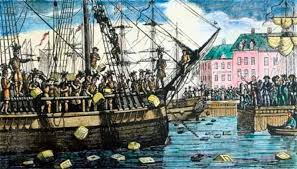
What event is depicted in this image?
a)
Boston Massacre
b)
Boston Tea Party
c)
Battle of Bunker Hill
d)
Lexington and Concord
73.
This patriot made a daring ride to warn colonists that British soldiers were approaching.
a)
Patrick Henry
b)
Paul Revere
c)
Phillis Wheatley
d)
Samuel Adams
74.
Samuel Adams and Paul Revere led members of the Sons of Liberty in this protest against taxes.
a)
First Continental Congress
b)
Boston Massacre
c)
Boston Tea Party
d)
Stamp Act Congress
75.
This enslaved person wrote poems and plays supporting American independence.
a)
Harriet Tubman
b)
Benjamin Banneker
c)
Paul Revere
d)
Phillis Wheatley
76.
Of the following events, which happened first? 
a)
Saratoga
b)
Yorktown
c)
Declaration of Independence
d)
Treaty of Paris of 1783
77.
Of the following events, which happened last?
a)
First Continental Congress
b)
Boston Massacre
c)
Boston Tea Party
d)
Stamp Act
78.
Of the following people, who did not help write the Declaration of Independence?
a)
Thomas Jefferson
b)
Patrick Henry
c)
John Adams
d)
Benjamin Franklin
79.
What event is depicted in this image?
a)
Boston Massacre
b)
Saratoga
c)
Lexington and Concord
d)
Yorktown
80.
Which one of these is not an advantage that helped the American patriots defeat Great Britain.
a)
defense of their own land, principles and beliefs
b)
support from France
c)
superior numbers of soldiers and greater experience
d)
strong leadership from men like George Washington
81.
What patriot leader is represented by this image?
a)
John Adams
b)
Samuel Adams
c)
Paul Revere
d)
Patrick Henry
82.
The U.S. was founded on July 4, 1776, by the approval of this document.
a)
the Treaty of Paris
b)
the Constitution
c)
the Declaration of Independence
d)
the Virginia Charter
83.
Which of the following events occurred before the event illustrated?
a)
First Continental Congress
b)
Stamp Act
c)
Declaration of Independence
d)
Boston Tea Party
84.
The event illustrated happened before which of the following?
a)
First Continental Congress
b)
Lexington and Concord
c)
Saratoga
d)
Boston Tea Party
85.
The location of what event is shown on this map?
a)
Lexington and Concord
b)
First Continental Congress
c)
Saratoga
d)
Yorktown
86.
Who fought in the French and Indian War?
a)
French vs. Indians
b)
British vs. French
c)
British vs. French and Indians
d)
Indians vs. British
87.
What were the 2 main reasons for the French and Indian War?
a)
Control of land and trade with Native Americans
b)
Land and Slaves
c)
Gold
d)
Claim to land in Europe
88.
Who was the King of England during this time?
a)
King Ferdinand and Queen Isabella
b)
King Henry VIII
c)
Queen Elizabeth
d)
King George III
89.
Why do you suppose the Indians helped the French?
a)
The French forced them to fight because the Indians were enslaved by them.
b)
The British attacked the Indians first, and the French decided to help the Indians.
c)
The French and Indians cooperated with one another often; traded with one another and taught each other many techniques for survival.
d)
The French were fighting the Indians in the war.... The Indians didn't help the French at all.
90.
As a result of the cost of the war, what did King George III do to the colonists?
a)
Killed them
b)
Removed them from the land in the colonies just like the Indians.
c)
Imposed taxes to pay for the war
d)
Paid for the war out of his own pocket
91.
What slogan did the colonists begin to use in order to express their frustrations with the British government?
a)
"No Taxation!"
b)
"We Need Representation!"
c)
"No Taxation without Representation!"
d)
"We Want Freedom!"
92.
The French and Indian War, unfair taxes in the colonies, along with many other events all led to what eventually?
a)
World War I
b)
American Revolution
c)
World War II
d)
Civil War
93.
What was stated in the Proclamation of 1763?
a)
Colonists were banned from settling west of the Appalachian Mountains.
b)
Colonists were encouraged to begin settling west of the Appalachian Mountains.
c)
The Proclamation ended the French and Indian War. 
d)
The Proclamation proclaimed independence for the American colonists. 
94.
In general, how did the colonists view the Proclamation of 1763?
a)
They felt that it supported their freedom and they supported it.
b)
They felt it was an infringement on their freedom of movement and were angry about it.
c)
They were not involved so it did not affect them.
d)
They supported it because they believed the King had the AUTHORITY to make this law.
95.
Which treaty ended the French and Indian war in 1763? 
a)
Treaty of Versailles
b)
Treaty of Paris 
c)
Treaty of Greenville 
d)
Proclamation Act 
96.
This event made colonists angry with the British.
a)
Civil War
b)
Boston Massacre
c)
Jamestown
d)
the Lost Colony
97.
To protest against taxes, the colonists did what?
a)
Moved West
b)
Boston Massacre
c)
Boston Tea Party
d)
Wrote letters
98.
The Boston Tea Party was when colonists:
a)
had a nice lunch and drank tea
b)
dressed like Indians and threw tea in the harbor
c)
gave tea to their friends
d)
stopped drinking tea
99.
What was the purpose of the Stamp Act?
a)
To raise money for the fair
b)
To raise money for their horses
c)
To raise money for protection of the colonies
d)
To raise money for the football team
100.
What items were taxed under the Stamp Act
a)
Deeds
b)
Wills
c)
Marriage License
d)
All of the above
101.
What was the British view of colonial taxes?
a)
They thought it was unfair because it was at night
b)
They thought it was fair because British citizens had been paying a similar tax for years
c)
To raise money for protection of the colonies
d)
The Stamp Act collected very little money
102.
Who were the Sons of Liberty?
a)
British Government
b)
A group of colonial protesters that united to defend the colonies against the Stamp Act
c)
Stamp Act
d)
All of the above
103.
What was the purpose of the Sons of Liberty?
a)
To house the soldiers
b)
To feed the soldiers
c)
To force the British government to repeal the Stamp Act
d)
All of the above
104.
How did the Sons of Liberty protest the Stamp Act?
a)
Had a picnic
b)
Rode horses into the buildings
c)
Through their iphone
d)
Boycotted British goods, refused to pay the tax, and intimated tax collectors
105.
Where did Americans stockpile ammunition?
a)
Lexington
b)
Concord
c)
Village Green
d)
Boston
106.
What is mercantilism?
a)
A system where a mother countries gains money and power from natural resources that come from its colonies.
b)
where colonies trade gold and silver with each other.
c)
Wars that start over money.
d)
Plantation colonies trading slaves for money.
107.
In this economic system, a mother country gained wealth by...
a)
allowing competition in the marketplace
b)
giving colonist political and religious freedom
c)
carefully controlling trade
d)
participating in the Great Awakening
108.
In 1620, the Mayflower Compact was created to promote ________________ within Plymouth.
a)
a representative assembly
b)
peace and harmony
c)
self-expression
d)
self-government
109.
One motivation for England's exploration in the New World was _________________.
a)
to find new species of plants and animals
b)
profit
c)
to find a cure for new diseases
d)
to claim Florida
110.
_______________________ was the first written colonial constitution.
a)
The Mayflower Compact
b)
The Fundamental Orders of Massachsetts
c)
The Fundamental Orders of Connecticut
d)
The Declaration Of Independence
111.
The colony started by The Virginia Company of London, was saved by ___________________.
a)
cotton
b)
tobacco
c)
Squanto
d)
mercantilism
112.
Representative government developed in the colonies because ________________.
a)
they were far away from England, making them independent
b)
of mercantilism
c)
of The Starving Time
d)
of The Mayflower Compact
113.
1607
a)
Plymouth
b)
Roanoke
c)
Jamestown
d)
Massachusetts Bay Colony
114.
Plymouth was established for _________________ reasons.
a)
political
b)
geographic
c)
economic
d)
social
115.
The  ________________ has thin, rocky soil.
a)
New England Colonies
b)
Middle Colonies
c)
Southern Colonies
116.
 Maryland was a refuge for _______________________.
a)
Puritans
b)
Quakers
c)
Catholics
d)
Pickle Rick
117.
_______- many European countries benefitted from the natural resources taken from its colonies.
a)
mermaidism
b)
mercenaries
c)
mercurial
d)
mercantilism