
 Worksheets
Interdependence
Total questions: 20
Worksheet time: 25mins

A student used this model of a wooly mammoth for a research project on the ecosystems and wanted to find out if elephants are related to Wooly Mammoth’s.
WOOLY MAMMOTH
What is a benefit of this model?
It shows the actual size of a wooly mammoth.
It helps the student understand what mammoths ate.
It predicts what mammoths will look like in the future.
It helps the student understand what mammoths looked like.
At one time, fungi, like the mushrooms shown below, were classified in the same kingdom as plants. Today, fungi are classified in their own kingdom and are described as decomposers in ecosystems.
Which statement best summarizes why fungi and plants are now classified in separate kingdoms?
The discovery of new evidence led to a reclassification of fungi.
Advancements in technology showed that fungi and plants are closely related.
The plant kingdom was getting two large, so scientists divided it into two kingdoms
Plants and fungi both contain cell walls and share more characteristics than separate them
Dr. Yang conducted a field study of the nesting habits of red cardinals. Why did she choose a field study over other types of investigation?
because she wanted to manipulate variables in the field
because she wanted to observe the birds in their natural habitat
because she wanted to simulate the life cycle of the birds in a lab
because she wanted to observe a simplified version of the environment

In the diagram, which organism is NOT a consumer?
Plants, because they get energy from the sun.
Caterpillars, because they get energy from the plants.
Frogs, because they get energy from the caterpillars.
Snakes, because they get energy from the frogs.
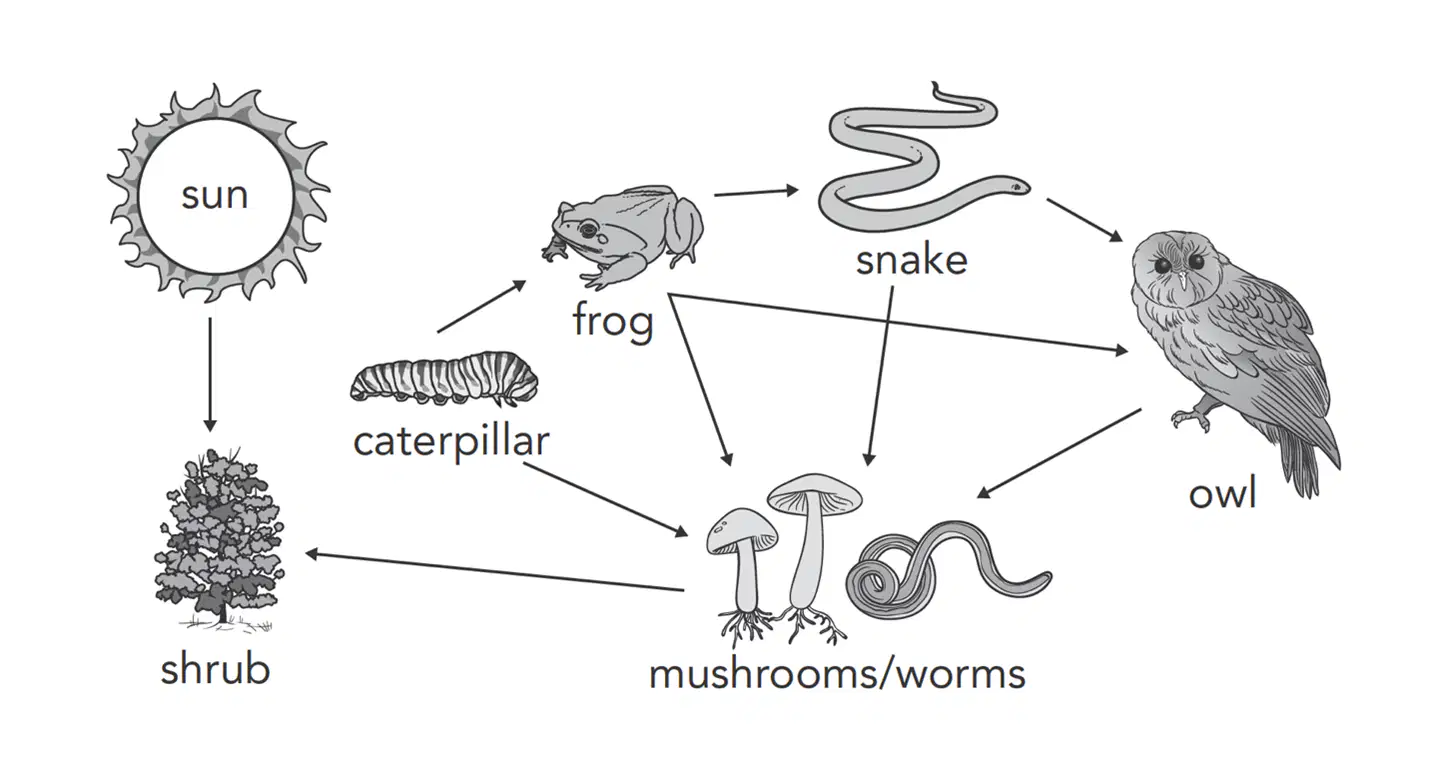
If a crab were added to this food web, and it ate the scraps left behind by the frog, what would best describe the relationship between the crab and the frog?
Mutualism
Consumer
Parasitism
Commensalism

A food web including five species is shown
Which of the following is most likely to cause the greatest decrease in the population of species B?
increase in species E
decrease in species C
decrease in species D
decrease in species A
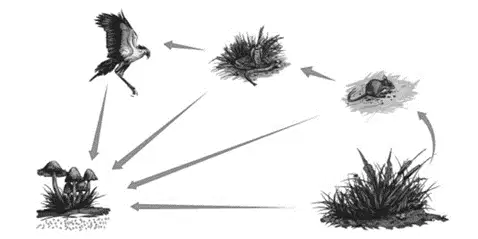
Which statement is most true for the food web shown?
The mushrooms and grass are both producers.
The mushroom and grass are both decomposers.
The mushroom is a decomposer and the grass is a producer.
The mushroom is a producer and the grass is a decomposer.
A tiny shrimp lives among the poisonous spines of a sea animal called the fire urchin. The spines provide the shrimp with protection from enemies. The fire urchin gains no benefit from the shrimp, but the shrimp causes it no harm.
What term is used to describe this type of relationship?
mutualism
competition
predator-prey
commensalism
Ostriches and gazelles are two animals that live in Africa. They graze for food near each other because they help each other spot predators. The gazelle has excellent eyesight, but poor hearing, and the ostrich has excellent hearing, but poor eyesight. These two animals will alert one another when danger is near.
Which term best describes this relationship?
Competition
Commensalism
Parasitism
Mutualism
Goby fish live in close proximity to many other water animals. They often lay their eggs in burrows built by blind shrimp. The blind shrimp have feelers that sense when the goby fish flee predator fish. Some goby fish eat the parasites of other, larger predator fish.
Based on the information provided, what would be considered a limiting factor in the goby fish’s ecosystem?
The length of the predator fish because their parasites infect the goby fish
The number of blind shrimp because goby fish often lay their eggs in blind shrimp burrows.
The size of the predators because they eat the goby fish and the blind shrimp.
The species of seaweed because they could poison the goby fish.
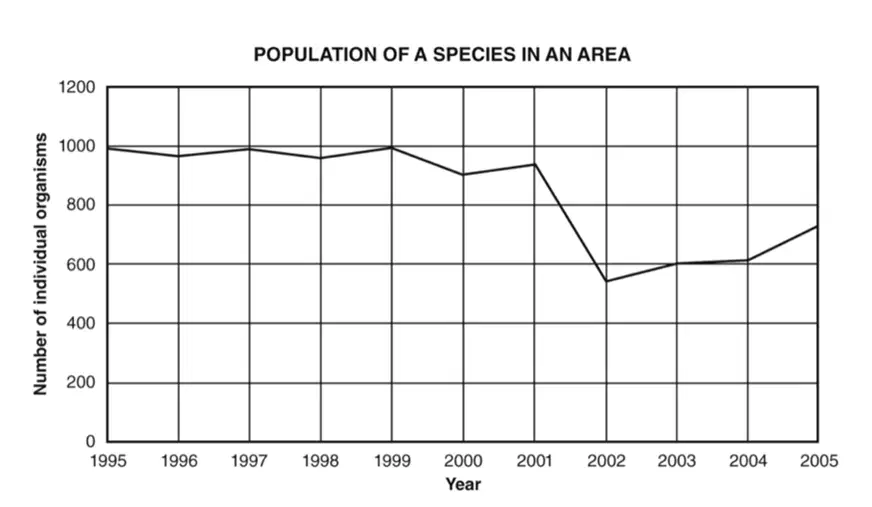
Once a year, beginning in 1995, a group of volunteers had counted the frogs in the area by listening for individual frog calls. The biologists used the data to make a graph. Florida biologists noted that after 2001 the population of a small frog species declined along a section of the Kississimee River.
After studying the trend in the graph, what was most likely the next step in the biologists’ research on the problem?
They formed a hypothesis that there was a limiting factor on the frog population and set out to determine what it could be.
They counted the frogs once a month instead of once a year for more accurate data.
They increased the frogs’ food supply by bringing insect larvae to the river.
They formed a hypothesis that the count was not accurate and sent volunteers to get a more accurate count by looking for, rather than just listening for, frogs
Which of the following can limit the growth of a population of organisms?
Both the number of predators and diseases can limit the growth of a population of organisms.
The number of predators can limit the growth of a population of organisms, but diseases cannot.
Diseases can limit the growth of a population of organisms, but the number of predators cannot
Neither the number or predators nor diseases can limit the growth of a population of organism
The endangered Key Deer is the smallest deer in North America. They make their home on the Florida Keys, where they eat the thatch palm berries found on the islands that they swim between.
If climate change were to raise sea levels, what best describes the effect this would have on the Key Deer located at the National Key Deer Refuge on Big Pine Key?
The animals would be stranded on separate islands.
They would have to migrate to Florida’s mainland.
Saltwater would kill the plants, leaving less food for the deer.
The deer would need to adapt to drink brackish water.
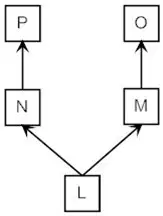
Using only the relationships between the organisms shown in the diagram, what will happen to the number of N if most of the O are killed and why?
The number of N will decrease because the number of individuals in all of the populations of organisms in this diagram will decrease when the number of O decreases.
The number of N will decrease because there will be more M to eat the L, so fewer L will be available for the N to eat.
The number of N will stay the same because there will be no effect on the number of individuals in the populations of organisms below the O in the diagram.
The number of N will stay the same because O and N are not connected by an arrow in the diagram.
Aphids are small insects that feed by burrowing their heads into the stems of plants, like orange trees, and feed on sap. When an orange tree loses its sap, it gets weaker because sap contains all the nutrients that a plant needs. As aphids live in large colonies, their number can quickly cause extensive damage to orange trees.
Which type of relationship best describes the interaction between the Aphids and the orange tree?
Mutualism because the Aphids get energy from consuming the sap, and the orange tree gets protection from even more harmful insects.
Parasitism because one organism benefits and the other organism is harmed.
Parasitism because one organism benefits and the other organism is not affected.
Parasitism because both organisms are harmed.

A new species that eats only mice becomes part of this food web, greatly reducing the number of mice in this area. Using only the relationships between the plants and animals shown in the diagram, which of the following would decrease? You can assume that the number of foxes stays the same and that no other organisms leave or enter the area.
The number of robins would decrease.
The amount of grass would decrease.
The number of caterpillars would decrease.
Only the number of mice would decrease.
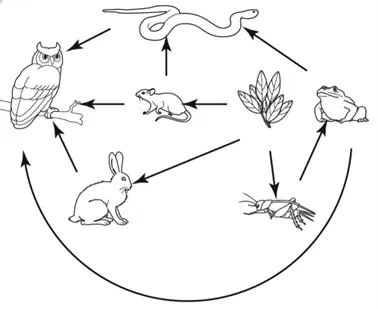
Which statement correctly describes one way that energy from the sun might flow through the food web from a producer to the owl?
The snake eats the frog and the owl eats the snake.
The snake eats the rodent and the rodent eats the owl.
The rabbit eats the plant and the grasshopper eats the plant.
The rabbit eats a leafy green plant and the owl eats the rabbit.
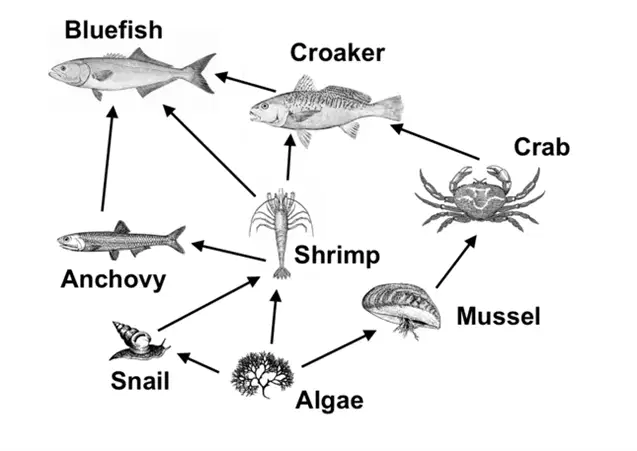
Which of the organisms in this food web gets energy from both producers and consumers?
Anchovy
Shrimp
Snail
Algae
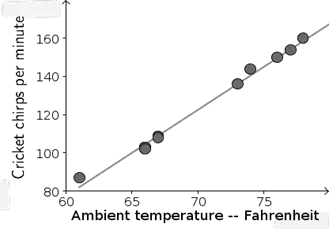
Kaylee is learning about ecosystems and how organisms within an ecosystem interact with each other. She reads an article that states the frequency of chirping by crickets is related to the temperature of their environment. She wants to conduct an experiment to see if this is true. Kaylee states this hypothesis: Crickets chirp more frequently when the temperature of their environment increases. Results of investigation shown below.
What is the test variable (independent variable) and outcome variable (dependent variable) in Kaylee’s experiment?
test variable (independent variable): number of crickets; outcome variable (dependent variable): frequency of chirping
test variable (independent variable): temperature of environment; outcome variable (dependent variable): frequency of chirping
test variable (independent variable): number of crickets; outcome variable (dependent variable): temperature of environment
test variable (independent variable): frequency of chirping; outcome variable (dependent variable): temperature of environment
Mandy is investigating migration for her project on ecosystems. She thinks that birds instinctively fly south for the winter and hypothesizes that they do so because they cannot survive in cold weather, thus disrupting the local habitat and food web.
Which of the following could serve as empirical evidence to support her hypothesis?
inferences made about the birds based on observations of flocks of flying geese
data from another scientist’s experiment on bird anatomy
feelings based on her own reactions to winter weather
charts displaying birds’ migratory patterns in relation to weather

