
 Worksheets
EOC Review Part II
Total questions: 86
Worksheet time: 50mins
Which was a chemical that took the leaves off trees?
Agent Orange
Napalm
LBJ's "Great Society" included all of the following EXCEPT:
The Federal Reserve
Medicare
Title IX
Expansion of welfare programs
LBJ feared a full-scale invasion of North Vietnam might cause ______ to enter the war.
the USSR
China
Japan
North Korea
How did a South Vietnamese monk protest Diem's persecution of Buddhists?
Set himself on fire
Chained himself to the White House fence
Hanged himself in public
Set off a bomb in Saigon
What was the goal of "Vietnamization"?
Hand South Vietnam over to the communists
Keep peace with the Soviet Union
Retake territory lost during the Tet Offensive
Force South Vietnam to take over more of the fighting
Which law required the president to gain congressional approval for long-term troop deployments?
24th Amendment
Tonkin Gulf Resolution
War Powers Act
What European country controlled Vietnam until World War II?
France
Germany
Great Britain
Spain
In the ____________________, United States soldiers killed at least 450 women, children, and elderly men, shocking the American public.
My Lai Massacre
Attack on Sai Pan
Tet Offensive
Attack on Khe Sanh
Leading Vietnamese nationalist figure, supporting the Communist party
Ngo Dinh Diem
Ho Chi Minh
Viet Cong
Kent State University
If one country falls to communism, the countries around would also fall to communism
Vietnamization
Domino Theory
Tet Offensive
Democratic Republic of Vietnam
The Vietnamese who fought against the U.S. and South Vietnamese troops
Democratic Republic of Vietnam
Ngo Dinh Diem
Viet Cong
Ho Chi Minh
1968, massive attack by the Viet Cong on major cities in South Vietnam; caused American public support of war to plummet
Operation Rolling Thunder
Gulf of Tonkin Resolution
Tet Offensive
Kent State University
Protests over military missions in Cambodia resulted in confrontation between protestors and police, with four students killed on May 4, 1970
Kent State University
Vietnamization
Domino Theory
Viet Cong
Why did Kennedy cancel air support for the Bay of Pigs invasion?
to keep US involvement a secret
to avoid going to war with Cuba
to withdraw his support for the overthrow of Castro's gov't
to give the operation a better chance to succeed
What was Johnson's legislative agenda called?
Great Society
New Frontier
Fair Deal
Square Deal
Which Supreme Court case says suspects are entitled to an attorney, even if they cannot pay?
Escobedo v Illinois
Gideon v Wainwright
Engel v Vitale
Griswold v Connecticut
Korea was divided along the __________ Parallel after World War II.
35th
36th
37th
38th

North Korea was supported by ________________, which has a _________________ government.
Soviet Union/communist
Soviet Union/democratic
U.S.A./communist
U.S.A./democratic
What were the defining characteristics of Civil Rights?
Increased participation of minorities in the political process, Protests, Boycotts, Marches, Desegregation, Integration, Struggle for equality, due process strengthened.
Communism, containment, Arms Race/Space Race, Red Scare, McCarthyism
OPEC oil problems, conflict in the Middle East, Reaganomics, large military, Cold War ends, NAFTA
Economic instability, Unemployment, Breadlines, Poverty

What court case made segregation of schools illegal in the 1950s?
Guzman V. School
Brown V. Board of Education
Miranda V. Arizona
Plessy V. Ferguson
Which leader of the civil rights movement used non-violent civil disobedience to oppose segregation in the south?
Dolores Huerta
Malcom X
Martin Luther King Jr.
Ceaser Chavez
What organization created by W.E.B. Dubois sought immediate equality for minorities?
WAC
HUAC
NAACP
SNCC

What group during the Civil Rights Movement allowed members to use all necessary means to defend and provide for their community?
Southern Peace Corps
NAACP
SNCC
Black Panthers

During which event did Eisenhower send troops to Arkansas in order to desegregate a high school?
Tuskegee Airmen
Little Rock Nine
Atomic Bombs
Flying Tigers
What acts of protest during the Civil Rights Movement encouraged the government to expand political and economic opportunities for minority citizens?
March on Washington, Freedom Rides, Greensboro Sit-In, Montgomery Bus Boycott
Black Panthers
Mass Support Demonstrations
Little Rock Nine
The ruling of this court case ensured that people were informed of their due process rights when arrested-
Miranda v. Arizona
Brown v. Board of Education
Plessy v. Ferguson
Guzman v. STAAR

What peace treaty did President Carter negotiate in order to end the conflict between Israel and Egypt?
United Nations
War Powers Act
Camp David Accords
NATO
Which action has come to symbolize the end of the Cold War?
establishing the Peace Corps
achieving a truce in the Korean War
tearing down the Berlin Wall
improving United States relations with China
Term coined in the early 1970s to describe a period of high inflation and high unemployment
Stagflation
Stagnation
Carnation
Reincarnation
Government organization established in 1970 to establish pollution standards, conduct environmental research, and assist state and local governments in pollution control
Environmental Protection Agency (EPA)
Environmental Promotion Agency (EPA)
Environmental Prosecution Agency (EPA)
Environmental Probation Agency (EPA)


Why did Reagan's advisors illegally funnel money to the Contras in Nicaragua?
to prevent Nicaragua from becoming capitalist
to prevent Nicaragua from becoming communist

Which law was created to deter/ prevent future terrorist attacks after 9/11?
Affordable Care Act
Patriot Act
Reaganomics
What treaty stated that as of January 1, 2008, all tariffs and quotas were eliminated on U.S. exports to Mexico and Canada?
North Atlantic Treaty Organization
General Agreement on Tariffs and Trade
Organization of Petroleum Exporting Countries
North American Free Trade Agreement
This man was declared to be the mastermind behind the 9/11 attacks?
Osama Bin Laden
Sadaam Hussein
Vladimir Putin
Adolf Hitler
What do many find Nixon's greatest accomplishment to be?
opening of relations with Cuba
opening of relations with Communist China
Watergate
ending the Vietnam War
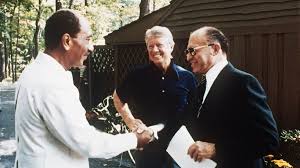
The photograph above shows foreign leaders meeting with President Carter at Camp David in 1978. What was the outcome of this meeting?
The United States and its allies halted grain sales to the Soviet Union
The United States persuaded Egypt and Israel to sign a future peace treaty
The United States signed a treaty promising the return of the Panama Canal Zone
The United States successfully rescued hostages held by Iranian students in Tehran
Which Nazi action is referred to as the Holocaust?
the bombing of major European cities
the arson attack on the German Reichstag
the systematic elimination of European Jews
the signing of a nonaggression pact with Russia
What directly led to a rise of dictatorships prior to WWII
Instability caused by the Treaty of Versailles
Economic achievements of the communist system
Concern resulting from the Zimmermann Telegram
Financial success of international trade agreements
Which was a result of the GI Bill?
Labor disputes were prevented
Federal highway systems were created.
Taxes on personal income were reduced
Suburban neighborhoods were developed
What was a political consequence of the United States’ use of the atomic bomb in World War II?
It started an arms race between the United States and the Soviet Union.
It caused a rift between the United States and its allies in Europe.
It lead to the Soviet Union and Japan becoming allies.
It rallied support in Japan to continue the war.
What was the primary purpose of the Neutrality Acts passed by the United States during the 1930s?
to prevent the country from getting involved in a military conflict
to punish countries for breaking the conditions of a peace treaty
to assist countries struggling with communist revolutions
to stimulate the economy by increasing exports

Why did the U.S. government produce posters like these during World War II?
to recruit soldiers
to prevent espionage
to prohibit price gouging
to ration natural resources
Which statement most likely describes what President Harry Truman would have predicted if he had decided to use a different tactic to end World War II?
Japan would have eventually agreed to support the Marshall Plan
Japan would have resisted surrender for as long as possible
Japan would have suffered from a civil war
Japan would have allied with communist China
Which goal motivated the creation of the United Nations in 1945?
reducing potential conflicts between member countries
regulating nuclear proliferation among member countries
establishing an international organization to isolate communist regimes
establishing an international organization to promote cultural exchange
What was Mary McLeod Bethune’s contribution as a delegate to the founding conference of the United Nations?
She encouraged the establishment of equal rights throughout all countries.
She supported the promotion of economic advancement in developing countries.
She promoted the creation of a security council to prevent future military conflicts.
She supported the creation of an international justice system that applied the rule of law.
Which statement describes one precedent set by the Nuremberg Trials?
Soldiers who commit crimes while following orders can avoid prosecution
Heads of state have immunity from being prosecuted for war crimes
A person can be prosecuted for committing crimes against humanity
An individual convicted of war crimes loses the right to appeal the decision
What was the purpose of the Fair Employment Practices Committee established during World War II?
requiring businesses to give women equal pay for equal work
enforcing equality of access to jobs for rural and urban residents
banning child labor for jobs in defense and manufacturing industries
preventing hiring discrimination by companies with government contracts
Which statement describes one reason for establishing rationing during World War II?
Industrial production declined from a lack of workers.
Free trade agreements with allied nations were dissolved.
Troops serving overseas needed a steady supply of resources
Drought conditions led to a decrease in agricultural production
Which is a true statement about the Zoot Suit Riots of 1943?
The riots came about as a result of anti-German sentiment prevalent in California during the 1940s
The riots showed the conflict between young Hispanic men of the "Zoot Suit culture" and the white military men stationed in California in the 1940s.
The Zoot Suit Riots showed the long-standing conflict between men and women in the military and the civilians who did not support an unpopular war.
The violence came about as a result of the extreme Anti-Japanese sentiment that was particularly evident in California, where groups of Asian Americans lived
Supreme Court decision in Korematsu v. United States
Which government policy did this ruling reaffirm?
the requirement of separating armed forces by race
the monitoring of private communications among people
the use of internment camps established by executive order
the movement of recent immigrants to containment facilities
Which statement explains why women and minorities made social and economic gains during World War II?
Labor shortages provided economic opportunities.
Executive orders encouraged the protection of civil rights
Labor unions fought to obtain economic equality for women
Government policies allowed women to serve in combat units
What was the most likely reason for apanese-American citizens being forced to leave San Francisco during World War II
the fear of espionage
the fear of enemy air raids
the lack of jobs in defense plants
the conscription of men into the military
What foreign policy guided American presidents during the Cold War to stop the spread of communism?
Open Door Policy
Dollar Diplomacy
Big Stick Policy
Containment

What American policy provided Western European countries financial assistance so they could recover from WWII?
Marshall Plan
Domino Theory
Truman Doctrine
Big Stick Policy

What individual/group contributed to the Red Scare and accused American citizens of being communists?
Martin Luther King & Black Panthers
Jane Addams & Settlement Houses
Joseph McCarthy & HUAC
Cesar Chavez & United Farmworkers Union

What happened as a result of the launch of Sputnik in 1957?
It started the space race.
U.S. began to invest more money into math & science education.
The U.S. started NASA.
All of the above
During what event did the U.S. bypass a Soviet blockade without provoking a military conflict?
Berlin Airlift
Cuban Missile Crisis
Korean War
Vietnam War
During the Cuban Missile Crisis, what did JFK do when he heard that the Soviet Union was construction a missile site in Cuba.
JFK gave into the Soviet demands.
JFK bombed the Soviet Union with an atomic bomb.
JFK ordered a naval blockade of Cuba.
JFK invaded Cuba from Guantanamo Bay.

How did the G.I. Bill contribute to the economic prosperity of the 1950s?
It decreased consumer spending.
It allowed Veterans to get an education and buy homes in suburbs.
It offered incentives under the Bracero Program to temporary laborers.
It created federal domestic programs as part of the Great Society.
After WWII what happened to the population of the U.S?
The population moved westward as a result of the railroad.
African Americans moved north as part of the Great Migration.
The population shifted from the Rust Belt to the Sun Belt.
The population grew due to the Baby Boom.
What did those in the counter-culture do when the government escalated deployment of troops in Vietnam and implemented a draft?
The counter-culture organized protests.
There were mass anti-war demonstrations.
Some individuals burned their draft cards.
All of the above
What wars were fought during the Cold War as a result of containment and the Domino Theory?
Korean & Vietnam War
WWI & WWII
Civil War & Spanish American War
Persian Gulf & War on Terror

What law did Congress pass to limit the military authority of the executive branch in order to avoid another Vietnam?
Marshall Plan
New Deal
War Powers Act
Gulf of Tonkin Resolution

What amendment was passed to lower the voting age because it was unfair that 18-20 year olds were fighting in Vietnam but couldn't vote.
18th
22nd
24th
26th

How did the media (television) impact the Vietnam War?
Negative press coverage contributed to the public disillusionment with the war.
The positive press coverage encouraged enlistment in the military.
The impact of the media in Vietnam was rather minimal.
The media showed that the majority of Americans supported the war effort.
Plan after WWII to give billions of dollars to Western Europe in an effort to stop the spread of Communism.
Truman Doctrine
Marshall Plan
Nato
Iron curtain
Policy of providing economic and military aid to any country threatened by communism, mainly to help Greece and Turkey.
Truman Doctrine
Marshal Plan
Eisenhower Doctrine
Domino Theory
Which act permitted the US to sell arms to warring countries on a cash & carry basis?
Neutrality Act 1939
Lend-Lease Act
Anschluss
Double V
allowed economic assistance to the Allies
Lend Lease Act
Selective Service Act
Four Freedoms
Executive Order 9066
a government that controls all aspects of society
totalitarianism
democracy
laissez faire
capitalism
reason why Japan attacked Pearl Harbor
US stopped selling oil to Japan
US stopped buying oil from Japan
Japan wanted to conquer the US
Japan wanted to spread communism

