
 Worksheets
Chapter 14: Heat and Tempurature
Total questions: 27
Worksheet time: 15mins
Temperature
a measure of how hot or cold something is; specifically, a measure of the average kinetic energy of the particles in an object
an instrument that measures and indicates temperature
the temperature at which molecular energy is at a minimum
the energy transferred between objects that are at different temperatures
Thermometer
the temperature at which molecular energy is at a minimum
an instrument that measures and indicates temperature
a measure of how hot or cold something is; specifically, a measure of the average kinetic energy of the particles in an object
One degree Celsius is equal to 1.8 degrees Fahrenheit.
Absolute Zero
the height at which molecular energy is at a minimum
the rate at which molecular energy is at a max
the temperature at which molecular energy is at a minimum
the temperature at which molecular energy is at a max
Heat
the energy that is transferred as electromagnetic waves, such as visible light and infrared waves
the movement of matter due to differences in density that are caused by temperature variations
the transfer of energy as heat through a material
the energy transferred between objects that are at different temperatures
Thermal conduction
the transfer of energy as heat through a material
a machine that transforms heat into mechanical energy, or work
the energy transferred between objects that are at different temperatures
Heat transfer always occurs from the object to the object.
Convection
movement of matter that results from differences in density; may be vertical, circular, or cyclical
the movement of matter due to differences in density that are caused by temperature variations
the energy that is transferred as electromagnetic waves, such as visible light and infrared waves
the amount of energy required to raise the temperature of 1 kg of that substance by 1 K
Convection current
a machine that transforms heat into mechanical energy, or work
the energy that is transferred as electromagnetic waves, such as visible light and infrared waves
movement of matter that results from differences in density; may be vertical, circular, or cyclical
the movement of matter due to differences in density that are caused by temperature variations
Radiation
the movement of matter due to differences in density that are caused by temperature variations
a measure of the randomness or disorder of a system
the amount of energy required to raise the temperature of 1 kg of that substance by 1 K
the energy that is transferred as electromagnetic waves, such as visible light and infrared waves
Specific heat
the amount of energy required to raise the temperature of 1 kg of that substance by 1 K
the temperature at which molecular energy is at a minimum
the energy transferred between objects that are at different temperatures
the transfer of energy as heat through a material
Entropy
a measure of the randomness or disorder of a system
the amount of energy required to raise the temperature of 1 kg of that substance by 1 K
the transfer of energy as heat through a material
the energy transferred between objects that are at different temperatures
Heat engine
the temperature at which molecular energy is at a minimum
a machine that transforms heat into mechanical energy, or work
a measure of how hot or cold something is; specifically, a measure of the average kinetic energy of the particles in an object
an instrument that measures and indicates temperature
Explain how a liquid thermometer measures temperature.
Substances in it shrink as the temperature increases
Substances in it expand as the temperature increases
Substances in it expand as the temperature decreases
Substances in it expand as the gravity increases
Describe the relationship between temperature and kinetic energy
If KE goes down, temp goes down
If KE goes up, temp goes down
If KE goes up, temp goes up
If PE goes up, KE goes up
What makes things feel hot or cold?
Convection current
Energy transfer
gravity
absolute zero
Temperature scales
Fahrenheit
Celsius
Kalvin
Meters
Ways energy can be transferred
Radiation
Fire
Conduct
Convection
Absolute Zero
Example of radiation
heat above fire
heat from the sun
touching the hot seat belt
Example of conduction
heat above fire
heat from the sun
touching the hot seat belt
Example of convection
heat above fire
heat from the sun
touching the hot seat belt
Diagram of convection current

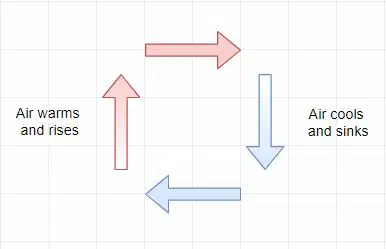

Contrast conductors and insulators
Conductors conduct well
Insulators conduct poorly
conductors conduct poorly
Insulators conduct well
Summarize the first law of thermodynamics
The total gravity used in any process is wasted
The total energy used in any process is conserved
The total gravity used in any process is conserved
The total energy used in any process is wasted
Which direction does heat transfer?
cold to hot
hot to cold
Does the disorder of a system tend to increases or decrease?
Stay the same
Increase
Decresase
What do heat engines do?
transfer heat into mechanical energy
transfer ice into mechanical energy
trasfer heat form one place to another
transfer water into thermal energy
What is the role of a carburetor in an engine?
water is melted
Gas is melted
Water is vaporized
Gas is vaporized
Four strokes of an automobile cylinder
Intake
Compression
Power
Exahst
Gravity

