wayground logo

Free Printable Worksheets

Font size

S
M
L
XL
Worksheets

Question Bank for Grade 8 Social Studies

Total questions: 125

Worksheet time: 2hrs 40mins

Name
Class
Date
1.
As Americans took over more and more land, what happened to Native Americans?
a)
They agreed to give up their land.
b)
They were given their choice of where to live.
c)
They were forced to live in reservations.
d)
They voluntarily moved to Canada and Mexico.
2.
What states were part of the Mexican Cession?
a)
Massachusetts, Rhode Island, Pennsylvania
b)
Louisiana, Arkansas, Alabama, Mississippi
c)
Oregon, Washington, Idaho
d)
California, New Mexico, Utah, Nevada
3.
The war with Mexico BEGAN with
a)
California's rebellion
b)
a border dispute in Texas
c)
the Battle of Buena Vista
d)
a US invasion of Mexico City
4.
Which of the following presidents purchased Louisiana?
a)
Washington
b)
Adams
c)
Jefferson
d)
Jackson
5.
How did the U.S. acquire Oregon? 
a)
treaty with the British
b)
war with England
c)
purchased from the British
d)
war with Mexico
6.
Why was the Gadsden Purchase added to the U.S. in 1853?
a)
it was needed for the building of a railroad
b)
it was a gift from Mexico
c)
it was part of the treaty with Mexico
d)
gold was discovered in that area
7.
Which of the following contributed to the westward expansion of the United States?
a)
European warships attacked the eastern seaboard, forcing citizens to move westward for safety.
b)
Most of the land east of the Mississippi River was not suitable for farming.
c)
Many Americans felt it was their right and duty to move westward.
d)
The standard of living on the Pacific Coast was very high, so many people wanted to move there.
8.
The philosophy of "Manifest Destiny" stated that American should expand from the Atlantic Ocean to the __________
a)
Mississippi River
b)
Pacific Ocean
c)
Rocky Mountains
d)
Great Lakes
9.
Name the piece of Land.
a)
Texas Annexation
b)
Mexican Cession 
c)
Louisiana Purchase 
d)
Florida Cession
10.
Name the piece of land.
a)
Mexican Cession
b)
Northwest Territory 
c)
Trans-Appalachian West 
d)
Oregon Country 
11.
Which of these would be the best title for the illustration above?
a)
Divine Nature
b)
Survival of the Fittest
c)
Universal Expansion
d)
Manifest Destiny
12.
What did the Louisiana Purchase of 1803, the annexation of Texas in 1845, and the Mexican War of 1846 have in common?
a)
They brought about a war with Spain.
b)
They increased the territory of the United States.
c)
Each resulted in territory annexed by the United States.
d)
Each involved land forcibly taken from Mexico.
13.
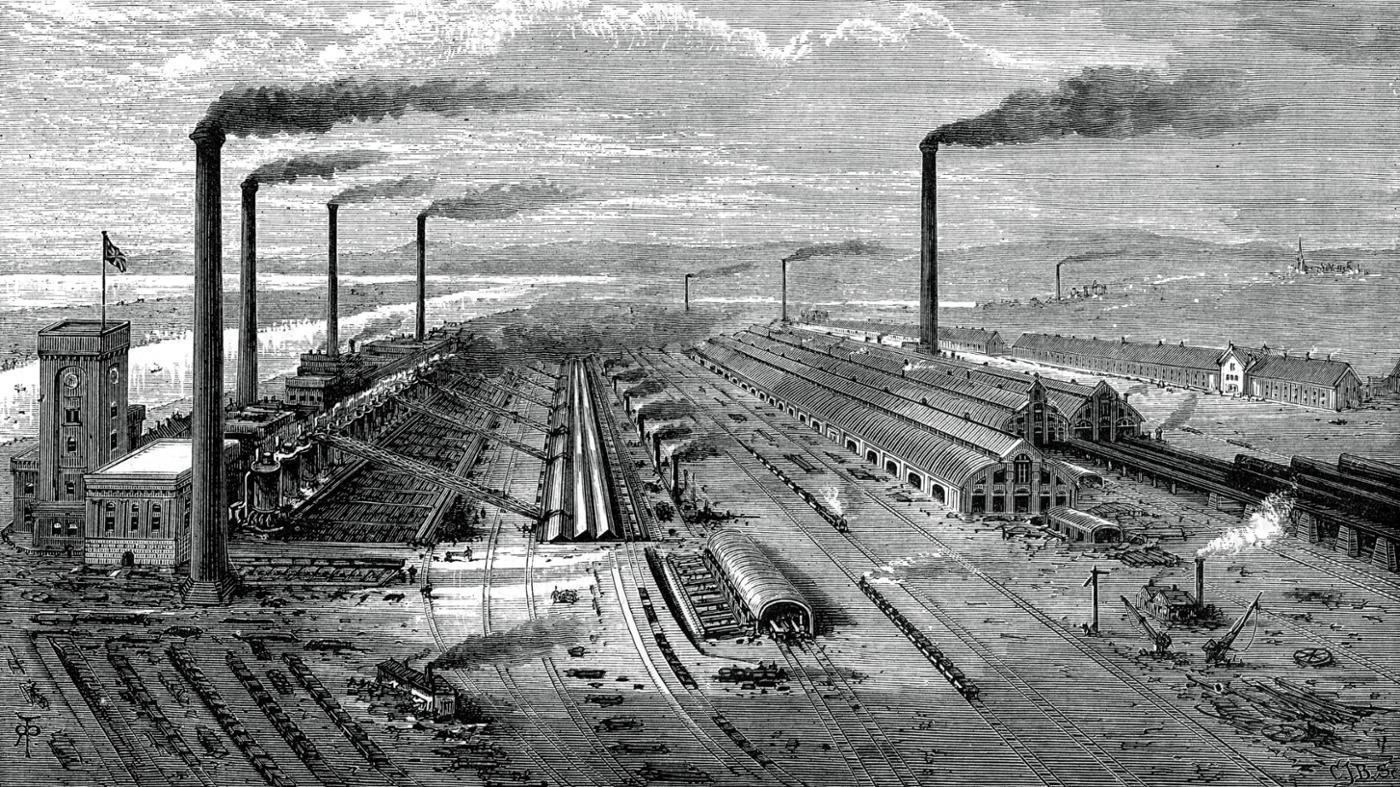
Why did people move to the cities during the Industrial revolution?
a)
Jobs in factories
b)
Jobs on the farm
c)
Family
d)
Friends
14.
What is Manifest Destiny?
a)
The belief that it was America's destiny to control and civilize all of North America
b)
The belief that their destiny was to manifest
c)
A religious term used to explain how to be saved
15.
What was the name of the time period where people from all over flocked to California in search for gold?
a)
The Gold Rush
b)
The Gold Movement
c)
Goldilocks
d)
Gold Gathering
16.
What were the difficulties of the Oregon Trail?
a)
Length of the journey
b)
Disease
c)
Weather
d)
All of the above
17.
Where did the travellers of the Oregon Trail originally set out from?
a)
Nebraska
b)
Idaho
c)
Wyoming
d)
Missouri
18.
Why would people head West on the Oregon Trail?
a)
Free pizza at the end of the trip.
b)
They win a million dollars.
c)
New land, opportunities & life.
d)
The Oregon coast was prettier than the East coast.
19.
Why were Mormons going on the Mormon Trail?
a)
They were being persecuted 
b)
People wanted their lands 
c)
Natives didn't want them on their land 
d)
All of the above
20.
What did the Texans refer themselves to after breaking free from Mexico?
a)
Freedom Riders
b)
Lone Star Republic
c)
Union of Texas
d)
Republic of New Mexico
21.

The belief that the United States was destined to stretch all the way across the continent of North America

a)

Manifest Destiny

b)

Bill of Rights

c)

Mexican-American War

d)

Gold Rush

22.
Which part of the country was the Mexican Cession in?
a)
Northeastern U.S.
b)
Southeastern U.S.
c)
Northwestern U.S.
d)
Southwestern U.S.
23.

The purchase of Louisiana

a)

was a costly mistake

b)

was opposed by western farmers

c)

doubled the size of the United States and gave control of the Mississippi River

d)

led to war with Great Britain

24.

How did the U.S. acquire Oregon?

a)

treaty with the British in 1846

b)

war with England in 182

c)

purchased from the British in 1783

d)

war with Mexico in 1848

25.
In what year did the United States purchase the Louisiana Territory?
a)
1803
b)
1819
c)
1845
26.
How did the Northwest Ordinance of 1787 provide for the orderly expansion of the United States?
a)
It provided the president with the power to sign treaties with foreign powers to buy additional territory
b)
It provided a review process for laws in new territories and states.
c)
It provided procedures for establishing territories and creating states.
27.
To take over territory and incorporate it into another political entity
a)
cede
b)
annexation
c)
treaty
d)
war
28.
49ers
a)
Group of settlers who moved to California in search of land. 
b)
Group of settlers who moved to California in search of religious freedom
c)
Group of settlers who moved to California in search of white beaches
d)
Group of settlers who moved to California in search of gold
29.
“Mr. Manifest Destiny”; added more territory to the United States than any other President. 
a)
Jefferson
b)
Jackson
c)
Monroe
d)
Polk
30.
The U.S. annexed the this place in 1845, eventually causing the Mexican-American War. Letter C on the map.
a)
Missouri
b)
Republic of Texas
c)
Oregon
d)
California
31.
1848 land acquisition given up by Mexico following the Treaty of Guadalupe Hidalgo.
Letter D on the map.
a)
Spanish Cession
b)
Oregon Territory
c)
California
d)
Mexican Cession
32.
Members of a church founded by Joseph Smith in 1830; moved to Utah in search of freedom from religious persecution. 
a)
Mammoths
b)
Minions
c)
Mormons
d)
Morphins
33.

Which of the following DOES describe Jackson's upbringing? Click ALL that apply.

a)

Poor

b)

Suffered many hardships

c)

He was the son of a lawyer

d)

Often in trouble

34.

How many died on the Trail of Tears?

a)

1 out of every 6

b)

1 out of every 2

c)

1 out of every 4

d)

1 out of every 10

35.

The following image shows Jackson's war vs.....

a)

Clay

b)

Second National Bank

c)

South Carolina

d)

Natives

36.

What state threatened to secede over tariff issue

a)

North Carolina

b)

Georgia

c)

Florida

d)

South Carolina

37.

Who swayed the House in the "corrupt bargain" vote of 1824?

a)

Calhoun

b)

H. Clay

c)

John Q. Adams

d)

N. Biddle

38.

What southern leader became Jackson's enemy during tariff issue?

a)

Henry Clay

b)

John C. Calhoun

c)

N. Biddle

d)

John Q. Adams

39.

What present day state was designated as the new Indian territory?

a)

Georgia

b)

Texas

c)

Oklahoma

d)

Kansas

40.

Replacing opponents with your supporters was known as the...

a)

Spoils System

b)

Nominating Conventions

c)

Victors System

d)

Hire and Fire

41.

Click ALL the following the Jackson hated about the Second National Bank.

a)

Run by a wealthy easterner named Nicholas Biddle

b)

Favored the rich and corruption

c)

Held a monopoly on federal funds

d)

Location wasn't centralized

42.

What election introduced "mudslinging"?

a)

1824

b)

1828

c)

1832

d)

1836

43.

What two native groups resisted the United States removal?

a)

Seminole and Creek

b)

Seminole and Choctaw

c)

Seminole and Cherokee

d)

Seminole and Chickasaw

44.

Which of the following is true regarding Jackson's military history? Click ALL that apply.

a)

Fought in Creek and Seminole wars

b)

Taken prisoner during the American Revolution

c)

Hero of New Orleans

d)

Hero of Yorktown

45.

Click ALL that are true

a)

Jackson was involved in many duels

b)

Jackson once fired his entire cabinet

c)

Jackson was a military hero

d)

Jackson was a lawyer from Tennessee

46.

Jackson won the electoral and popular vote in ALL 3 elections(1824, 1828, and 1832) he was involved in?

a)

True

b)

False

47.

Andrew Jackson's election victory in 1828 depended on support from

a)

the rich and well-born.

b)

Native Americans.

c)

the common people.

d)

states' rights supporters.

48.

Jackson's practice of rewarding political supporters with government jobs became known as

a)

the spoils system.

b)

Jacksonian democracy.

c)

mudslinging.

d)

a corrupt bargain.

49.

Did Andrew Jackson support the National bank?

a)

yes

b)

no

50.

The Nullification Crisis was triggered by strong opposition to the

a)

Force Bill.

b)

Indian Removal Act.

c)

Tariff of Abominations.

d)

Bank of the United States.

51.
Which group was most hurt by Jackson's removal policy?
a)
the rich and well-born
b)
Native Americans
c)
the common people
d)
states' rights supporters
52.
Which group was most hurt by Jackson's removal policy?
a)
the rich and well-born
b)
Native Americans
c)
the common people
d)
states' rights supporters
53.
Why did Jackson oppose the Bank of the United States?
a)
He thought its president was inexperienced and poorly educated.
b)
He thought it loaned too much money to farmers and workers.
c)
He thought it was unconstitutional and that it favored the rich.
d)
He thought it benefited western business owners over those in the east.
54.

What does the Indian Removal Act do?

a)

Pushes all Native Americans into Florida

b)

Allows Georgia to use Native Americans as slaves

c)

Enacts the policy of assimilation

d)

Moves Native Americans west beyond the Mississippi River

55.
What is the main criticism of the spoils system?
a)
It rewards political loyalty
b)
It is based on merit
c)
It often leads to unqualified people getting jobs
d)
It promotes diversity
56.
Which of the following is the best definition for the spoils system?
a)
a bribe
b)
choosing the most qualified applicant for the job
c)
voting for the best candidate to represent the public
d)
rewarding your supporters with jobs in the government once elected
57.

The Trail of Tears refers to

a)

Jackson’s angry negotiations with the Five Civilized Tribes.

b)

the movement of Seminole Indians from the West to Florida.

c)

government workers who lost their jobs due to Jackson’s spoils system.

d)

the removal of Cherokee Indians from Georgia to Indian Territory.

58.
Andrew Jackson ran on the support of the "common man". Which is the best description of what this means?
a)
He made himself relatable to the average American.
b)
He limited the amount of voters by increasing property requirements
c)
He supported transportation growth
d)
He came from a wealthy family in the upper class
59.
Why did three times as many people vote i the presidential election of 1828 as voted in 1824?
a)
By 1828, women had gained the right to vote in some states, while no women could vote in 1824.
b)
By 1828, voting laws had been changed in most states to give all white men the right to vote.
c)
The United States had twice as many states in 1828 as it had in 1824.
d)
The candidates running for president in 1828 were more interesting than those running in 1824.
60.

In 1832 the supreme court ruled the Georgia did not have legal authority over the Cherokees living in the state. President Andrew Jackson responded to the decision by-

a)

filing another petition against the Cherokee Nation

b)

ignoring the ruling and allowing Georgia to evict the Cherokee Nation

c)

ordering state officials in Georgia to negotiate with Cherokee Nation

d)

asking congress to pay reparations to the Cherokee Nation

61.

What was the Santa Fe Trail founded for?

a)

trade/markets

b)

gold

c)

religion

d)

farmland

62.

What was the Oregon Trail founded for?

a)

trade/markets

b)

gold

c)

religion

d)

farmland

63.

Why did the Mormons go to Mexico?

a)

less marriage law restrictions

b)

more marriage law restriction

c)

more economic opportunity

d)

disagreed with slavery

64.

What was the Mormon Trail founded for?

a)

trade/markets

b)

gold

c)

religion

d)

farmland

65.

Who invented the telegraph?

a)

Samuel Adams

b)

Samuel Morse

c)

Robert Fulton

66.

Where did the Industrial Revolution begin?

a)

Massachusetts

b)

France

c)

England

67.

The first factories in the U.S. focused on creating....

a)

Machines

b)

Textiles

c)

Cotton

68.

Which group most likely received the greatest benefit from the invention of the cotton gin.

a)

factory managers

b)

Irish immigrants

c)

plantation owners

69.

The combination of resources, improved transportation, and technological breakthroughs all led to the

a)

industrial revolution

b)

adoption of gold standard

c)

era of good feelings

70.

During the mid-1800s the development of the factory system in the United States contributed to .....

a)

a decline in number of immigrants

b)

the rapid growth of cities

c)

decrease in standard of living

71.

In the early days of the Industrial Revolution, many factories were built along rivers because

a)

water was a major source of irrigation

b)

ships could easily deliver goods to factories

c)

water power was used to power factory machines

72.

Which is most likely the importance of the Erie Canal being built in 1825?

a)

connected the Mississippi River and the Hudson River making transportation of goods easier

b)

more water for the settlers to use for their crops

c)

loss of business in the port of New York

73.

Mass Production led to:

a)

products being superior in quality

b)

laborers received higher wages

c)

goods became less expensive

74.

What is the movement from rural to urban areas called?

a)

moving

b)

inflation

c)

urbanization

75.

Which one of following would be a PULL factor for "people moved to the cities during the Industrial Revolution?"

a)

Family

b)

Jobs on the farm

c)

Jobs in factories

76.

This machine allowed factories to be built anywhere, powered by coal?

a)

flying shuttle

b)

spinning jenny

c)

steam engine

77.

The powered loom made textile production easier. What is the best synonym for "textile?"

a)

Steel

b)

Coal

c)

Cloth

78.

Which of the following was a major effect of the Industrial Revolution?

a)

Poverty was completely eliminated.

b)

Societies moved from agriculture to industry.

c)

The number of wars between countries decreased.

79.
Who Invented the cotton gin and interchangeable parts
a)
Eli Whitney
b)
Robert Fulton
c)
Slater
d)
Lowell
80.
What is the area of the United States where the Industrial Revolution began
a)
South
b)
Midwest
c)
New England
d)
South
81.
The invention of the cotton gin increased the efficiency of cotton production and actually increased the demand for this
a)
Water Power
b)
Coal
c)
FIre
d)
Slaves
82.
He began the factory system in which all manufacturing steps are combined in one place
a)
Eli Whitney
b)
Robert Fulton
c)
Francis Lowell
83.
This invention by Eli Whitney made it possible to produce items in large numbers by standardizing parts to allow for easier replacement
a)
Interchangeable Parts
b)
Cotton Gin
c)
Steamboat
d)
Factory System
84.
An area defined by a feature or characteristic
a)
Sectionalism
b)
Region
c)
Florida
85.
This artificial waterway was built to connect New York City with the Great Lakes Region.
a)
Slave States
b)
Mississippi River
c)
Toll Road
d)
Erie Canal
86.
His steamboat, the Clermont, allowed passengers to travel upstream ushering in a new age of river travel.
a)
Eli Whitney
b)
Robert Fulton
c)
F. Lowell
d)
Slater
87.
This statement was issued as a warning to European countries to keep out of the Americas
a)
Uncle Sam Statement
b)
Robert's Repeal
c)
Washington Warning
d)
Monroe Doctrine
88.
This agreement maintained a balance between the free states of the North and the slave states of the South in the Senate
a)
Monroe Doctrine
b)
National Road
c)
Missouri Compromise
d)
Adas-Onis Treaty
89.

What is famine?

a)

a family gathering

b)

Extreme scarcity (short supply) of food

c)

a group of something that is familiar to you

90.

The Great Hunger in Ireland was caused by

a)

a blight (fungus) outbreak on potato crops

b)

corn imports to Ireland from the U.S.

c)

vegetable crops sold to Ireland from India

d)

the British Prime minister

91.

During the wave of Chinese Immigration in the 1800s most were

a)

Women

b)

Families

c)

Men

92.

During the wave of Irish Immigration in the 1800s most were

a)

Families

b)

Men

c)

Women

93.

Both Irish and Chinese Immigrants made huge contributions to the construction of

a)

Ellis Island and the Statue of Liberty

b)

the White House

c)

the Transcontinental Railroad

94.

The man in the striped pants is:

a)

George Washington

b)

Andrew Jackson

c)

Uncle Sam

d)

Uncle Tom

95.

Which sentence shows WHY immigrants arrived in the United States?

a)

In the late 1800s, people in many parts of the world decided to leave their homes and immigrate to the United States.

b)

 Many came to the U. S. because they were fleeing crop failure, land and job shortages, rising taxes, and famine ( Barely any food).

96.

Photo Analysis: While working in factories, individuals faced harsh working conditions.

a)

True

b)

False

97.

Photo Analysis: Immigrants were forced to live in tenements. Describe the image of the tenement and the living conditions these individuals faced.

a)

Tenements were a safe and clean environment.

b)

Tenements were small, cramped, and unsafe.

98.
How did the population of European immigrants in America change in the late 1800s and early 1900s. 
a)
Most immigrants came from northern and western Europe. 
b)
Most immigrants came from eastern and southern Europe. 
c)
The number of European immigrants decreased. 
d)
The number of Protestant immigrants decreased. 
99.
What was one positive impact of the development of ethnic communities in the United States during the early 1900s? 
a)
The brought new traditions and foods to American culture. 
b)
They stayed separate from American culture. 
c)
They were unable to assimilate to American culture. 
d)
They were unable to spread negative ideas into the American culture. 
100.
What motivated many immigrants to come to the United States in the late 19th and early 20th centuries? 
a)
The lack of discrimination and prejudice in the U.S.
b)
The fair treatment and short work hours in American factories. 
c)
The desire for better social and economic opportunities. 
d)
The hope of becoming sharecroppers in the south
101.

Who is considered the "father" of Transcendentalism?

a)

Henry David Thoreau

b)

Margaret Fuller

c)

Ralph Waldo Emerson

d)

Robin Williams

102.

What is the transcendentalist belief about nature?

a)

nature is "just there"

b)

nature is awe-inspiring and reflects spirituality

c)

nature is unstable and changes too much

d)

nature is the origin of evil

103.

Transcendentalists believe that ___________ , humanity, and nature share a universal soul.

a)

God

b)

Animals

c)

Literature

d)

Government

104.

Transcendentalism encourages:

a)

following the rules

b)

being like everyone else

c)

joining the majority opinion

d)

not conforming to what others do and say

105.

The Transcendentalists believed in self-reliance and free thought.

a)

True

b)

False

106.

According to the Transcendentalists, the way to discover spirituality is:

a)

by looking inwards & connecting to nature to discover self

b)

by listening to what your parents & following the rules

c)

by going to church every Wednesday & Sunday

d)

by listening to music & reading poetry by listening to music & reading poetry

107.

This School of Early American Art painted America's Beautiful Landscapes.

a)

Old School

b)

Western Painters

c)

Rocky Mountain School

d)

Hudson River School

108.

These Themes were found in the work of the Hudson River School Painters

a)

secular

b)

Nature and Wonder

c)

Religous and Moral

d)

surreal and fantacy

109.
What was the effect of the 2nd Great Awakening?
a)
The Second Great Awakening caused the start of many reform movements designed to remedy the evils of society.
b)
The 2nd Awakening caused many people to reconsider their beliefs and turn to philosophy for direction. 
c)
The Second Great awakening caused a great panic about the evils of alcohol in the world. 
d)
The Second Great Awakening created the conditions necessary to make the Southern United States consider abolition. 
110.

Who was Horace Mann?

a)

leader of abolitionism

b)

leader of the temperance movement

c)

leader of the evil empire

d)

Leader of the education reform movement

111.

What was the temperance movement?

a)

A Reform movement that wanted to ban the sale and consumption (drinking) of alcohol

b)

Reform movement that fought for women's equal rights

c)

Reform movement that improved care for the disabled

d)

Reform movement that improved care of prisoners

112.

Who was Frederick Douglas?

a)

A slave who advocated for slavery

b)

A leader of the abolition movement

c)

A leader of the prison reform movement

d)

A leader of the education reform movement

113.

What was the argument for women's rights?

a)

Reform movement for womens suffrage and equal pay (among other issues)

b)

Led by Elizabeth Cady Stanton

c)

Created the Declaration of Sentiments in Seneca New York (A declaration for womens rights).

d)

Each of these were apart of the women's rights Reform movement.

114.

What was the educational reform movement?

a)

Reform movement that advocated for better pay for teachers and access to learning for the poor

b)

Reform movement that removed special education students from the classroom

c)

Reform movement that allowed girls to attend school

d)

Reform movement to provide education to slaves

115.

What was the abolition movement?

a)

A movement to abolish sales and consumption (drinking) of alcoholic beverages

b)

A reform movement to end slavery

c)

A reform movement to improve education

d)

Immigrants who came to America to build the railroad

116.

What did Dorothea Dix do?

a)

She helped the mentally ill.

b)

She was an abolitionist.

c)

She saved slaves.

d)

She helped the poor.

117.

What could women not do in the 19th century?

a)

Hold any job

b)

Vote in national elections

c)

Get married

d)

Learn to read

118.

I was the editor of "The Liberator", the most important newspaper of the abolitionist movement.

a)

William Lloyd Garrison

b)

John Brown

c)

Jonathan Walker

d)

Henry Box Brown

119.
At the ______________________ history is made because it is the first organized group which addresses the women's suffrage movement and creates an organized attempt to earn women the right to vote.
a)
New York State Convention
b)
Abolitionist State Convention
c)
Niagara Falls Convention
d)
Seneca Falls Convention
120.
__________________ is a term used to describe the struggle to earn the right to vote.
a)
Supper
b)
Suffrage
c)
Electoral College
d)
Abolitionist Movement
121.

How did Susan B. Anthony and Elizabeth Cady Stanton fight for women's suffrage?

a)

They gave speeches about abolishing slavery.

b)

They gave speeches about fair pay for women.

c)

They wrote books about their history.

d)

They gave speeches about the right to vote.

122.

Sojourner Truth was...

a)

a former slave, women's rights activist, and abolitionist

b)

a pastor during the 2nd Great Awakening

c)

the first women to earn a degree from Harvard

d)

founded the first black church

123.

What did reformer Dorothea Dix do to contribute to the prison reform movement in the early 1800s?

a)

She spoke of the horrid conditions of prisons and inspired the building of separate facilities for the mentally ill.

b)

She founded an organization of women that worked together to provide education for imprisoned criminals.

c)

She organized many protest in hopes of motivating the government to build separate facilities for child offenders.

d)

She brought American's attention to the need for prison reform by writing novels detailing the condition of prisons.

124.

What does this picture represent?

a)

Self-Reliance

b)

Spirituality

c)

Civil Disobedience

d)

Temperance

125.

Elizabeth Cady Stanton was_____

a)

the leader of the abolition movement .

b)

the leader of the women's rights movement.

c)

the leader of the prison reform movement.

d)

the leader of the educational movement.