wayground logo

Free Printable Worksheets

NEW

Font size

S
M
L
XL
Worksheets

N5 Nuclear Radiation

Total questions: 57

Worksheet time: 33mins

Name
Class
Date
1.

Which sub-atomic particles are found in the nucleus of an atom?

a)

protons only

b)

neutrons and electrons

c)

protons and electrons

d)

protons and neutrons

2.

Which sub-atomic particles contribute the most to the mass of an atom?

a)

protons only

b)

electrons only

c)

protons and electrons

d)

protons and neutrons

3.

What is the charge of an electron?

a)

+1

b)

-1

c)

0

4.

An atom has an equal number of positively charged protons and negatively charged electrons, thus it is said to be electrically ______?

a)

positive

b)

neutral

c)

negative

5.
What is an atom? 
a)
The smallest particle (electron)
b)
The smallest proton in a nulceus
c)
The largest particle outside the nucleus
d)
The basic unit of matter (elements) 
6.
What three sub-atomic particles consist of (make up) the atom/element
a)
Protons, Neutrons, and Electrons
b)
Protons, Atomic Mass, and Density
c)
Boiling Point, Protons, and Electrons 
d)
Protons, Quarks, and Neutrons 
7.
What two sub-atomic particles are inside the nucleus of the atom? 
a)
Protons and Electrons
b)
Electrons and Neutrons
c)
Protons and Nucleus 
d)
Protons and Neutrons 
8.
What is an atom mostly made up of?
a)
protons
b)
electrons
c)
empty space
d)
neutrons
9.
What charge is an electron
a)
Positive
b)
Negative
c)
Neutral
d)
Positive or Negative 
10.
What charge is an proton
a)
Positive
b)
Negative
c)
Neutral
d)
Positive or Negative 
11.
Which sub-atomic particle is OUTSIDE the nucleus of the atom? 
a)
Electron
b)
Neutron
c)
Proton
d)
Nucleus 
12.
Which sub-atomic particle is the smallest?
a)
Electron
b)
Neutron
c)
Proton
d)
Nucleus 
13.

What are the penetrating rays and particles emitted by a radioactive source?

a)

Radiation

b)

Radioactivity

c)

Radioisotopes

14.
What is the process by which nuclei emit particles and rays?
a)
Radiation
b)
Radioactivity
c)
Radioisotopes
15.
Which type of radiation is the least penetrating?
a)
Alpha
b)
Beta
c)
X-ray
d)
Gamma
16.

Which type of radiation travels the furthest in air?

a)

Alpha

b)

Beta

c)

Sound

d)

Gamma

17.
What charge is an alpha particle?
a)
It's a wave, it has no charge
b)
Neutral (no charge)
c)
Positively charged.
d)
Negatively charged.
18.
What device detects radiation?
a)
A Muller-Corner tube.
b)
A Geiger-Muller tube.
c)
A U-tube.
d)
A Rutherford tube.
19.
What material can be used to absorb alpha radiation?
a)
Thin aluminium (a few mm thick)
b)
Thick lead or concrete
c)
A piece of wood
d)
A sheet of paper
20.
What is the range of alpha radiation in air?
a)
A few centimetres (up to 5 cm)
b)
About 1 metre
c)
100 metres
d)
More than 1km (almost infinite)
21.
What material can be used to absorb beta radiation?
a)
Thick lead or concrete
b)
Thin aluminium (a few mm thick)
c)
A sheet of paper
d)
A piece of wood
22.

What is the range of beta radiation in air

a)

A few centimetres (up to 5 cm)

b)

A few metres

c)

100 metres

d)

More than 1km (almost infinite)

23.

What material can be used to absorb gamma radiation?

a)

Thin aluminium (a few mm thick)

b)

Thick lead or concrete

c)

A piece of wood

d)

A sheet of paper

24.
What is the range of gamma radiation in air
a)
A few centimetres (up to 5 cm)
b)
About 1 metre
c)
100 metres
d)
More than 1km (almost infinite)
25.
Which radiation is the most ionising?
a)
Alpha
b)
Beta
c)
X-ray
d)
Gamma
26.
What is the structure of a beta particle?
a)
An electron
b)
A neutron
c)
Two protons and two neutrons. This is the same as a helium nucleus.
d)
An electromagnetic wave
27.
Which type of nuclear radiation is not a particle?
a)
Alpha
b)
Beta
c)
Gamma
d)
Neutron
28.

As well as alpha, beta and gamma radiation, the nucleus can also emit...

a)

Sound

b)

A neutron

c)

Isotopes

d)

Half-life

29.

The time it takes for a radioactivity level to drop by a half is is the sample's ___________________.

a)

quarter life

b)

whole life

c)

wonderful life

d)

half life

30.

If the half life of a radioactive element is 100yrs, how long would it take for the radioactivity to reduce by one half?

a)

200yrs

b)

100yrs

c)

50yrs

d)

300yrs

31.
_______________ is the process by which unstable atoms emit radiation until they become stable.
a)
Radiation
b)
Chemical Reaction
c)
Radioactive Decay
d)
Isotopes
32.
What is Half-life?
a)
The amount of time it takes for some of the nuclei in a sample of the isotope to decay
b)
The amount of time it takes for half the electrons in a sample of the isotope to decay
c)
The amount of time it takes for half the nuclei in a sample of the isotope to decay
d)
the amount of time it takes to double the nuclei in a sample of the isotope to decay
33.
When a nucleus undergoes nuclear decay by gamma rays, the atomic number of the element....
a)
remains the same
b)
  decreases by one.
c)
increases by one.
d)
increases by two.
34.
The process of the production of lighter nuclei from heavier nuclei is called
a)
mass energy
b)
magneticism
c)
fusion
d)
fission
35.
A helium nucleus with two protons and two neutrons is called a(n) ____.  
a)
alpha particle
b)
electroscope
c)
beta particle
d)
gamma ray
36.
Negatively charged particles emitted from a nucleus at a high speed are ____.  
a)
alpha particle
b)
gamma rays
c)
beta particles
d)
X rays
37.
The process by which nuclei having low masses are united to form nuclei with larger masses is ____.  
a)
a chain reaction 
b)
fission
c)
a chemical reaction 
d)
fusion 
38.
Has a mass of 4 and a charge of +2
a)
Alpha
b)
Beta
c)
Gamma
39.
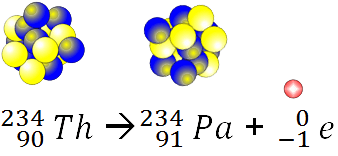
Which type of nuclear radiation is being emitted here?
a)
Alpha
b)
beta
c)
gamma 
d)
none
40.
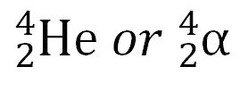
Has the symbol
a)
Alpha
b)
Beta 
c)
Gamma
41.
What do these symbols represent?
a)
alpha particle
b)
beta particle
c)
neutron
d)
gamma ray
42.
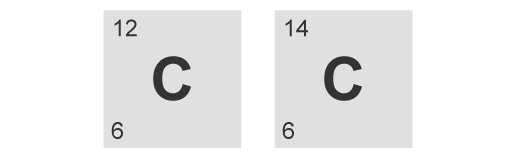
How are these isotopes different?
a)
Different atomic numbers
b)
Different number of protons
c)
Different number of neutrons
d)
Different number of electrons
43.
What is the mass number of at isotope that has 20 protons, 21 neutrons and 18 electrons?
a)
18
b)
20
c)
21
d)
41
44.
Why does an atom undergo beta decay?
a)
It has too many electrons.
b)
It has an atomic number greater than 83
c)
It has more neutrons than protons
d)
It has more protons than neutrons
45.

In the symbol 167N what the 7 stand for?

a)

Mass number

b)

Atomic number

c)

Atomic mass

d)

Number of neutrons

46.
The technetium-99 isotope has a half-life of 6.0 hours. If 100.0 mg were injected into a patient how much remains after 18 hours?
a)
33.0 mg
b)
12.5 mg
c)
.33 mg
d)
15.8 mg
47.
The half life of Thorium-234 is 24 days. What fraction of the element remains after 96 days
a)
1/2
b)
1/4
c)
1/8
d)
1/16
48.
Complete the sentence: As time passes the level of radiation produced by a radioactive material...
a)
Decreases
b)
Increases
c)
Remains constant
49.
If 10 mg of iodine 131 is given to a patient, how much is left after 24 days? The half-life of iodine-131 is 8 days.
a)
1.25mg
b)
1.25g
c)
10g
d)
10mg
50.
What is the half-life of iodine-131?
a)
32 days
b)
8 days
c)
16 days
d)
24 days
51.

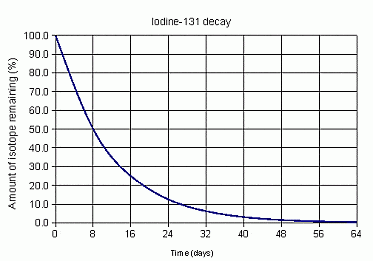
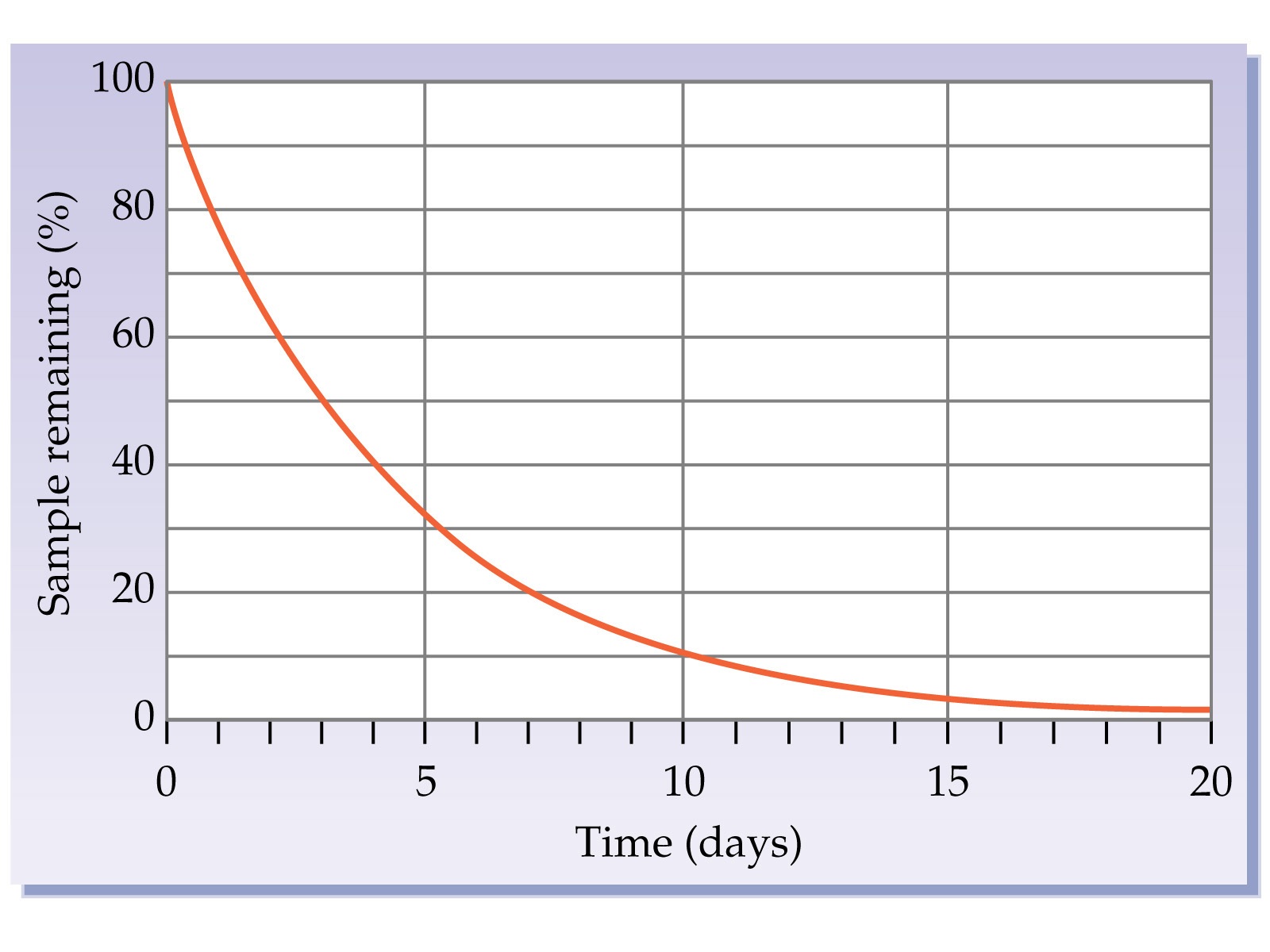
What is the Half Life of this isotope?

a)

3 days

b)

5 days

c)

8 days

d)

10 days

52.

Nuclear power plant uses ____ for fuel.

a)

steel

b)

coal

c)

uranium

d)

hydrogen

53.
Splitting a uranium atom is called - 
a)
fission
b)
fusion
54.
What is an advantage  of nuclear energy?
a)
radioactive waste
b)
no pollution
c)
we will never run out
d)
it is the safest way to make energy
55.

What nuclear process occurs in the sun?

a)

fission

b)

fusion

c)

endothermic

d)

atomic bomb

56.

This is an example of

a)

Nuclear Fission

b)

Nuclear Fusion

c)

No reaction

57.

A major scientific concern over nuclear energy is how to--

a)

store the waste products safely

b)

reduce the high levels of carbon dioxide emitted into the air

c)

deal with the large amounts of fossil fuels required

d)

prevent the depletion of the ozone layer