
 Worksheets
8th Grade Comprehensive SS STAAR Review
Total questions: 154
Worksheet time: 2hrs 28mins


Which statement shows how this excerpt is an example of transcendentalism in the early-to-mid 1800s?
Thoreau uses reason to explain natural events that happen in the world
Thoreau focuses on the role of science in changing the natural world.
Thoreau studies the relationship between nature and historical events.
Thoreau focuses on the relationship between humans and the natural world.
Which statement explains how the work of Dorothea Dix benefited U.S. society?
Mental-health facilities were opened to treat patients.
Doctors were required to get federal licenses to practice medicine.
States passed laws giving harsher sentences to criminals
The government distributed land to poor people.

Which word correctly replaces the question mark in the title of this timeline?
Suffrage
Abolitionist
Temperance
Transcendentalist

Which of the following best completes this excerpt?
equal pay
own property
a public education
vote


Andrew Jackson's election victory in 1828 depended on support from
the rich and well-born.
Native Americans.
the common people.
states' rights supporters.

Jacksonian Democracy
an informal group of trusted advisers who sometimes met in the White House kitchen
The practice of giving government jobs to political backers
The period of expanding democracy that gave voting rights to all white males
The Court ruled that the national bank was constitutional

The Trail of Tears refers to
Jackson’s angry negotiations with the Five Civilized Tribes.
the movement of Seminole Indians from the West to Florida.
government workers who lost their jobs due to Jackson’s spoils system.
the removal of Cherokee Indians from Georgia to Indian Territory in Oklahoma.
Which Supreme Court decision is most closely associated with the Trail of Tears?
McCullough v. Maryland
Gibbons v. Ogden
Worcester v. Georgia
Dred Scott v. Sanford

Which bank was Andrew Jackson having a conflict with?
First Bank of the United States
Second Bank of the United States
Pet Banks
State Banks


Vice President who declared that the states had the right to nullify any federal law with which they disagreed was who? This guy said people in South Carolina didn't have to pay the tariffs.
John Marshall
Martin Van Buren
John Douglas
John C. Calhoun

How did tariffs affect imported goods?
Tariffs lowered the prices of imported goods.
Tariffs made imported goods illegal to buy.
Tariffs set weight restrictions for imported goods.
Tariffs raised the cost of imported goods.

Andrew Jackson was seen as a national hero after defeating the British at what battle?
Battle of New Orleans
Battle of Yorktown
Battle of Little Big Horn
Battle of Saratoga
What was President Jackson's response to the nullification crisis?
He admitted that the Union was a "compact" of the states
He offered to raise tariffs to keep South Carolina in the Union
He conceded South Carolina's right to secede
He threatened to use force against South Carolina if it did not repeal its nullification policies

The Nullification Crisis happened when which state nullified a federal law
Georgia
Virginia
Maryland
South Carolina
William Crawford
John Quincy Adams
William Henry Harrison
Henry Clay
Corrupt Bargain
How Jackson viewed the deal between John Q. Adams and Henry Clay
Spoils System
The practice of replacing government employees with campaign supporters
McCulloch vs Maryland
Landmark case that supported the Constitutionality of the National Bank
Democrats
Political party supported westward expansion, and supported by the common man
Whigs
Opposition party to Jackson, based on English party that opposed the King
The (a) began as a result of South Carolina's belief in the principle of (b) to cancel "unconstitutional" laws.
Which of the following are considered results of the Indian Removal Act?
Worcester vs Georgia
Trail of Tears
Rechartering of the Second National Bank
Jackson ignoring a Supreme Court Decision
The creation of the Whig Party
The (a) was a result of Jackson's (b)
A _____________ is when an extreme change happens over a period of time, like the colonies replacing their government with a new one.
The economic policy where the colonies were mostly ignored and allowed to become self-sufficient is known as?
Salutary Neglect
Navigation Acts
What was the first direct tax imposed on the colonies by King George III? This was a tax on all printed materials.
This person was the leader of the Sons of Liberty, a protest group that organized boycotts against British goods.
John Hancock
George Washington
Samuel Adams
Thomas Jefferson
How did the colonists react to the Tea Act of 1773?
Colonist sent the Olive Branch Petition to the King
The Sons of Liberty dumped 342 chests of tea into the Boston Harbor
The 1st Continental Congress met
The first battles of the American Revolution took place
Which amendment in our Bill of Rights addresses this grievance - For Quartering large bodies of troops among us
3rd Amendment
2nd Amendment
4th Amendment
8th Amendment
Join or Die
1770, five colonists are killed in this violent event between the colonists and British soldiers, including Crispus Attucks
Boston Massacre
Lexington and Concord
Quartering Act
Parliament's reaction to the Boston Tea Party, closed the Boston Harbor, banned town meetings and enforced a stricter quartering act.
Intolerable Acts
Townshend Acts
Sugar Act
Tea Act
Which law forbad westward expansion beyond the Appalachian Mountains?
Quartering Act
Proclamation of 1763
Naviagation Acts
Stamp Act
How did the colonists react to the Intolerable Acts
Met at the First Continental Congress
Declared Independence
Sent the Olive Branch Petition
The First battles of the American Revolution, where the minutemen confronted the british redcoats was known as? (Shot heard round the world)
Battles of Lexington and Concord
Battle of Yorktown
Winter at Valley Forge
Who is considered the main author of the Declaration of Independence?
George Washington
Thomas Jefferson
John Hancock
Alexander Hamilton
Who was chosen as the Commander of the Continental Army?
Thomas Paine
Benjamin Franklin
George Washington
Mercy Otis Warren
The King of England during the American Revolution was -
George III
Henry VIII
Fernand II
Charles II
This Enlightenment philosopher influenced the author of the Declaration of Independence.
Thomas Paine
John Locke
Montesquieu
Voltaire
This Englishman wrote the pamphlet Common Sense to encourage independence in the colonies.
Thomas Jefferson
George Washington
King George III
Thomas Paine
This member of the Second Continental Congress is famous for this quote "Give Me Liberty or Give me Death"
Patrick Henry
James Madison
Benjamin Franklin
John Paul Jones
Eli Whitney
Henry Bessmer
Alexander Bell
Thomas Edison
Match the following
Cotton Gin
Increased slavery in the South
Interchangeable Parts
Mass Production of Goods
Steel Process
More Railroads
Erie Canal
Connected the Midwest to the East Coast and Cities grow in NY
Textile Mill
1st Factory System & Women moved to cities
The era in which a change from household or cottage industries to factory production using powered machinery took place.
American Revolution
Industrial Revolution
Technological Innovations
Boom and Bust
During the Industrial Revolution, the production of goods to the factory system. Select all the characteristics that apply to the factory system.
Steam Power
Create one product at at time
Work for yourself
Create multiple products at once

Many canals were built in the darker shaded states. These canals were built in order to connect -
Areas that are below sea level
mountain ranges
natural waterways
forested areas
How did Samuel Morse’s best known innovation contribute to U.S. growth and development?
It allowed manufactured goods to be produced at lower costs
It boosted the speed of cross-country mail delivery
It increased national unity by reducing sectional differences
It enabled instantaneous long distance transmission of information
How did the War of 1812 affect the US economy?
Agricultural imports increased
Imports of raw materials increased
The use of federal paper currency increased
Manufacturing increased
Which of these was an effect of the Industrial Revolution on U.S. women in the early nineteenth century?
Women in unions gained bargaining power with employers
The government passed laws to improve the safety for women in the workplace
Women seeking work migrated from rural communities to cities
State governments called conventions in support of women's suffrage
Which of the following were two effects of the Erie Canal on the US economy?
Reduced transportation costs of goods
Contributed to the growth of slavery
Limited flooding concerns for citizens
Led to a growth in trade
Provided irrigation for crops
Steel Process
Henry Bessemer
Cotton Gin
Eli Whitney
Steam Boat
Robert Fulton
Steel Tipped Plow
John Deere
Steam Engine
James Watt
In which court case was the U.S. principle of judicial review established?
Dred Scott vs Sanford
McCulloch vs Maryland
Worcester vs GA
Marbury vs Madison
Which precedent was established by the Supreme Court ruling in Marbury v. Madison?
The federal government has the power to regulate trade among the states.
State governments lack the authority to regulate federal bureaus.
Federal courts determine the constitutionality of a law
State courts lack the authority to hear cases challenging federal law.
Which landmark case established the constitutionality of the National Bank
Marbury vs Madison
McCulloch vs Maryland
Gibbons vs Ogden
Worcester vs GA

Which action should be added to this list?
Upheld the doctrine of states’ rights
Supported the popular election of Supreme Court justices
Allowed slavery to extend into western territories
Expanded the power of the Federal Government
Which court case allowed for the National Government to regulate interstate commerce?
Gibbons vs Ogden
Dred Scott vs Sanford
McCulloch vs Maryland
Marbury vs Maryland
Which court case stated that states could not interfere with federal agencies?
McCulloch vs Maryland
Worcester vs GA
Marbury vs Maryland
Dred Scott vs Sanford
Which precedent was established by the Supreme Court ruling in Gibbons v. Ogden?
The federal government has the power to regulate interstate commerce
State governments lack the authority to regulate federal bureaus
Federal courts determined the constitutionality of a law
State courts lack the authority to hear cases challenging federal law

The terms provided were most likely included in which of the following pieces of legislation?
Kansas Nebraska Act
Missouri Compromise
The Great Compromise
Compromise of 1850
What impact did the Kansas-Nebraska Act have on slavery?
It reopened the question of whether slaves would be permitted in the Northern territories of the Louisiana Purchase
It emancipated all slaves living in Kansas and Nebraska, making them into free men.
It halted the spread of slavery into Kansas and New Mexico.
It allowed slaves in Kansas to buy their freedom after a period of seven years of service to their owner.

What was one major impact of the book written by Harriet Beecher Stowe?
The profits from book sales funded early labor organizations
Congress was inspired to pass laws outlawing the abuse of slaves
The Supreme Court overturned fugitive slave laws
Support grew for the abolitionist movement
Which of the following was a result of the Kansas-Nebraska Act of 1854?
Fighting broke out between pro-slavery and anti-slavery groups in Kansas
Kansas entered the Union as a slave state through popular sovereignty in 1856
Nebraskan settlers who supported abolition moved to Kansas
The boundary established by the Missouri Compromise of 1820 extended farther south.

Which of the following best replaces the question mark in the diagram provided?
Prohibit slavery in the North
Nullified by Southern conventions
Allow for the use of popular sovereignty
Led to slave uprisings
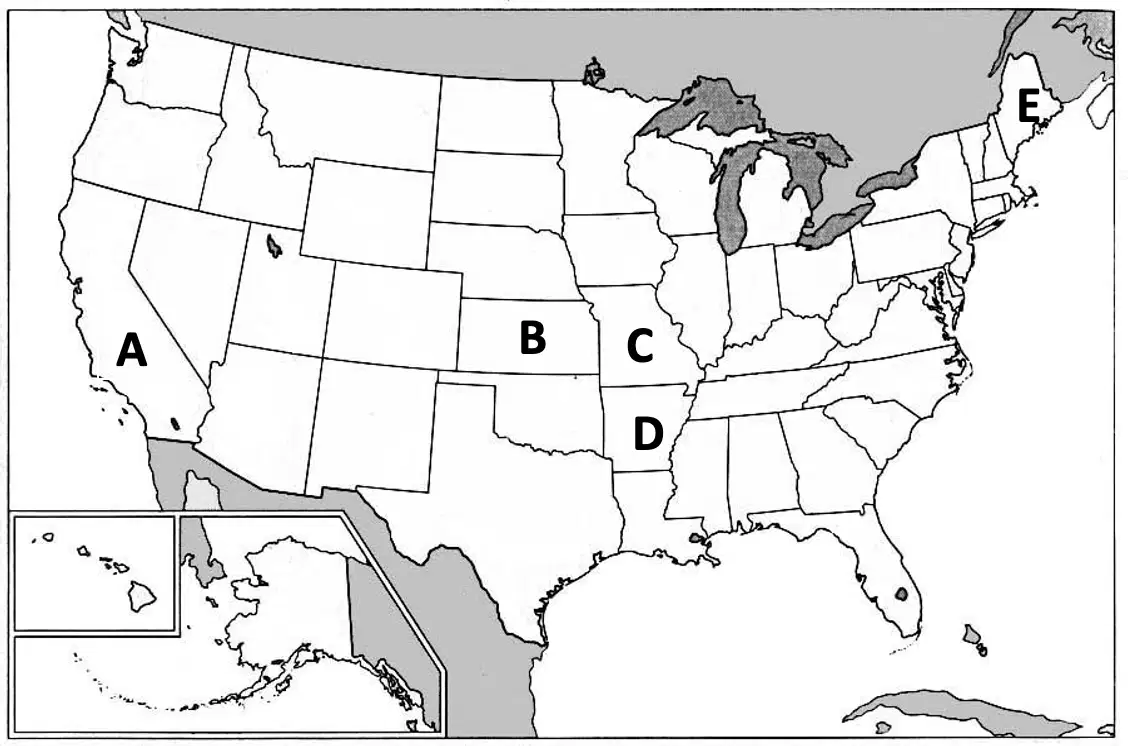
Which combination of states entered the Union under the Missouri Compromise?
A
B
C
D
E
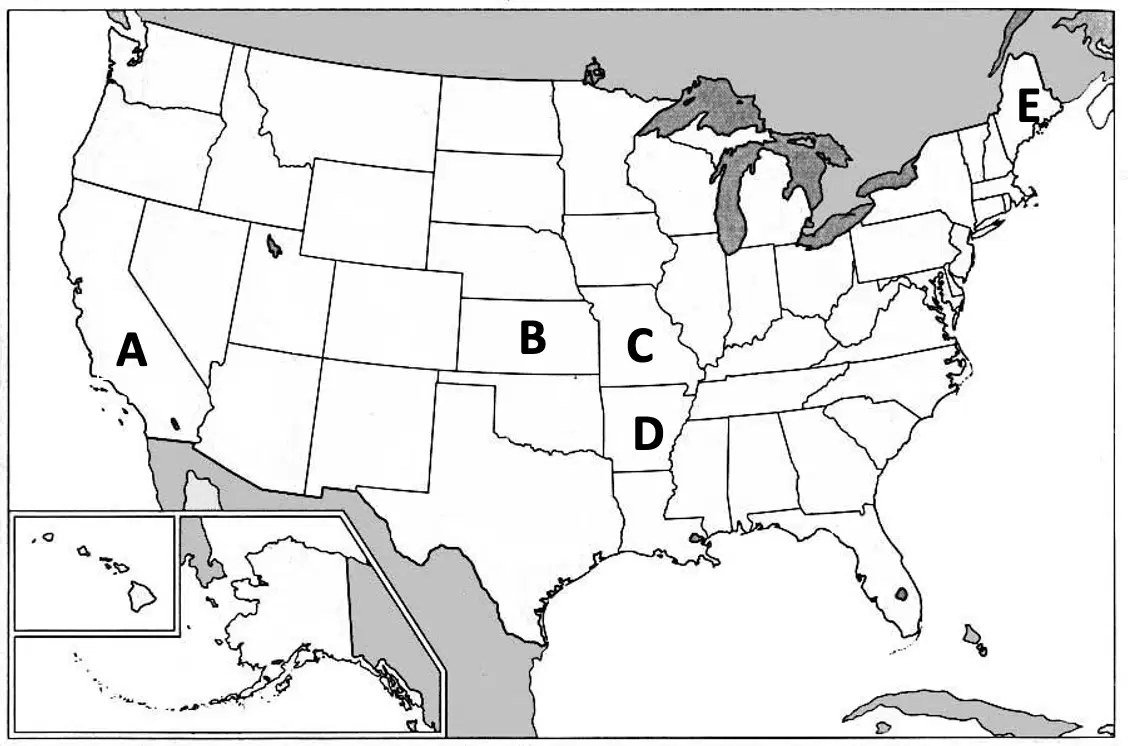
Which state entered in the Union as a free state under the Compromise of 1850?
A
B
C
D
E

What was one result of the law described in the excerpt provided?
Free African-Americans could be subjected to the horrors of slavery
Religious groups left the abolitionist movement to avoid political controversy
Southerners used the law to challenge the constitutionality of the Missouri Compromise
Abolitionist societies began to focus their efforts on promoting women’s suffrage

Which of the following best completes the diagram provided?
John C. Calhoun
John Quincy Adams
Stephen Douglas
Henry Clay
The Compromise of 1850 allowed certain territories to use popular sovereignty to determine whether the territory would be free or slave. This decision applied to much of the land gained from the –
Revolutionary War
War of 1812
U.S. Mexican War
Civil War
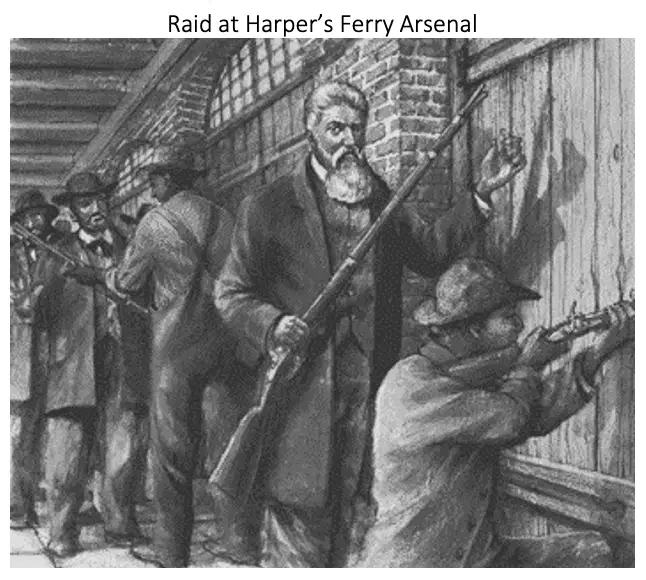
How is the event depicted in this image significant to the Civil War?
Northerners began to talk about secession from the Union
Southerners were upset by what they perceived to be Northern aggression
The invasion of the Confederate capital resulted in the surrender of the Confederacy
The Confederate attack upon the Union fort initiated the war

Which landmark court case is most likely being excerpted?
Marbury vs Madison
Plessy vs Ferguson
Gibbons vs Ogden
Dred Scott vs Sanford
Which of the following would be considered causes of the Civil War? (choose 3)
Sectionalism
Transcendentalism
Slavery
State's Rights
Impressment
When Republican candidate (a) won the election of 1860, (b) immediately seceded to form the (c)
Label the map using the following terms
Abraham Lincoln
Republican President of the Union
Henry Clay
"The Great Compromiser," Author of Missouri Compromise
Stephen Douglass
Proposed the use of Popular Sovereignty in the Kansas Nebraska Act
Charles Sumner
Northern Senator caned for his speech "Crimes Against Kansas"
Jefferson Davis
President of the Confederate States of America
(a) was overturned with the passage of the (b) Amendment
1st President
(Commander of Continental Army)
George Washington
2nd President
(Alien & Sedition Acts)
John Adams
3rd President
(Louisiana Purchase)
Thomas Jefferson
4th President
(War of 1812)
James Madison
5th President
(Prevented Colonization of Americas)
James Monroe
6th President
(Corrupt Bargain)
John Quincy Adams
7th President
(Leader of Common Man)
Andrew Jackson
8th President
(Panic of 1837)
Martin Van Buren
11th President
(Annexed Texas)
James K. Polk
16th President
(Civil War)
Abraham Lincoln
Why is the year 1803 significant to U.S. history?
Congress passed the Naturalization Act
The United States doubled in size
England declared war on the United States
Washington wrote his "Farewell Address"
Which problem did George Washington encounter when he became president?
Southern states were threatening to secede from the Union.
The United States had large debts from the American Revolution.
Great Britain was refusing to trade with the United States.
Disagreements between Thomas Jefferson and Alexander Hamilton led to -
the creation of reservations for American Indians
a struggle to ratify the Bill of Rights
the establishment of the first political parties
A (a) issue is something that happens inside the country, whereas a (b) issue is something that happens outside of the country and usually involves other countries.
Why did many farmers, artisans, and former Anti-Federalists support the Democratic-Republican Party?
The Democratic-Republicans favored the expansion of a strong national government.
The Democratic-Republicans supported strict restrictions on immigration.
The Democratic-Republicans favored states' rights and the rights of the common man.
A central issue contributing to the development of political parties in the United States was -
the expansion of U.S. territory
the role of the Supreme Court
the power of the federal government
Match the following issues during the Early Republic with their appropriate Founding Father:

Alexander Hamilton

Thomas Jefferson
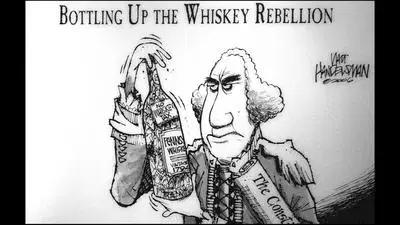
George Washington

James Madison
James Monroe
In his Farewell Address, George Washington warns us of two things: avoid creating (a) because they create division, and staying out of (b) because we need to focus on domestic issues.
Which action contributed to the start of the War of 1812?
Seizure of American ships by the Spanish navy
Attacks on American ships by barbary pirates
Impressment of American sailors into the British navy
Which of the following free slaves in states still in rebeliion on January 1, 1863?
13th Amendment
14th Amendment
Emancipation Proclamation
Act of Toleration
Match the following significant events with the proper era
Whiskey Rebellion
Early Republic
Establishment of Jamestown
Colonization
No Taxation without Representation
American Revolution
Bleeding Kansas
Sectionalism
Indian Removal Act
Age of Jackson
Match the following significant events with the proper era
Texas Annexation
Westward Expansion
Prohibition
Reform Movements
Missouri Compromise
Sectionalism
Appomattox Court House
Civil War
Freedmen's Bureau
Reconstruction
Fort Sumter
Initiated the Civil War
Antietam
Led to the Emancipation Proclamation
Gettysburg
Northern Turning point
Vicksburg
Divided the Confederacy in half
Appomattox Court House
Robert E. Lee surrenders to Ulysses S. Grant
Which of the following would be considered advantages of the Union during the Civil War?
Larger Population
Better Generals
More Factories
Navy
Home-field Advantage
Where did Robert E. Lee surrender to Ulysses S. Grant, ending the Civil War?
Washington, D.C.
Richmond, Virginia
Appomattox Court House, Virginia
Atlanta, Georgia
Which Civil War battle was the deadliest single day of fighting in the war and led to a Union victory as Robert E. Lee's Army of Northern Virginia had to retreat? This battle also marked the first time that the Southern army had invaded the North.
Battle of Vicksburg
Appomattox Court House
Battle of Gettysburg
Battle of Antietam
What was the original goal of the Union at the start of the Civil War?
Ban slavery
Restore the Union
Separate from the United States
Make slavery legal everywhere

