
 Worksheets
Unit Test 5, 6, 8, 28
Total questions: 52
Worksheet time: 27mins
_________ conquered the Inca and claimed what is now Peru for Spain
Hernando de Soto
Vasco Nunez de Balboa
Francisco Coranado
Francisco Pizarro
_________ claimed all land that touched the Pacific Ocean for Spain
Hernando de Soto
Vasco Nunez de Balboa
Francisco Coranado
Francisco Pizarro
_________ found Pueblo Indians and buffalo herds and the Great Canyon
Hernando de Soto
Vasco Nunez de Balboa
Francisco Coranado
Francisco Pizarro
_________ discovered the Mississippi River
Hernando de Soto
Vasco Nunez de Balboa
Francisco Coranado
Francisco Pizarro
_____: Pioneers were able to move through the Appalachian mountains to western farmland more easily.
The National Road
The Erie Canal
The Transcontinental Road
The Pony Express
_____: New York City became the largest seaport in the country.
The National Road
The Erie Canal
The Transcontinental Road
The Pony Express
_____: People and goods could travel across the country (from Nebraska to California) in less than 10 days.
The National Road
The Erie Canal
The Transcontinental Railroad
The Pony Express
_____: Mail was delivered across the country (from Missouri to California) in 8-10 days.
The National Road
The Erie Canal
The Transcontinental Railroad
The Pony Express
Popularized by their curved wagon box, six horse/oxen yoke, and white canvas hood, ___________ were used to carry freight and people from place to place in the early 1700s.
Consestoga Wagons
The Erie Canal
The National Road
Transcontinental Railroad
People who lived in teepees were from which region?
Southeast
Great Plains
Southwest
New Englanc
What is one way the Aztec and Maya were alike?
They both still exist today.
They both lived in hogans.
They both thought the cow was sacred.
They both built step pyramids.
Which of the following lists contains tribes of the Great Basin?
Cheyenne, Dakota, Apache
Algonquian, Powhatan
Nez Perce, Crow
Navajo, Hopi, Ute
Who tried to stop Bacon’s Rebellion?
Governor William Berkeley
Governor Ron Desantis
Governor George Washington
King Charles II
What evidence is there that the ancient Maya were a civilized society?
Archaeologists found stop signs and speed limit signs in the ruins.
The Maya were the first people to trade goods and services with other tribes.
They studied astronomy and they had a written symbol for zero in math.
There were china dishes, silverware and candelabras found in their homes.
In which part of the United States would you be likely to find the headquarters of the Seminole tribe?
Northeast
Southwest
Northwest
Southeast
Which tribe’s cultural symbols would you most likely see if you vacation this summer in the Northwest?
Cherokee
Tillamook
Navajo
Choctaw
After near extinction, American bison (buffalo) have recovered due to protection and care. In which region of the country can we infer that this happened?
Great Plains
Great Basin
Northeast
Southeast
Match the tribes with the area they lived in.
Caddo, Natchez, Cherokee, Creek, Timcua, Seminole
Southeast
Northwest
Great Plains
Southwest
Eastern Woodlands
Match the tribes with the area they lived in.
Anasazi, Navajo, Hopi, Zuni
Southeast
Northwest
Great Plains
Southwest
Eastern Woodlands
Match the tribes with the area they lived in.
Chinook and Tillamook
Southeast
Northwest
Great Plains
Southwest
Eastern Woodlands
Match the tribes with the area they lived in.
Arapaho, Apache, Cheyenne, Dakota
Southeast
Northwest
Great Plains
Southwest
Eastern Woodlands
Match the tribes with the area they lived in.
Iroquois and Algonquian
Southeast
Northwest
Great Plains
Southwest
Eastern Woodlands
What is Antonio Pigafetta’s journal an example of?
Primary Source
Secondary Source
Poetry
Reference
What were early Portuguese explorers trying to find?
a new place to live
freedom from discrimination
peaceful countries to become allies
a new trade route to India
Henry the Navigator sponsored _________________ to go exploring.
navigators
businessman
cartographers
astronomers
Hernando de Soto discovered the (a) River.
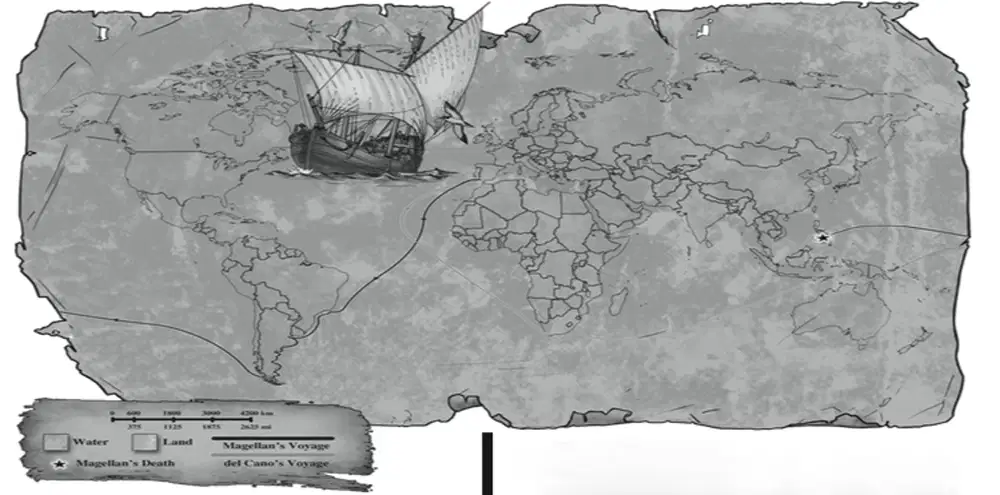
What can we infer by looking at the routes of the explorers?
They explored almost all of what is now the United States of America.
They didn't have good maps and stayed fairly close to the shorelines.
They were insisted in America but not South America.
They discovered gold just about everywhere they went.
Vasco de Gama used his knowledge of _______________ to keep him and his crew from getting lost on their journey to India that created a spice trade route.
Cartography
Astronomy
Languages
Ships
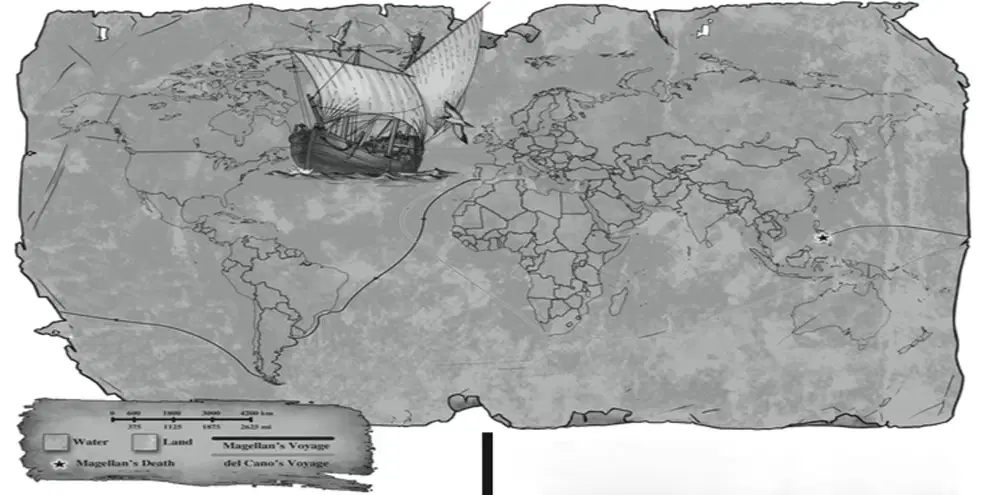
What happens in the Caribbean Sea today that happened to the explorers of the 1500s?
They explored almost all of what is now the United States of America.They crossed from the Caribbean through the Panama Canal to the Pacific Ocean.
Their ships ran aground often because it is so shallow.
Sometimes their ships sank if they were caught in a dangerous hurricane.
They had to be careful not to sail their ships into oil rigs that drill in the Caribbean Sea.
Francisco Coronado found all of the following except _________________.
Pueblo Indians
Buffalo Herds
the Grand Canyon
gold and silver.
Which is the third event that happened in Magellan's expedition.
Magellan and his crew fins a route between islands that save time (later named the Strait of Magellan)
Magellan is killed by angry natives in the Phillippines.
Sebastians del Cano leads the remaining crew as they sail around the Southern tip of Africa.
Magellan and his crew spend months trying to start a colony in South America.
Vasco de Gama was a famous Portuguese sailor who helped connect continents of the world via trade.
Select the facts below that you know to be true about de Gama.
followed Henry the Navigators route away from Portugal
navigated the open sea with his knowledge of astronomy
followed Hernando de Soto's route away from Portugal
opened an important spice trade route between Europe and India
Which American Indian group from Mexico used chocolate to make a bitter, watery drink?
The Aztec
The Columbians
The Pinta
The Spaniards
Which of these helped connect the continents by making ocean voyages even faster?
New Amsterdam
Caravels
Textile Workshops
Slaves
In the 1500s, European nations sent settlers to the New World to do what?
trade food, take land, and transfer ideas
make friends, grow food and build farms
claim land, find labor and search for loot
steal ideas, settle down and sail often
In order to make sure there would be enough labor in the New World, some Europeans brought which of these with them?
children
work animals
machines
African slaves
Hernán Cortés improved Spanish society by bringing ______________ back to Europe from the Aztec people in Mexico.
chocolate
potatoes
sugarcane
peanuts
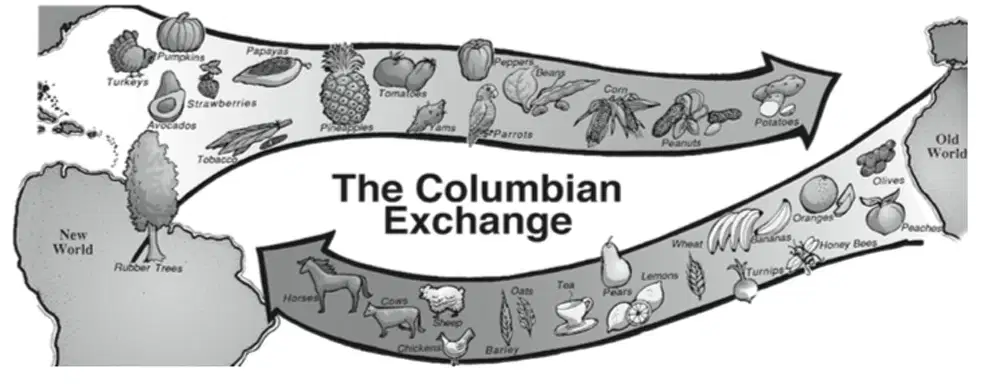
Europeans kept migrating to the New World because these items were found there and could be sent back to the Old World for a profit:
peanuts, potatoes, and turnips
papayas, strawberries and pineapples
wheat, barley and oats
tobacco, sheep and honey bees
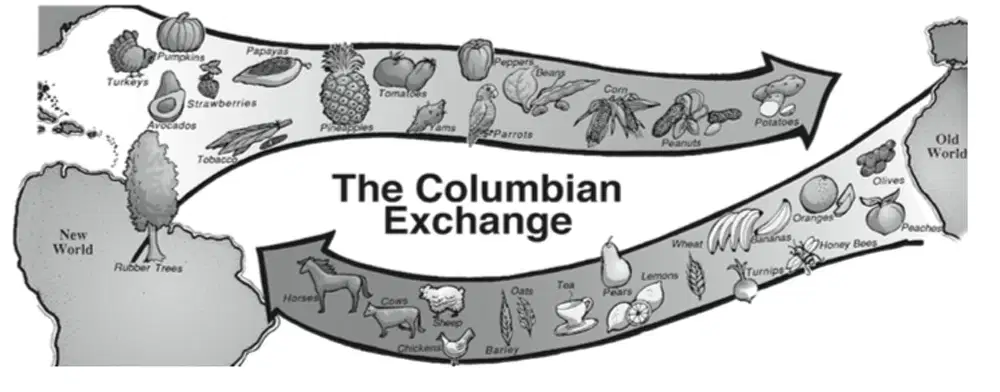
How were fruits like bananas, oranges, and pears traded?
west across the Atlantic Ocean, from the Americas to Europe
east across the Atlantic Ocean from the Americas to Europe
west across the Atlantic Ocean, from Europe to the Americas
east across the Atlantic Ocean, from Europe to the Americas
The Columbian Exchange brought ____________ to the New World, which killed thousands of American Indians.
cattle
Christianity
peanuts
diseases
corn, potatoes, tobacco
Transferred from the Old World to the New World
Transferred from the New World to the Old World
Christianity, disease, African Slaves
Transferred from the Old World to the New World
Transferred from the New World to the Old World
Choose an answer from the drop down menu to complete the sentence below. Of the 10 million slaves brought to America between 1500 and 1900, over
____
million died of disease.
2
4
6
8
In the 1500s, ships crossed the _______________ Ocean as they brought goods, ideas, and people from the Old World to the New World.
Pacific
Atlantic
Indian
Artic
Some say that a California newspaper ad for the Pony Express called for “young, skinny, wiry fellows.” Why did the Pony Express try to recruit these types of riders?
The Pony Express wanted to help children earn money for their families
The Pony Express uniforms were only made in small sizes to save fabric.
The Pony Express needed small, quick riders to keep their service speedy.
The Pony Express hired skinny riders because they didn't need as much to eat.
The National Road was similar to the Erie Canal in which way?
Both were suggested by Theodore Judah.
Both made travel quicker and easier.
Both were built by companies racing each other.
Both made it easier to ship items from seaports.
Who convinced railroad officials that tracks could be built across the Sierra Nevada Mountains?
Abraham Lincoln
Hepburn Russell
William Bradford Waddell
Theodore Judah
What differences set the Conestoga Wagon apart from other styles of wagon used by pioneers heading west?
curved wagon box, white canvas hood, a six-oxen yoke
white canvas hood, six-oxen yoke, a rectangular wagon box
four-oxen yoke, white canvas hood, curved wagon box
curved wagon box, six-oxen yoke, grey canvas hood
What was a fundamental difference between the flatboats and steamboats used to travel through canals in the early 1800s?
Steamboats could not travel downstream, but flatboats could.
Flatboats could not travel upstream, but steamboats could.
Steamboats could pick up farm produce, but flatboats could not.
Flatboats could carry passengers, but steamboats could not.
What effect did the invention of the telegraph have on the Pony Express?
The large number of telegraph messages sent meant more work for the Pony Express.
Telegraphs often needed repairs, so the Pony Express shipped the parts when needed.
People weren't sure how to use telegraphs so they continued to use the Pony Express.
The speed of messages sent via the telegraph made the Pony Express unnecessary.
Where did construction of the National Road begin?
Albany, New York
Sacramento, California
Cumberland, Maryland
Omaha, Nebraska
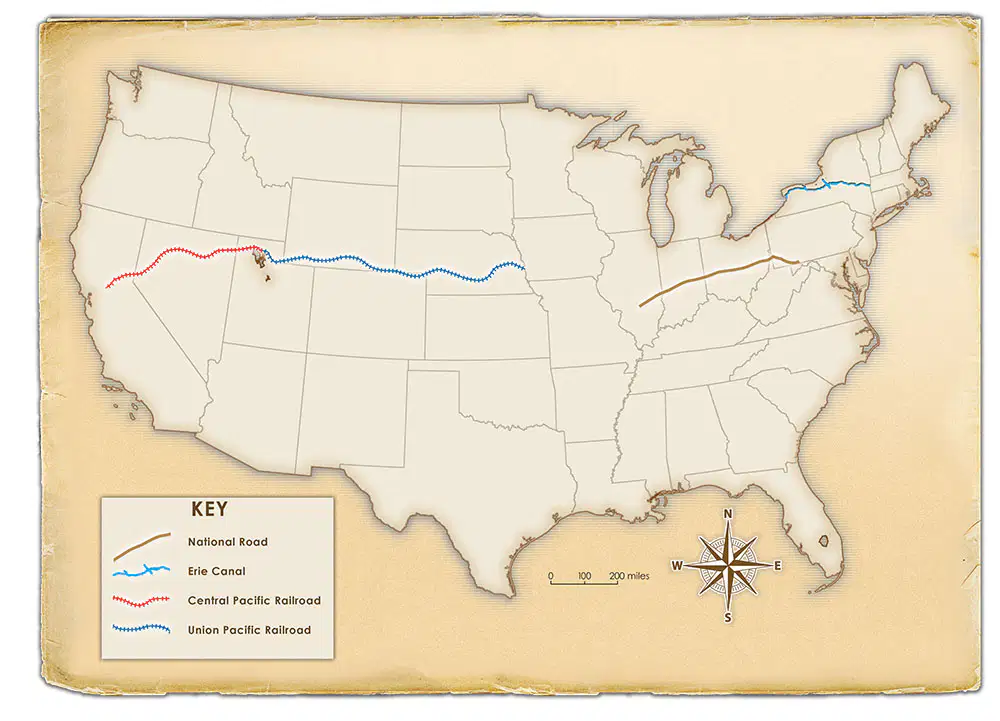
The National Road, Erie Canal, Central Pacific Railroad and Union Pacific Railroad were used for travel and shipping __________ across the United States
east to west
northwest to southeast
north to south
northeast to southwest

