wayground logo

Free Printable Worksheets

Font size

S
M
L
XL
Worksheets

Nuclear Chemistry, PT, Endo/Exo, Solutions

Total questions: 168

Worksheet time: 10hrs 2mins

Name
Class
Date
1.

Which diagram best represents the percentage of this radioactive isotope sample that will remain after 2 half-lives?

a)
b)
c)
d)
2.

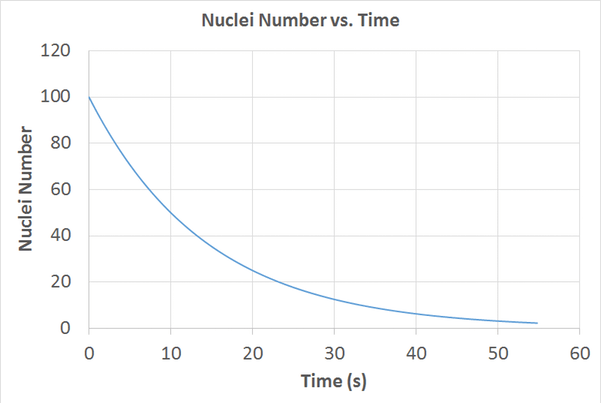
What is the Half life of this isotope?

a)

5 seconds

b)

10 seconds

c)

15 seconds

d)

20 seconds

3.

The half-life of Zn-71 is 2.4 minutes. If 6.25 g of Zn-71 are needed for an experiment, how much should be prepared if it will take 9.6 minutes before the experiment can begin? (FIND Mi)

a)

100.0g

b)

50.0g

c)

12.5g

d)

8.5g

4.

Barium-122 has a half-life of 2 minutes. If after 10 minutes a sample of 15.0 g is left, what mass must have been initially present?

a)

30 g

b)

480 g

c)

240 g

d)

120 g

5.

The half-life of Po-218 is three minutes. If it is allowed to decay from 150.0 grams to 2.34 grams, how many half lifes have occured?

a)

6 half lifes

b)

3 half lifes

c)

8 half lifes

d)

5 half lifes

6.

The half-life of strontium-90 is 25 years. How much strontium-90 will remain after 100 years if the initial amount is 4.0 g? Round to two decimal points.

(a)  
7.

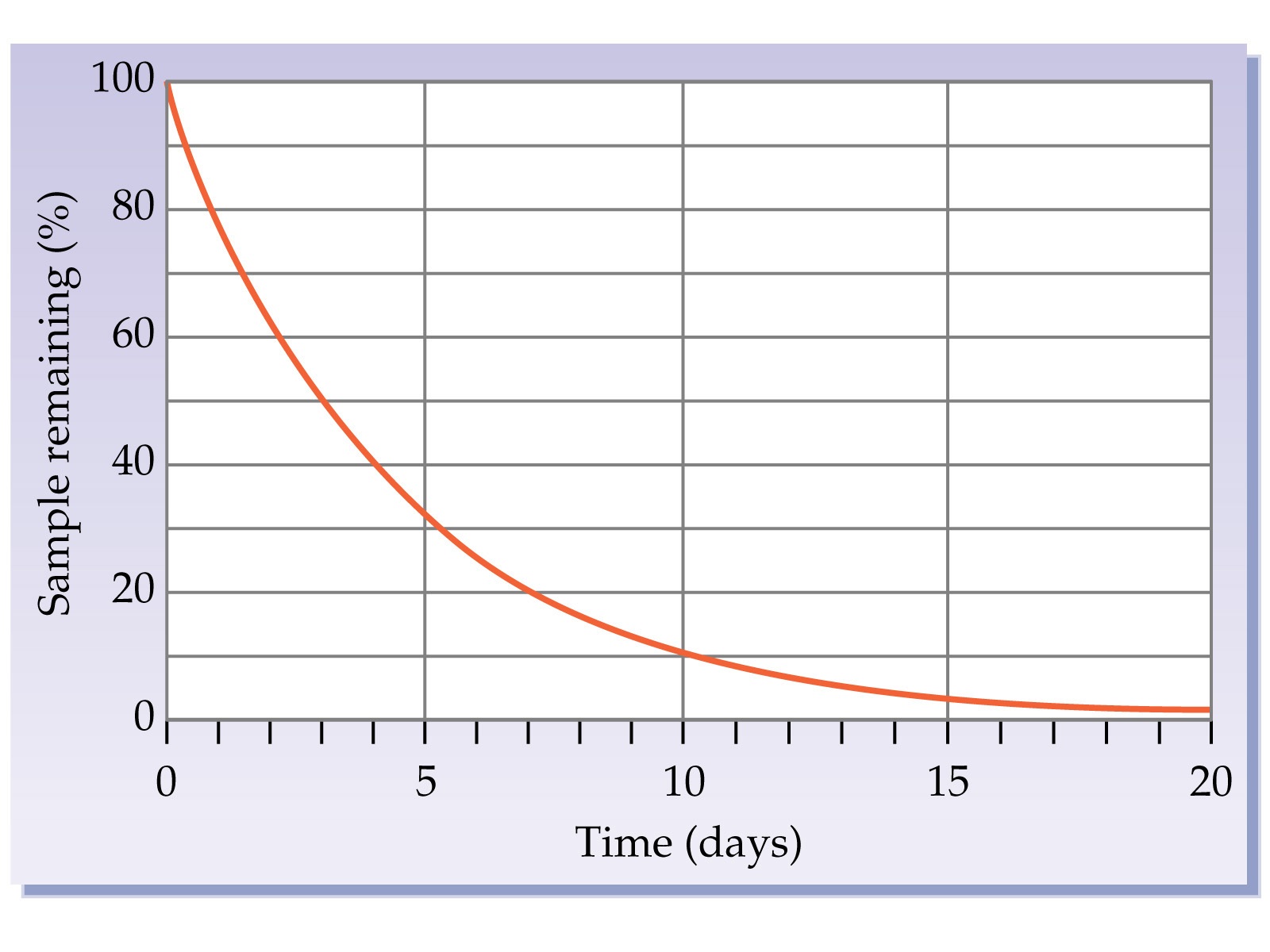
What is the Half Life of this isotope?

a)

3 days

b)

5 days

c)

8 days

d)

10 days

8.

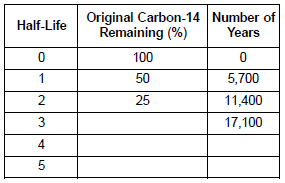
After 22,800 years, approximately what percentage of the original carbon-14 remains?

a)

15%

b)

12.5%

c)

6.25%

d)

3.125%

9.
A radioisotope of silver has half life of 10 minutes. What fraction of the original mass would remain after one hour?
a)
1/64
b)
1/2
c)
1/4
d)
1/8
10.
Selenium-83 has a half life of 25 minutes. How many minutes would it take for a 20 milligram sample to decay and only have 1.25 milligrams of it remaining? 
a)
25 minutes
b)
50 minutes
c)
75 minutes 
d)
100 minutes
11.

A 50.0 g sample of a radioactive element has a half-life of 40 years. How much mass will be left after 80 years?

a)

50

b)

25

c)

12.5

d)

6.25

12.

How long would it take for an element with a half-life of 100 years to reach 5 half-lives?

a)

50

b)

500

c)

5000

d)

5

13.
What is the universal solvent?
a)
salt
b)
sugar
c)
water
d)
ice
14.

A mixture with more solute dissolved in the solvent than is usually soluble is called:

a)

concentrated

b)

supersaturated

c)

saturated

d)

unsaturated

15.

When you have added as much solute as can dissolve in the solvent, the solution is called:

a)

concentrated

b)

supersaturated

c)

saturated

d)

unsaturated

16.
What is a solvent?
a)
The substance that does the dissolving in a solution.
b)
The substance that is being dissolved in a solution.
c)
The mixing of different substances.
d)
The process in which neutral molecules lose or gain electrons
17.
This is the part of a solution that dissolves
a)
Solute
b)
Solvent
c)
Solution
d)
Mixture 
18.
Kool-Aid - Powder, sugar, and water
Identify the solvent 
a)
water
b)
powder
c)
sugar
d)
powder and sugar
19.
salt water is a 
a)
compound
b)
element
c)
heterogeneous mixture
d)
solution
20.

Solubility refers to the ____ of solute that can dissolve in a certain volume or mass of solvent, at a certain temperature.

a)

Mean

b)

Range

c)

Amount

d)

Mode

21.
What does it mean to dilute a solution?
a)
lower the concentration of solute per solvent
b)
increase the concentration of solute per solvent
22.

What is the molarity of a 0.5L sample of a solution that contains 60.0 g of sodium hydroxide (NaOH)

a)

0.8 M

b)

1.5M

c)

3.0M

d)

6.0M

23.

Which of the following is the correct formula for calculating molarity?

a)

moles/liters of solution

b)

moles/kg of solvent

c)

# particles/Avogadro's #

d)

theoretical yield/actual yield

24.
How many moles of NaCl are present in a solution with a molarity of 8.59 M and a volume of 125 mL?
a)
1074 mol
b)
0.069 mol
c)
1.07 mol
d)
62.7 mol
25.
What is the molarity of 4 g of NaCl (MM=58.45) in 3,800 mL of solution?
a)
0.018 M
b)
0.0011 M
c)
1.052 M
d)
0.062 M
26.
How many grams of solute are dissolved in 125.0 mL of 5.00 M NaCl (MM = 58.45)?
a)
0.625 g NaCl
b)
625 g NaCl
c)
36.5 g NaCl
d)
0.04 mol NaCl
27.

Which of the following is the Dilution Formula?

a)

V1M1 = V2M2

b)

M = m/V

c)

V = mT

d)

PV = nRT

28.

A dilution is when

a)

solute is added to the volume of solution

b)

water is added to the volume of solution

c)

solute is removed from the volume of solution

d)

water is removed from the volume of solution

29.

What volume, in milliliters, of 10.0 M NaOH is needed to prepare 300.0 mL of 2.00 M NaOH by dilution?

a)

0.067 mL

b)

60.0 mL

c)

100 mL

d)

125 mL

30.
How many mL of 10.8M HCl are required to make 100.0 mL of 3.00M acid?
a)
27.8 mL
b)
27.78 mL
c)
2.8 mL
d)
278 mL
31.

What element has this electron configuration?

a)

hydrogen

b)

helium

c)

lithium

d)

beryllium

32.

What element has this orbital notation?

a)

lithium

b)

beryllium

c)

boron

d)

carbon

33.

What element has this electron configuration?

a)

helium

b)

lithium

c)

beryllium

d)

boron

34.

What element has this electron configuration?

a)

boron

b)

carbon

c)

nitrogen

d)

oxygen

35.

Which element is represented by this orbital notation?

a)

carbon

b)

nitrogen

c)

oxygen

d)

fluorine

36.

Which element is represented by this electron configuration?

a)

neon

b)

sodium

c)

magnesium

d)

aluminum

37.

Which element is represented by this orbital notation?

a)

neon

b)

sodium

c)

magnesium

d)

aluminum

38.

Which of the following is the electron configuration for Fluorine

a)
b)
c)
d)
39.

Which of the following is the electron configuration for neon?

a)
b)
c)
d)
40.

Which of the following is the electron configuration for silicon?

a)
b)
c)
d)
41.

Which of the following is the orbital notation for oxygen?

a)
b)
c)
d)
42.
An electron occupies the lowest energy orbital that can receive it.
a)
Hund’s rule
b)
Pauli exclusion principle
c)
Bohr model of the atom
d)
Aufbau principle
43.
All orbitals of equal energy are occupied by one electron before any single orbital is occupied by a second electron.
a)
Aufbau principle
b)
Pauli exclusion principle
c)
Hund’s rule
d)
Core Notation
44.
No two electrons in the same atom can have the same four quantum numbers.
a)
Aufbau principle
b)
Pauli exclusion principle
c)
Hund’s rule
d)
Noble gas notation
45.
Which guideline, Hund’s rule or the Pauli exclusion principle, is violated in the following orbital diagrams?
a)
Hund's
b)
Aufbau's
c)
Pauli's Exclusive
46.
Which guideline, Hund’s rule or the Pauli exclusion principle, is violated in the following orbital diagrams?
a)
Aufbau's
b)
Hund's
c)
Pauli exclusive
47.
Electrons are paired based on their spin directions, clockwise and counterclockwise, is what electron configuration rule?
a)
Hund’s Rule
b)
Aufbau Principle
c)
Pauli Exclusion Principle
48.

What is the element?

a)

Neon

b)

Chlorine

c)

Aluminum

d)

Argon

49.

What is the element?

a)

sulfur

b)

chlorine

c)

phosphorus

d)

silicon

50.

Which is the electron configuration for beryllium?

a)
b)
c)
d)
51.
Adding or subtracting neutrons (charge = 0, mass = 1) makes the element change into an...
a)
ion
b)
mixture
c)
isotope
d)
neutral atom
52.
The atomic number is equal to _.
a)
the number of protons and electrons
b)
the number of neutrons only
c)
the total number of protons and neutrons
d)
the number of protons neutrons and electrons
53.
What is the charge on a lithium atom that looses 1 electron?
a)
+1
b)
0
c)
-1
d)
-2
54.
Is the element shown in this image an ion, isotope or normal atom?
a)
atom
b)
isotope
c)
cation (+ ion)
d)
anion (- ion)
55.
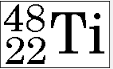
How many protons does this isotope of titanium have? Hint titanium has an atomic number of 22.
a)
48
b)
22
c)
26
d)
70
56.
What element is this?  What is the mass number of this atom?
a)
sodium, 23
b)
magnesium, 23
c)
magnesium, 12
d)
sodium, 11
57.
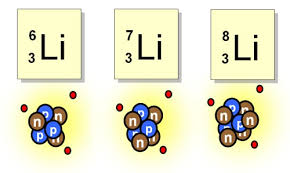
Which atom has  4 neutrons?
a)
Li-6
b)
Li-7
c)
Li-8
d)
they have the same # of neutrons
58.
What is the atomic number of Fe? (click to see image)
a)
26
b)
55.845
c)
56
d)
None of these
59.
How many neutrons does B (Boron) contain?
a)
5
b)
11
c)
6
d)
10.811
60.
Carbon has an atomic number of 6 and an atomic mass of 12. Which elements are considered isotopes of carbon?
a)
Carbon-12
b)
Carbon-13
c)
Carbon-14
d)
Both Carbon-13 and Carbon-14
61.
How many neutrons does Lithium have (atomic mass = 6.94)
a)
3
b)
4
c)
6.94
d)
24.94
62.

An atom with the same number of protons and electrons (no charge) and the expected atomic mass or number of neutrons from the periodic table.

a)

Neutral/Normal Atom

b)

Ion

c)

Isotope

63.

An atom that has gained or lost electrons in an attempt to become stable/bond with another atom.

a)

Normal/Neutral Atom

b)

Ion

c)

Isotope

64.

A negatively charged ion that has gained electrons to satisfy the octet rule (metals do this)

a)

Anion

b)

Cation

c)

Neutral Atom

d)

Isotope

65.

A positively charged ion that has lost electrons to satisfy the octet rule (non-metals do this)

a)

Anion

b)

Cation

c)

Neutral Atom

d)

Isotope

66.

Atoms of the same element that have different mass than expected because they have a different number of neutrons.

a)

Neutral Atom

b)

Ion

c)

Isotope

d)

Cation

67.

If an atom has 9 protons and 10 electrons it has a charge of ____.

a)

0

b)

-1

c)

+1

d)

-2

68.

If an atom has 4 protons and 2 electrons it has a charge of ____.

a)

0

b)

-2

c)

+2

d)

+1

69.

If an atom has a charge of +3 and an atomic number of 5 it should have _______ electrons.

a)

1

b)

2

c)

3

d)

4

70.

If an atom has a charge of -2 and an atomic number of 16 it should have _______ electrons.

a)

14

b)

16

c)

18

d)

20

71.

If an atom has a charge of 0 (neutral) and an atomic number of 8 it should have ____ electrons.

a)

0

b)

8

c)

7

d)

9

72.

Which of the following is the strongest base?

a)

oven cleaner - 13.5

b)

lemon juice - 2.5

c)

soap - 10

d)

blood - 7.4

73.

Which of the following is the weakest base?

a)

oven cleaner - 13.5

b)

lemon juice - 2.5

c)

soap - 10

d)

blood - 7.4

74.

Which of the following is the strongest acid?

a)

oven cleaner - 13.5

b)

lemon juice - 2.5

c)

soap - 10

d)

blood - 7.4

75.

Solutions that have more OH– ions than H+ ions are

a)

acids

b)

bases

c)

enzymes

d)

neutral

76.

Solutions that have more H+ ions than OH- ions are

a)

acids

b)

bases

c)

enzymes

d)

neutral

77.

Which of the following is the strongest base?

a)

soap - 10

b)

HCL - 0

c)

blood - 7.45

d)

soft drink - 3

78.

Which of the following is the strongest acid?

a)

soap - 10

b)

HCL - 0

c)

blood - 7.45

d)

soft drink - 3

79.
a)

detergents

b)

milk

c)

bleach

d)

orange juice

80.

A scientist runs tests on an unknown substance. He finds that it is extremely corrosive. It produces H+ ions in solution. And, it has a pH of 1. What type of substance has he identified?

a)

weak acid

b)

strong acid

c)

weak base

d)

strong base

81.

A substance is found to have the following characteristics:


Very bitter taste

Feels slippery to the touch

Produces OH- ions when dissolved in water


In what category would the substance be classified?

a)

acid

b)

base

c)

enzyme

d)

fatty acid

82.

Which of the following is the strongest acid among the choices listed here?

a)

lemon juice - 2.5

b)

sodium hydroxide - 14

c)

soap - 10

d)

urine - 6

83.

Which of the following is the weakest acid among the choices listed here?

a)

lemon juice - 2.5

b)

sodium hydroxide - 14

c)

soap - 10

d)

urine - 6

84.

Which of the following is the strongest base among the choices listed here?

a)

lemon juice - 2.5

b)

sodium hydroxide - 14

c)

soap - 10

d)

urine - 6

85.

What type of solution is formed when the H+ ions equal the OH- ions?

a)

acidic

b)

basic or alkaline

c)

neutral

d)

enzymatic

86.
Which type of radiation has the greatest penetrating power?
a)
Alpha
b)
Beta
c)
Gamma 
d)
Microwaves
87.
The technetium-99 isotope has a half-life of 6.0 hours. If 100.0 mg were injected into a patient how much remains after 18 hours?
a)
33.0 mg
b)
12.5 mg
c)
.33 mg
d)
15.8 mg
88.
What happens to the atomic number during alpha decay?
a)
The atomic number decreases by 4
b)
The atomic number increases by 1
c)
The atomic number decreases by 2.
d)
The atomic number stays the same.
89.
Arrange in order of increasing ability to penetrate matter.
a)
Beta, gamma, alpha
b)
Alpha, gamma, beta
c)
Gamma, beta, alpha
d)
Alpha, beta, gamma
90.
Balance the following equation:
146C --> 0-1e + ________
a)
145B
b)
146C
c)
147N
d)
42He
91.

In the symbol 167N what the 7 stand for?

a)

Mass number

b)

Atomic number

c)

Atomic mass

d)

Number of neutrons

92.
The half life of Thorium-234 is 24 days. What fraction of the element remains after 96 days
a)
1/2
b)
1/4
c)
1/8
d)
1/16
93.
Complete the nuclear equation and determine the type of decay that is occurring in this reaction. 
a)
alpha
b)
beta
c)
gamma
d)
none
94.
Alpha particles have a _____ charge.
a)
+2
b)
0
c)
+1
d)
-1
95.
Barium-122 has a half-life of 2 minutes. A fresh sample weighing 80 g was obtained. If it takes 10 minutes to set up an experiment using barium-122, how much barium-122 will be left when the experiment begins?
a)
0.25g
b)
2.5g
c)
25g
d)
80g
96.
What does it mean when an element is radioactive?
a)
atom emits radiation
b)
nucei unstable due to uneven p to n ratio
c)
nuclei changes to become stable
d)
all of the above
97.
What is the missing isotope that will balance the following nuclear equation?
94Be  +  11H →  _____  +  42He
a)
105B
b)
105Ne
c)
63Li
d)
63C
98.
The time taken for half of an amount of radioactive atoms to decay.
a)
Nuclear fusion
b)
Full-life
c)
Dead time
d)
Half-life
99.
What is NOT a characteristic of an alpha particle?
a)
A negatively charged electron
b)
Stopped by paper
c)
A positively charged particle
d)
Low penetration
100.
If Thorium-234 undergoes a beta decay, What element will be left in its place?
a)
Actinium-234
b)
Thorium-233
c)
Protactinium-234
d)
Radium-230
101.
What is the name of the group that never reacts--ever ever they are stable with a full outermost ring!!!
a)
noble gases
b)
transition
c)
halogens
d)
borons
102.
The atoms along the staircase are called 
a)
metals
b)
nonmetals
c)
metalloids
d)
noble gases
103.
Which is an alkali metal?
a)
Magnesium
b)
Iron
c)
Sodium
d)
Europium
104.
Which term represents the attraction one atom has for the electrons in a bond with another atom?
a)
electronegativity
b)
electrical conductivity
c)
first ionization energy
d)
mechanical energy
105.
A solid element that is malleable, a good conductor of electricity, and reacts with oxygen is classified as:
a)
metal
b)
metalloid
c)
noble gas
d)
non metal
106.
Which elements have the most similar chemical properties?
a)
Si, As, Te
b)
N2, O2, F2
c)
Mg, Sr, Ba
d)
Ca, Cs, Cu
107.
Explain in terms of atomic structure why elements in group 18 are nonreactive.
a)
They all have 8 valence electrons.
b)
They are noble gases.
c)
They all have filled valence shells.
d)
They have an oxidation number of 0.
108.
An atom in the ground state has two electrons in its first shell and six electrons in its second shell. What is the total number of protons in the nucleus of this element?
a)
5
b)
2
c)
7
d)
8
109.
What is the net charge of an ion that has 8 protons, 9 neutrons, and 10 electrons?
a)
+1
b)
+2
c)
-1
d)
-2
110.
Which of these is NOT a halogen?
a)
fluorine
b)
bromine
c)
carbon
d)
 astatine
111.
Trends on the periodic table are related to the arrangement of ________ in each atom.
a)
protons
b)
neutrons
c)
electrons
d)
energy levels
112.
how many valence electrons must an atom have in order to be considered "Stable"?
a)
eight
b)
five
c)
six
d)
seven
113.
If an element GAINS 2 electrons, what will its ion charge be?
a)
plus 1
b)
plus 2
c)
minus 1
d)
minus 2
114.
What is the term for the horizontal rows on the periodic table?
a)
groups
b)
periods
c)
families
115.
Which term refers to atoms that have LOST electrons?
a)
anions
b)
cations
116.
which term refers to atoms that have GAINED electrons?
a)
cations
b)
anions
117.
Which element is "in a class by itself" and has only one proton and one electron?
a)
hydrogen
b)
helium
c)
boron
d)
carbon
118.
Which of the following elements belongs to the Alkali Earth metals group?
a)
sodium
b)
berylium
c)
hydrogen
d)
carbon
119.
Gold, Copper, and Silver belong to the _________ metals.
a)
alkali
b)
alkaline earth
c)
transition
d)
non-
120.
Carbon, hydrogen, and oxygen are _______ metals
a)
alkali 
b)
alkaline earth
c)
transition
d)
non-
121.
Elements are arranged by _____ on the periodic table.
a)
number of protons
b)
number of neutrons
c)
atomic mass
d)
color
122.
Which element is not a metal?
a)

He

b)
Re
c)
Al
d)
B
123.
Elements on the right side of the of the zigzag line are normally?
a)
non metals
b)
metals
c)
metalloids
d)
rare earth metals
124.
What does the C represent?
a)
atomic mass
b)
atomic number
c)
element name
d)
chemical symbol 
125.
Dmitri Mendeleey organized his periodic table in order of increasing.....
a)
density
b)
atomic number 
c)
atomic mass
d)
none of these
126.
Beryllium is in group number______.
a)
Group 2
b)
Group 3
c)
Group 4
d)
Group 7
127.
The period for Bromine is ___________.
a)
3
b)
2
c)
4
128.
Which of the following has a full outer level?
a)
Oxygen
b)
Neon
c)
Barium
d)
Carbon
129.
How many electrons does Si contain? (click to see image)
a)
14
b)
28
c)
2
d)
None of these
130.
Found in the nucleus of the atom
a)
electrons only
b)
protons only
c)
neutrons and protons
d)
neutrons and electrons
131.

The characteristic color bands that a hot, dilute gas emits when viewed with a spectroscope are called...

a)

emission spectra

b)

absorption spectra

c)

continuous spectra

d)

black body radiation

132.

What element is represented in this Bohr Model?

a)

Carbon

b)

Hydrogen

c)

Aluminum

d)

Lithium

133.
The shortest wavelength in visible light is______.
a)
violet
b)
red
c)
blue
d)
yellow
134.
_____ have the longest wavelengths and lowest frequencies of all electromagnetic waves.
a)
microwaves
b)
radio waves
c)
gamma rays
d)
ultraviolet
135.
_______ carry the greatest amount of energy. 
a)
x-rays
b)
gamma rays
c)
infrared rays
d)
visible light
136.
The shortest wavelength in visible light is______.
a)
violet
b)
red
c)
blue
d)
yellow
137.

The _____ determines the color of visible light.

a)

wavelength

b)

speed

c)

amplitude

d)

light

138.
Emission of light from an atom occurs when an electron
a)
drops from a higher to a lower energy level.
b)
   jumps from a lower to a higher energy level.   
c)
   moves within its atomic orbital.
d)
falls into the nucleus.
139.
A wave with a large wavelength will have a ______ frequency and _____ energy
a)
high, low
b)
high, high
c)
low, high
d)
low, low
140.
Blue visible light has a shorter wavelength than red visible light.
a)
True
b)
False
141.

Which drawing represents the process by which an emission line is formed? [Emission means that energy is being "emitted" or released by the atom.]

a)

A

b)

B

c)

C

d)

D

142.

Which drawing represents the process by which an absorption line is formed? [Absorption means that energy is being absorbed or taken-in by the atom.]

a)

A

b)

B

c)

C

d)

D

143.

An electron transitions from n = 6 to n = 3. Which wavelength is released?

a)

410 nm

b)

1875 nm

c)

1282 nm

d)

1094 nm

144.

An electron in n=4 has more _______ than an electron in n=2

a)

Stability

b)

Energy

c)

Spin

d)

Wave nature

145.

What color visible light is released when an electron transitions from n = 3 to n = 2?

a)

Red

b)

Blue

c)

Violet

d)

Green

146.

Which electron transition is associated with a higher energy wave?

a)

n = 4 to n = 3

b)

n = 4 to n = 2

c)

n = 4 to n = 1

147.
What is the light that you can see called?
a)
observatory
b)
wavelength
c)
visible light
148.
Emission of light from an atom occurs when an electron
a)
drops from a higher to a lower energy level.
b)
   jumps from a lower to a higher energy level.   
c)
   moves within its atomic orbital.
d)
falls into the nucleus.
149.
For an electron to change from ground state to an excited stated it must...
a)
Absorb energy
b)
Release energy
150.

Four gas spectra are given. What gases are in the unknown mixture?

a)

Gas B & Gas D

b)

Gas C & Gas B

c)

Gas A & Gas D

d)

Gas D & Gas C

151.
Which of the following is an example of nuclear fusion? 
a)
A plutonium atom is used to start a chain reaction that detonates a nuclear weapon 
b)
A uranium atom is split apart into lighter elements
c)
 Two hydrogen atoms are combined to form a helium atom
d)
Two hydrogen atoms bond with an oxygen atom to form a water molecule 
152.
In what part of an atom can protons be found? 
a)
Inside the electrons
b)
Inside the neutrons 
c)
Inside the atomic nucleus 
d)
 Inside the electron shells
153.
What is NOT a characteristic of gamma radiation?
a)
Most dangerous type of radiation
b)
High energy, high penetration
c)
stopped by thin metal
d)
Stopped by several feet of concrete or several inches of lead
154.
Has the symbol
a)
Alpha
b)
Beta 
c)
Gamma
d)
electron
155.
Has the symbol
a)
Alpha
b)
Beta
c)
Gamma
d)
proton
156.
Has the symbol
a)
Alpha
b)
Beta
c)
Gamma
d)
neutron
157.
In order of most to least penetrating radiation we have
a)
Alpha , Beta,  Gamma
b)
Beta , Gamma , Alpha
c)
Gamma, Beta, Alpha
d)
Gamma, Alpha, Beta
158.
Which type of nuclear radiation is being emitted here?
a)
Alpha
b)
Beta
c)
Gamma 
d)
none
159.
Has a mass of 4 and a charge of +2
a)
Alpha
b)
Beta
c)
Gamma
d)
neutron
160.
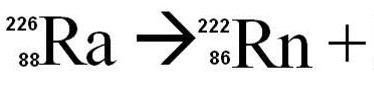
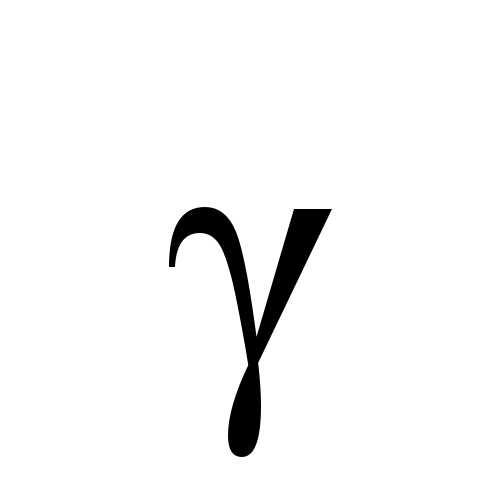
Which type of nuclear radiation is being emitted here along with Rn
a)
alpha
b)
beta
c)
gamma
d)
none
161.
This is an example of...
a)
Fission  reaction
b)
Fusion reaction
c)
Decomposition reaction
d)
Combustion
162.
How does nuclear fusion compare to nuclear fission? 
a)
Nuclear fusion produces no radioactive waste
b)
Nuclear fusion produces more radioactive waste
c)
. Nuclear fusion is cheaper and easier to produc
d)
Nuclear fusion requires rare, expensive elements to work
163.
Which of the following best describes the process of nuclear fission? 
a)
Splitting an atom's nucleus apart 
b)
Separating an atom's electrons from its nucleus 
c)
Fusing two atomic nuclei together 
d)
Splitting an atom's electrons in half 
164.
What do carbon-12 and carbon-14 have in common? 
a)
They have the same number of protons
b)
They have the same number of neutrons
c)
 They have the same atomic mass
d)
They have the same atomic weight
165.
How is carbon-12 different from carbon-14?
a)
They have a different number of protons 
b)
They have a different number of electrons
c)
They have a different number of neutrons
d)
They are different elements 
166.
If we start off with element 5024X after an gamma decay we get another element that looks like
a)
5224X
b)
5023X
c)
5024X
d)
5025X
167.
If we start off with element 5024X after an beta decay we get another element Y that looks like
a)
5023Y
b)
4622Y
c)
5025Y
d)
5024Y
168.
If we start off with element 5024X after an alpha decay we get another element Y that looks like
a)
5022Y
b)
 4622Y
c)
4820Y
d)
5426Y