
Font size
 Worksheets
Cold War UTW
Total questions: 33
Worksheet time: 32mins
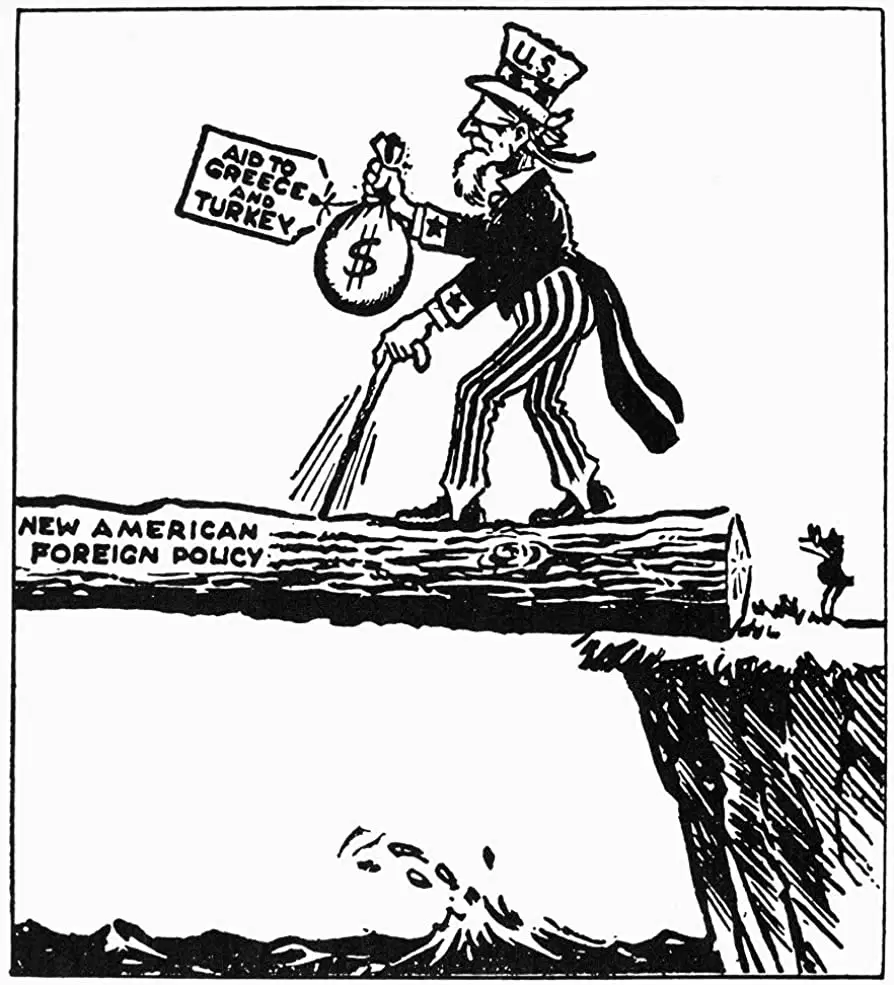
What policy implemented in the Cold War said the U.S. would give military aid to a country that needed to resist communism?
Marshall Plan
Truman Doctrine
Domino Theory
Open Door Policy

During what Cold War event did the U.S. bypass a Soviet blockade in Germany without provoking a military conflict?
Berlin Airlift
Vietnam War
Watergate Scandal
Bataan Death March

During the Cuban Missile Crisis, what did President J.F. Kennedy do when he heard that the Soviet Union was constructing nuclear missile sites in Cuba.
He launched a nuclear missile at the Kremlin in Moscow.
He gave into the demands of the Soviet & Cuban government.
He ordered a naval blockade around Cuba to prevent Soviet ships from bringing the necessary materials.
He declared war on the Soviet Union & Cuba.
What is NATO?
A military alliance between Western European Countries, the U.S. and Canada.
A military alliance between Western European Countries, the Soviet Union and China.
A military alliance between Eastern European Countries, Including the Soviet Union and its satellite nations.
A military alliance between Eastern European Countries.

Which event marked the end of the Cold War?
Allies unifying 4 sections of Germany to create West Germany
United States landing on the moon
Collapse of the Soviet Union
Signing of the Cold War peace treaty
Which word means, "easing/lessening of tension" wherein the U.S. engaged in peace-driven talks with communist nations like the Soviets?
Inflation
Détente
Stagflation
Constipation

Which of these events led to the breakup of the Soviet Union?
The arms race & government overspending with the Afghan War
Too many expenses and not enough revenue for the Soviet economy
Democratic reforms brought on by Mikhail Gorbachev
All of these

What did the destruction of the Berlin Wall symbolize in 1989?
the fall of communism and the Soviet Union
the fall of capitalism and the U.S.
the end of the Vietnam War
the end of the Cuban Missile Crisis

Which Cold War event is depicted in this political cartoon?
Soviet Afghan War
Vietnam War
Cuban Missile Crisis
Bandung Conference
What is the name of Mikhail Gorbachev's "economic restructuring" policy?
Glasnost
New Economic Policy
Perestroika
Detente

Which statement best explains why communist governments were established in most nations of Eastern Europe in the years following World War II?
Popular support for communist candidates allowed them to win free elections in these nations.
The Soviet Union used the threat of military action to force these nations to install communist governments.
Communist principles had a long history of support among the Eastern European population.
Struggling economies in the region believed agricultural productivity would improve greatly under communist leadership.

What was the name of the leader who led the Great Leap Forward and Cultural Revolution?
Deng
Mao
Meow
Qing

What were the goals of the Great Leap Forward?
To modernize China through agriculture and industry
To develop a stronger military
To make all the Chinese people work harder than ever before
To grow enough crops that they could sell what they don't eat

What was the Cultural Revolution?
Mao's attempt to regain control of China and get rid of anything "old" in the country
Introducing democracy to the Chinese people
Showing the rest of the world how powerful Mao was
Growing crops and producing steel at a very rapid rate
How did the Chinese government deal with the protestors at Tiananmen Square?
They asked them to leave
They let them protest as long as they wanted
They sent in soldiers and tanks and killed people
They dropped poison gas from the air and dispersed the crowd
Which statement best expresses the change in economic policy between Deng Xiaoping and Mao Zedong?
A more favorable attitude toward a market economy existed under Deng Xiaoping than under Mao Zedong.
Deng Xiaoping and Mao Zedong rejected Western capitalism.
Both Deng Xiaoping and Mao Zedong encouraged peaceful protest.
Deng Xiaoping wanted greater government control of the economy than Mao Zedong did.
What is a proxy war?
A war where powerful countries get weaker countries to fight for them.
A war where two superpowers fight against each other.
World War I and World War II.
A war when no countries fight against each other.
Who won the Korean War?
The North Koreans won and the whole country became communist.
The South Koreans won and the whole country became non-communist.
China won by defeating both North and South Korea.
No one won, so North and South Korea are still divided into two countries today.
Which country supported Fidel Castro, the communist leader of Cuba?
USA
USSR
Great Britain
Wakanda

How did the Marshall plan try to stop the spread of communism in Western Europe after WWII?
by providing government housing for refugees
by providing military assistance to Vietnam
by providing money to any country trying to resist communism
by selling weapons to Vietnam
Why did the U.S. support the Somoza family even though they were corrupt and bad for the people of Nicaragua?
Because they were not communists.
Because they were communists.
Because the Somoza family ruled all of Central America.
Because the U.S. didn't want to have any control over Central America.
Where did the Chinese Nationalist flee to after they lost the Chinese civil war?
Soviet Union
Mongolia
India
Taiwan
The United States decided to support _____, in the early 1970s, even though it was communist, because it would upset the Soviet Union and weaken their ties.
Cambodia
Vietnam
Korea
China
The U.S. sent troops to ______ in order to defeat the communists in the north and ended up getting stuck in a lengthy & costly war.
China
Vietnam
El Salvador
Angola
Which country had a civil war which lasted for 27 years involved the Soviets and Cubans supporting the MPLA and the US with South Africa supporting UNITA?
Angola
Korea
China
El Salvador
Which of these events was the closest the United States and the Soviet Union actually came to fighting each other during the Cold War?
Cuban Missile Crisis, 1962
Gulf of Tonkin, 1964
Bay of Pigs, 1961
Suez Crisis, 1956
How did Glasnot and Perestroika impact Gorbachev's ability to control and rule over the communist nations surrounding the Soviet Union? Describe
How was Berlin significant for the Soviets and the Western powers throughout the Cold War?
Was the formation of NATO and the Warsaw Pact beneficial or detrimental to the United States & the Soviet Union? Explain

