
 Worksheets
Question Bank for Grade 6 Science
Total questions: 80
Worksheet time: 1hrs 15mins
Scott travels north 5 miles and then goes west 3 miles before coming straight back south 2 miles. What is his distance?
10 miles
7 miles
8 miles
6 miles
Which is the length of the path an object has traveled?
displacement
distance
motion
reference point
1. Amy runs 2 miles south, then turns around and runs 3 miles north. What is displacement?
5 miles
1 mile North
2 miles South
2 miles
65 miles per hour North is an example of an object's what?
Speed
Velocity
Average Speed
Constant Speed
10 miles per hour is an example of an object's what?
Velocity
Speed
Acceleration
Inertia
What is a difference between distance and displacement
Distance is measured in seconds and displacement is measured in meters
Distance is always shorter than displacement
Displacement can be equal to zero if the object ends in the place it began in
This word describes how far an object has moved - its total journey
displacement
distance
motion
reference point
This is the difference between the initial position and the final position of an object
Reference Point
Displacement
Motion
Distance
Comparing your location to a starting point, or a _________, helps describe where you are
reference point
displacement
distance
motion

Two people walk across a parking lot. Their paths are shown in the image. Who traveled a larger distance?
Person A
Person B
They both went the same distance
Two people walk across a parking lot. Their paths are shown in the image. Who traveled with a larger displacement?
Person A
Person B
They both had the same displacement.

Stickdude traveled from A through B to C then D and back to A. What was his total distance traveled?
16 m
8 m
0 m
32 m
Stickdude traveled from A through B to C then to D and back to A. What was the magnitude of his total displacement?
16 m
8 m Northeast
0 m
32 m
Which is true?
Speed is measured in m/s but velocity is measured in s/m
Speed is a vector and velocity is a scalar
Speed and velocity are the same exact thing
Speed is like velocity but without a direction
18 km/hr North
speed
velocity
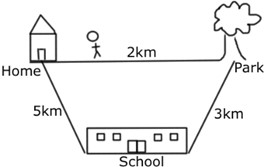
Jerry walked from home to school, then from the school to the park. What is his total distance?
2 km
5 km
8 km
10 km


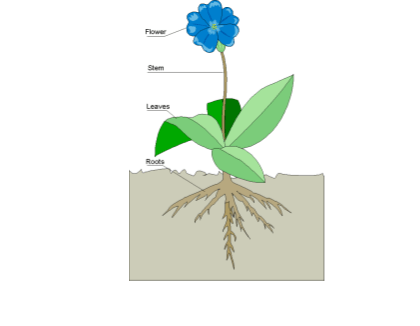
Where do plants get the energy for photosynthesis to take place?
nutrients in the soil
the sun
chlorophyll
bee pollination

Photosynthesis is used to produce food for plants in the form of glucose. In the process, oxygen is released. As shown in the diagram, plants require water and carbon dioxide (from the air). What else is required for photosynthesis and what role does it play?
Light is required to provide energy for photosynthesis.
ATP is required as an energy source for photosynthesis.
Glucose is required as an energy source for photosynthesis
Oxygen is required to split water molecules in photosynthesis.


What are the three Metric basic units of measurement?
meter, liters, and grams
mililiters, centimeters, miligrams
kilograms, mililites, meters
What tool do you use to measure length?
ruler
beaker
graduated cylinder
triple beam balance
What tool do you use to measure mass?
ruler
beaker
graduated cylinder
triple beam balance
What tool do you use to measure liquid volume?
ruler
graduated cylinder
triple beam balance
What tool do you use to measure volume of a regular solid?
ruler
graduated cylinder
triple beam balance
What tool do you use to measure volume of an irregular solid?
ruler
gradulated cylinder
triple beam balance
What do you call the procedure for measuring volume of an irregular solid?
balancing
displacement
measuring
L x W x H
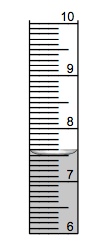


What does the mass on the triple beam read?
522 g
250.2 g
252 g
225 g
What is a hypothesis?
the thing changed on purpose in the experiment
an explanation about what you observed
using your 5 senses to gather data
an educated guess about the outcome of an experiment
What words should be in your hypothesis?
I think
If ...then...because...
It will
I believe
Choose the correctly written hypothesis for "What is the effect of putting Pam Cooking Spray on the bottom of a sled?"
I think the sled will slide faster.
If I put Pam Cooking Spray on the bottom of my sled, then I will win the race."
If I put Pam Cooking Spray on the bottom of my sled, then I will slide faster because the spray will cause the sled to be slick.
The independent variable is
the part the scientist measures
the part the scientist changes or is testing
a letter
The dependent variable is the part
the letter in the equation
the part being changed
the part being measured
Which hypothesis is correctly written?
I think I will do well on my test today, because I ate a good breakfast.
If I eat a good breakfast, then I will do well on my test today because breakfast will help me think clearly.
If I eat a good breakfast, then I will earn a passing grade on my test today because breakfast will help me think clearly.
If I do well on my test today, I get to out to eat for breakfast.
A hypothesis is never wrong.
True
False
What you measure or observe in an experiment.
constant variable
controlled variable
dependent variable
independent variable
The ONE thing you change in an experiment.
constant variable
controlled variable
dependent variable
independent variable
All the things that have to stay the same in an experiment (except for the one thing you change).
constant variable
controlled variable
dependent variable
independent variable
Justin wants to determine the effect of fertilizer on the growth of grass. What is the independent variable?
amount of fertilizer
height of grass
type of plant
time
Justin wants to determine the effect of fertilizer on the growth of grass. What is the dependent variable?
amount of fertilizer
height of grass
type of plant
time
Randell wants to determine if salt in the water has a health effect on his goldfish. What is the independent variable?
how much salt is in the water
temperature
health of his goldfish
amount of algae in the tank
Randell wants to determine if salt in the water has a health effect on his goldfish. What is the dependent variable?
how much salt is in the water
temperature
health of his goldfish
amount of algae in the tank
conclusion
What axis does the dependent variable go on?
x axis
y axis


Which skier has 50% kinetic energy and 50% potential energy?
A
B
C

Which skier has 100% kinetic energy?
A
B
C

Which skier has 100% potential energy?
A
B
C
Chemical Energy is
PE
KE
Both
Sound Energy is
PE
KE
Both
Bang, travels in waves
potential
electrical
sound
mechanical
heat
thermal
electrical
sound
kinetic
potential
Fuel
radiant
chemical
elastic potential
kinetic
sound

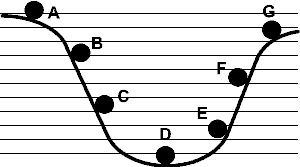
Which point has the most potential energy?
G
F
B
A


How could you change the design of the track to increase the gravitational potential energy at C?
Decrease the height of A
Increase the height of C
Decrease the height of C
Decrease the drop at D

