
 Worksheets
Unit 7 Test Review
Total questions: 28
Worksheet time: 14mins
Name
Class
Date
1.
Darwin drew ideas for his theory from observations of organisms on _________.
a)
the Samoan Islands
b)
Manhattan Island
c)
the Hawaiian Islands
d)
the Galápagos Islands
2.
Which of the following lists the four main principles of natural selection?
a)
adaptation, inheritance of acquired characteristics, overproduction of offspring, variation
b)
adaptation, inheritance of acquired characteristics, heritability, variation
c)
adaptation, descent with modification, overproduction of offspring, variation
d)
adaptation, descent with modification, heritability, variation
3.
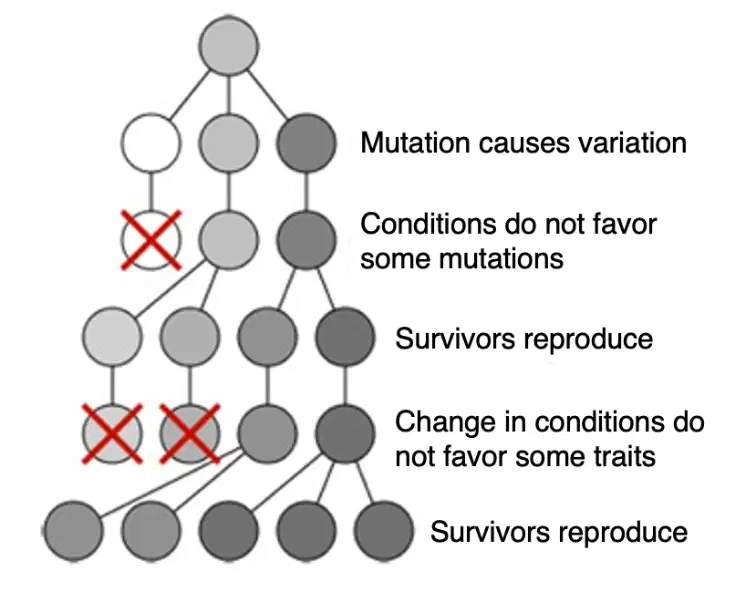
Consider the model for natural selection. In a population of living things, genetic variation exists. One source of variation is mutation. Which scenario listed here could be a mutation that causes members of a population to die out?
a)
In a population of fast-running cheetahs, some are born that run slower than most.
b)
In a populations of birds, mutations result in different beak sizes so the birds do not compete for food in the area.
c)
In a population of sunflowers, mutations cause some flower heads to produce more seeds.
d)
In a population of brownish rabbits that live in the tundra, some are born with fur that turns white in the winter.
4.
A trait that allows organisms/populations to be better suited to its environment is called a(n) _________.
a)
accommodations
b)
variation
c)
adaptation
d)
acclimation
5.
Natural selection could not occur without __________.
a)
genetic variation in species
b)
stable environments
c)
competition for unlimited resources
d)
gradual warming of the Earth
6.
A bird that can easily out-compete other birds for food & can produce many eggs has a high ____.
a)
fitness
b)
mutation rate
c)
life expectancy
d)
adaptability
7.
The peppered moth exists in 2 distinct colorations/phenotypes, black and peppered. Prior to the Industrial Revolution, peppered moths outnumber black moths 98% to 2%. The Industrial Revolution spewed coal ash into the air causing a discoloration on the trees on which they lived. The black moth now outnumbered the peppered moths 95% to 5%. In this example, scientists discovered that ________.
a)
the color of the moths was not important
b)
birds preferred the flavor of light-colored moths
c)
coloration was not an inherited trait
d)
moths whose color matched that of the tree trunks were more likely to survive
8.
Variations in genotype can be caused by all of the following except _________.
a)
mutations
b)
recombination of genes during crossing over
c)
asexual reproduction
d)
hybridization
9.
When individuals from two populations of squirrels can no longer successfully mate with each other, the chance that speciation will occur _________.
a)
decreases
b)
becomes zero
c)
stays the same
d)
increases
10.
In any field of sunflowers, the height of the plants vary. Birds first eat the seeds from the tallest plants. If this eating pattern continues season after season, what would happen to sunflowers over time?
a)
They would get shorter.
b)
They would become extinct.
c)
They would begin to reproduce asexually.
d)
They would stop producing seeds.
11.
What does being in genetic equilibrium mean for a population?
a)
The population is evolving very rapidly.
b)
The population is not evolving.
c)
Equilibrium would gradually end.
d)
Gene flow would occur, but slowly.
12.
The combined alleles of all the individuals in a population is called the _________.
a)
phenotype
b)
mutation rate
c)
gene pool
d)
allele frequency
13.
The hummingbird and trumpet plant have evolved together creating a specialized relationship between the two. This example of when two or more species become more adapted over time to each other’s presence is called ________.
a)
divergence
b)
radiation
c)
coevolution
d)
competition
14.
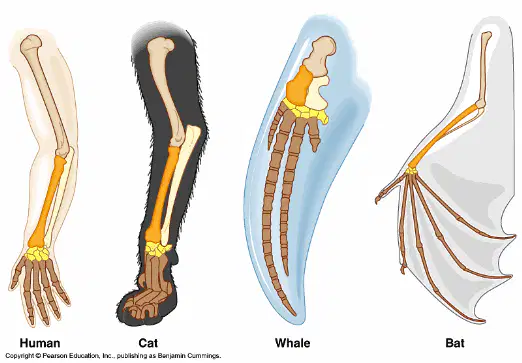
The similarity of these structures is one form of evidence that the organisms ________.
a)
share a common ancestor
b)
all grow at different rates
c)
evolved instantaneously
d)
do not share a common ancestor
15.
Anatomical structures that appear to be derived from a functional structure in an ancestor, but that currently do not serve an important function, are called ________ structures.
a)
homologous
b)
analogous
c)
vestigial
d)
fossilized
16.
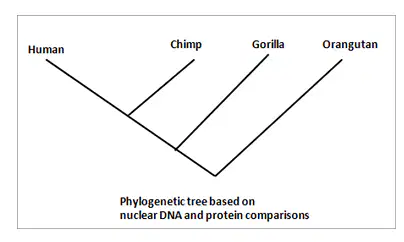
The phylogenetic tree illustrates the relationship between humans and our closest living relatives. The tree was based on biochemical comparisons, including DNA and amino acid sequences. What statement COULD we make about the four species based on the phylogenetic tree?
a)
The orangutan has nothing in common with the other three organisms.
b)
The four have molecular similarities, but have their own unique traits.
c)
The is no evidence of any connection between the four organisms.
d)
Humans are in no way similar to the other three organisms.
17.
The fact that many of the proteins produced by humans have identical or nearly identical counterparts in chimpanzees suggests that...
a)
all proteins are basically the same.
b)
humans and chimps actually belong to the same species.
c)
humans and chimps share a common ancestor.
d)
humans and chimps have convergently evolved.
18.
A population of bacteria is treated with an antibiotic. Because of variation in the population of bacteria, what is a possible outcome of the treatment?
a)
The population will be better able to obtain a food source.
b)
All of the bacteria will be resistant to the antibiotic.
c)
Some of the bacteria may be resistant to the antibiotic and survive.
d)
The population will increase rapidly.
19.
If scientists wanted to learn more about evolutionary history, they would study all but one of these molecules. Which biological molecule would NOT offer much information about the history of life?
a)
DNA
b)
Proteins
c)
Nucleic acids
d)
Phospholipids
20.
Genetic drift tends to occur in populations that _________________________.
a)
are very large
b)
are small
c)
are formed from new species
d)
have unchanging allele frequencies
21.
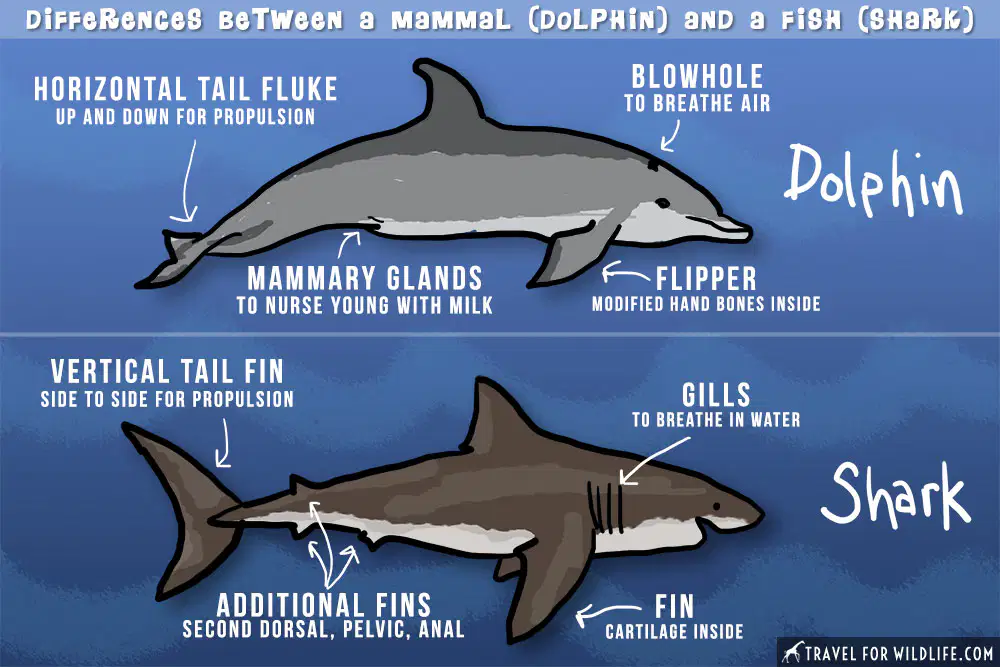
While the shark and dolphin are similar in appearance, dolphins evolved from ancestors that were very different from sharks. The current similarity between sharks and dolphins is an example of _________.
a)
coevolution
b)
biogeography
c)
convergent evolution
d)
divergent evolution
22.
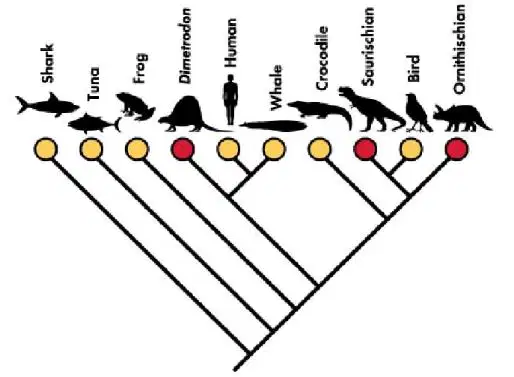
According to the diagram, which two organisms are most closely related?
a)
frog and human
b)
bird and human
c)
dinosaur and human
d)
whale and human
23.
Two bodily structures, found in different species, have different internal bone structures but serve a similar purpose in each organism. This is the best description of...
a)
homologous structures
b)
analogous structures
c)
vestigial structures
d)
natural selection
24.
Evidence of evolution from the field of paleontology examines...
a)
sequences of DNA and protein
b)
the location of different species across the planet.
c)
embryos of different species.
d)
fossils compared to living species.
25.
A population of mollusks are living in a stable ecosystem in the ocean. A rapid drop in sea level causes the formation of a lake, which isolates a group of mollusks from the rest. This quick environmental change causes rapid evolutionary change. Due to the new small population, genetic drift occurs, and mollusks with larger shells rapidly become the most common trait. Identify the pattern of evolution shown by this scenario.
a)
gradualism
b)
divergent evolution
c)
punctuated equilibrium
d)
speciation
26.
The Galapagos finches evolved through natural selection from a common ancestor into a wide variety of different looking species. Identify the pattern of evolution shown by this scenario?
a)
gradualism
b)
divergent evolution
c)
punctuated equilibrium
d)
speciation
27.
Which of these statements MUST be true if two different plants are members of the same species?
a)
They both produce flowers and seeds at the same time of year.
b)
Their leaf shapes and patterns appear to be exactly the same.
c)
They have the same number of chromosomes as one another.
d)
They can produce offspring plants that also produce fertile seed.
28.
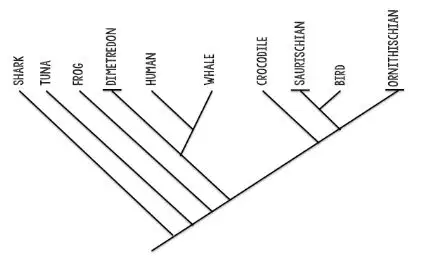
Analyze the figure below. Identify the organism most closely related to birds that are not extinct.
a)
crocodile
b)
human
c)
bird
d)
shark
e)
saurischians
100 %

