wayground logo

Free Printable Worksheets

Font size

S
M
L
XL
Worksheets

Unit 7 Test- Gene Expression & Biotech. Test Review

Total questions: 24

Worksheet time: 12mins

Name
Class
Date
1.

Through scientific research, genetic technologies have advanced the study of gene sequences. Which is a main benefit of gene therapy technology?

a)
the ability to cure genetic diseases by replacing defective genes
b)
the ability to genetically design organisms that have never existed
c)
understanding how human genes turn on and off to make carbohydrates
d)
making genetically superior plants and animals to benefit the entire world
2.

The term cloning in science can refer to several types of scientific technology, including therapeutic, reproductive, and recombinant DNA. Which result of reproductive cloning poses the greatest ethical issue?
a)
offspring that may transmit diseases
b)
cells without inherited genetic defects
c)
cells that may be used to heal damaged tisseus
d)
offspring with a heightened risk of developing health problems
3.

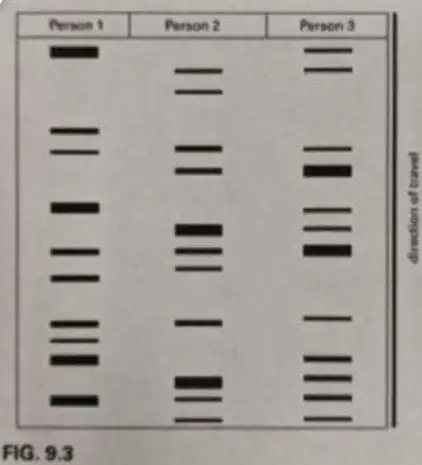
What is shown in Figure 9.3?

a)
Gene Sequencing
b)
Karyotype
c)
DNA Fingerprint
d)
Pedigree
4.

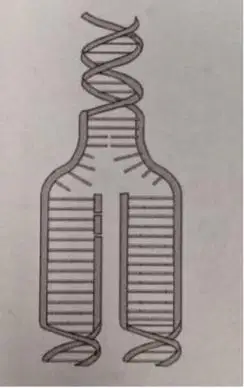
The diagram depicts the process of DNA replication. What is the significance of this process?

a)
provides the cell's genetic code to daughter cells
b)
ensures that proteins are synthesized for cell division
c)
provides the cell a chance to adapt to environmental changes
d)
ensures that environmental conditions are conducive to cell division
5.

In humans, where does DNA replication take place?

a)
cytoplasm
b)
ribosome
c)
nucleus
d)
vacuole
6.

Which of the following events occurs directly after a DNA molecule is unzipped?

a)
mismatched nucleotide bases are identified and replaced
b)
free-floating nucleotides pair up with exposed bases
c)
identical double-stranded DNA molecules are formed
d)
Enzymes break hydrogen bonds between base pairs
7.

Cystic fibrosis is an example of a genetic disease caused by the deletion of a nucleotide. What is the term for this type of mutation?

a)
translocation
b)
chromosomal
c)
gene mutation
d)
point mutation
8.

Crossing over occurs during meiosis. Sometimes the segments do not cross over properly. They may break off different sized segments and the resulting chromosome may be missing a gene or may have duplicated genes. They may also not exchange segments with the correct chromosome and will exchange with a nonhomologous chromosome (translocation). What type of mutations are these examples of?

a)
carcinogen
b)
chromosomal mutation
c)
point mutation
d)
frameshift mutation
9.

Errors sometimes happen during DNA replication. If a DNA nucleotide that contains guanine is accidentally substituted for a DNA nucleotide that contains thymine, which of the following will always happen because of the error in replication?

a)
The cell will produce mRNA with a mutated nucleotide sequence
b)
The cell will become a rapidly dividing cancer cell
c)
The cell will die when it divides
d)
The cell will have a better chance of surviving under different conditions
10.

The main function of tRNA is to

a)
carry a message that, when translated forms proteins
b)
form a portion of ribosomes, a cell's protein factories
c)
string together complementary RNA and DNA strands
d)
bring amino acids from the cytoplasm to the ribosomes
11.

What is the term for a three-nucleotide sequence that codes for an amino acid?

a)
base
b)
codon
c)
nucleotide
d)
serine
12.

A tRNA that carries the amino acid methionine pairs with which type of codon?

a)
serine codon
b)
tRNA codon
c)
start codon
d)
anticodon
13.

The process by which the order of bases in messenger RNA (mRNA) codes for the order of amino acids in a protein is called

a)
translation
b)
transcription
c)
replication
d)
nondisjunction
14.

Which of the following is the site of translation?

a)
vacuole
b)
lysosome
c)
nucleus
d)
ribosome
15.

DNA transcribes the information for protein synthesis in mRNA. Where does transcription take place?

a)
in the nucleus
b)
bound to amino acids on tRNA
c)
attached to the ribosomes
d)
in the cytoplasm
16.

During transcription, what does messenger RNA do?

a)
delivers DNA's instructions for making proteins
b)
constructs proteins out of random amino acids
c)
strings together two complementary DNA strands
d)
strings together two complementary RNA strands
17.

Why is DNA important for protein synthesis?

a)
DNA is used as a source of amino acids to produce a protein
b)
RNA molecules build a DNA strand that synthesizes a protein
c)
DNA interacts with the RNA to add amino acids during protein synthesis
d)
DNA is used as a template to produce RNA that is translated to a protein
18.

Which strand of the following identifies the process of forming a nucleic acid by using another molecule as a template and identifies its most common form?

a)
translation - the synthesis of RNA using one strand of DNA
b)
transcription - the synthesis of RNA using one strand of DNA
c)
replication - the synthesis of proteins using one strand of RNA
d)
protein synthesis - the synthesis of proteins using one strand of DNA
19.

During the process of protein synthesis, a section of the DNA molecule is copied into which other molecule?

a)
nucleic DNA
b)
cytoplasmic DNA
c)
messenger RNA
d)
transfer RNA
20.

Which sequence depicts the correct order of protein synthesis within a cell?

a)
DNA --> mRNA --> amino acids --> proteins
b)
DNA --> amino acids --> mRNA --> proteins
c)
DNA --> mRNA --> proteins --> amino acids
d)
DNA --> proteins --> amino acids --> mRNA
21.

Which BEST describes the interaction between DNA and RNA during protein synthesis?
a)
RNA carries the code to the nucleus where DNA translates the code into a protein
b)
DNA travels to the ribosome where RNA translates the code into a protein
c)
RNA carries the code from the DNA in the nucleus to the ribosome for protein synthesis
d)
DNA travels to the cytoplasm while RNA remains in the nucleus
22.

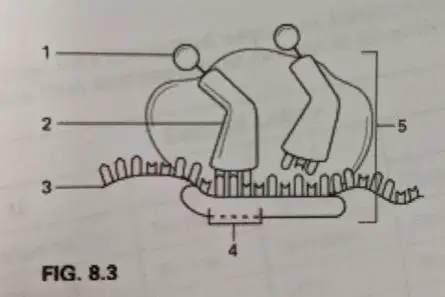
What process is shown in figure 8.3?

a)
translation
b)
replication
c)
transcription
d)
synthesis
23.

The process that converts an mRNA message into a polypeptide or amino acids

a)
Translation
b)
Mutation
c)
Start Codon
d)
Stop Codon
e)
RNA
24.

A change in an organism's DNA

a)
Mutation
b)
Start Codon
c)
Stop Codon
d)
Translation
e)
RNA