
 Worksheets
Final Review #2
Total questions: 32
Worksheet time: 16mins
Name
Class
Date
1.
In Medieval times, religion reigned supreme. The church expected all people to focus on God and his teachings without question. The Humanistic approach of the Renaissance questioned everything, and often butted heads with the Roman Catholic Church. With the shift of literature being written in common languages, the scriptures were too. Northern Europeans began to study and call out corrupt Christian clergy in the Roman Catholic Church. A Dutch Priest, Desiderius Erasmus, wrote The Praise of Folly to discredit some church rituals and refocus on Jesus’s teachings. It was such claims and concerns of Northern Europe that eventually lead to the Reformation, an era of change in the Church.
Source- Instructomania, Italian Renaissance Historical Snapshot, 2017
Based on the information in the passage, you can conclude that:
a)
Many people in Europe were unhappy with the Catholic Church.
b)
The Catholic Church was prepared to stamp out heretics.
c)
The Catholic Church had a less important role than major governments and kingdoms.
d)
The Humanistic approach was very unpopular in Europe.
2.
In Medieval times, religion reigned supreme. The church expected all people to focus on God and his teachings without question. The Humanistic approach of the Renaissance questioned everything, and often butted heads with the Roman Catholic Church. With the shift of literature being written in common languages, the scriptures were too. Northern Europeans began to study and call out corrupt Christian clergy in the Roman Catholic Church. A Dutch Priest, Desiderius Erasmus, wrote The Praise of Folly to discredit some church rituals and refocus on Jesus’s teachings. It was such claims and concerns of Northern Europe that eventually lead to the Reformation, an era of change in the Church.
Source- Instructomania, Italian Renaissance Historical Snapshot, 2017
The purpose of this passage is to:
a)
Explain the strained relationship between Desiderius Erasmus and the Catholic Church
b)
Explain the main teachings of humanist thinkers
c)
Explain the ways new ideas during the Renaissance led people to question the Church
d)
Explain the most important changes made during the Reformation
3.
During the Italian Renaissance almost every trade operated in a guild. A guild was a corporation made of many independent tradespeople. Bankers, merchants, tailors, and even artists belonged to guilds. Guilds had very strict rules governing their business practices and set up training programs for new members, who often entered the guild as apprentices, hoping to work their way up to “master” of the trade. In 1293 the Guild of Doctors, Apothecaries, and Grocers was established in Florence, Italy. The three trades operated in the marketplace, like many other merchants, offering their goods and services to consumers in their neighborhoods. Patients walked into apothecary stalls, where trained physicians and druggists would make medicines customized to the patient’s specific condition. Druggists also sold spices, sugar, wine, ink and paper, as well as grocery items. Because they were a large, organized group, they held political and economic power and could set and maintain prices for specific services and medicines.
According to the text, the medical profession was treated like a:
a)
Village
b)
Government
c)
Business/marketplace
d)
Recreation
4.
During the Italian Renaissance almost every trade operated in a guild. A guild was a corporation made of many independent tradespeople. Bankers, merchants, tailors, and even artists belonged to guilds. Guilds had very strict rules governing their business practices and set up training programs for new members, who often entered the guild as apprentices, hoping to work their way up to “master” of the trade. In 1293 the Guild of Doctors, Apothecaries, and Grocers was established in Florence, Italy. The three trades operated in the marketplace, like many other merchants, offering their goods and services to consumers in their neighborhoods. Patients walked into apothecary stalls, where trained physicians and druggists would make medicines customized to the patient’s specific condition. Druggists also sold spices, sugar, wine, ink and paper, as well as grocery items. Because they were a large, organized group, they held political and economic power and could set and maintain prices for specific services and medicines.
Based on the passage, you can infer that the druggist profession relied upon:
a)
The spice trade
b)
The knowledge of patients
c)
Patronage from wealthy Italians
d)
The number of apprentices they hired
5.
Where medieval art was two-dimensional and told mythical and spiritual stories, artists of the Renaissance learned perspective techniques such as shadowing and diverse subject size to create three-dimensional images. Additionally, the human body was scrutinized and art mediums from paintings to sculpture began to take into account the shape and tone of them. Everyday objects and religious based murals were created in their raw, natural form. Oil-based paints, linseed oil combined with color pigments, were also discovered. The well-known Italian artist Michelangelo is known for the paintings done on the ceiling of the Sistine Chapel with oil paints. He also penned poetry, drew plans for buildings, and carved sculptures.
Source- Instructomania, Italian Renaissance Historical Snapshot, 2017
Which of the following details best supports the topic sentence, “There are many differences between Medieval and Renaissance artwork”?
a)
Everyday objects and religious based murals were created in their raw, natural form.
b)
Oil-based paints, linseed oil combined with color pigments, were also discovered.
c)
The well-known Italian artist Michelangelo is known for the paintings done on the ceiling of the Sistine Chapel with oil paints
d)
Where medieval art was two-dimensional and told mythical and spiritual stories, artists of the Renaissance learned perspective techniques such as shadowing and diverse subject size to create three-dimensional images.
6.
Where medieval art was two-dimensional and told mythical and spiritual stories, artists of the Renaissance learned perspective techniques such as shadowing and diverse subject size to create three-dimensional images. Additionally, the human body was scrutinized and art mediums from paintings to sculpture began to take into account the shape and tone of them. Everyday objects and religious based murals were created in their raw, natural form. Oil-based paints, linseed oil combined with color pigments, were also discovered. The well-known Italian artist Michelangelo is known for the paintings done on the ceiling of the Sistine Chapel with oil paints. He also penned poetry, drew plans for buildings, and carved sculptures.
Source- Instructomania, Italian Renaissance Historical Snapshot, 2017
Which of the following details best supports the idea that Michelangelo was a man of many talents?
a)
Additionally, the human body was scrutinized and art mediums from paintings to sculpture began to take into account the shape and tone of them.
b)
Everyday objects and religious based murals were created in their raw, natural form. Oil-based paints, linseed oil combined with color pigments, were also discovered.
c)
The well-known Italian artist Michelangelo is known for the paintings done on the ceiling of the Sistine Chapel with oil paints.
d)
He also penned poetry, drew plans for buildings, and carved sculptures.
7.

25. Which image best supports the sentence, “Because people were largely uneducated artwork was more simple, flat, and two-dimensional”?
a)
Image A
b)
Image B
c)
Image C
8.
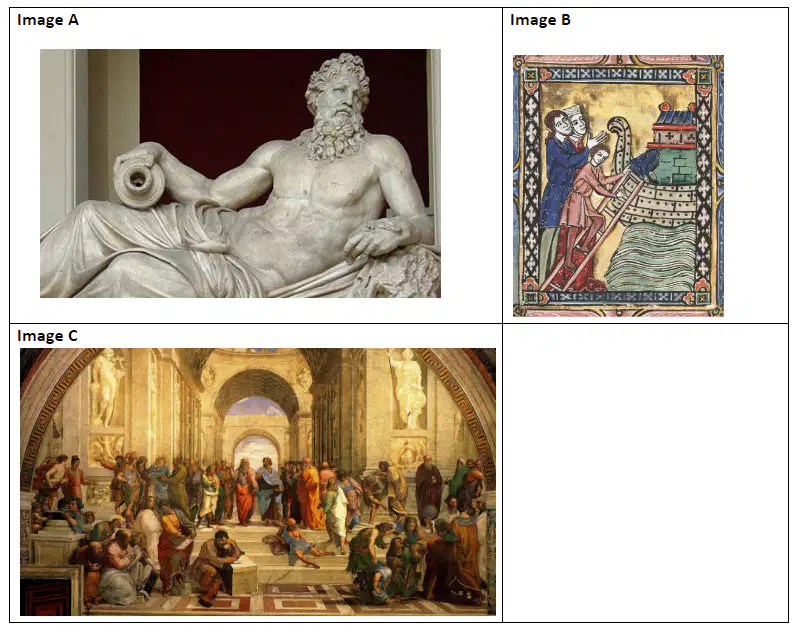
26. Which image best supports the sentence, “Renaissance artwork is characterized by 3-D perspectives, attention to small details, and idyllic beauty”?
a)
Image A
b)
Image B
c)
Image C
9.
Classical period artwork comes from the height of Roman Empire and Greek culture. This period lasted for roughly 1000 years. During the Classical period, art and architecture were important elements of society. Art was created to show important leaders, or tell stories about different gods or goddesses. The Medieval period followed the Classical period. Most people were more concerned with survival and religion than art. Because people were largely uneducated artwork was more simple, flat, and two-dimensional. Art patrons were mostly church leaders, so most medieval art is religious. The Renaissance marked a change in European artwork. This time period is considered a rebirth of Classical thought and style. Artwork of this era reflects the importance of curiosity and detail. Artists studied what the ancient Romans and Greeks did. They often copied their style, while experimenting with new techniques and subjects. Renaissance artwork is characterized by 3-D perspectives, attention to small details, and idyllic beauty.
Source- Instructomania, Italian Renaissance Historical Snapshot, 2017
Which of the following topic sentences is best supported by the information in the passage?
a)
Renaissance artwork was more detailed than other periods.
b)
Artwork changed and evolved across the Classical, Medieval, and Renaissance periods.
c)
Renaissance artwork was far superior to artwork from the Classical and Medieval periods.
d)
Classical period artwork was more likely to show mythological figures than Medieval or Renaissance artwork.
10.
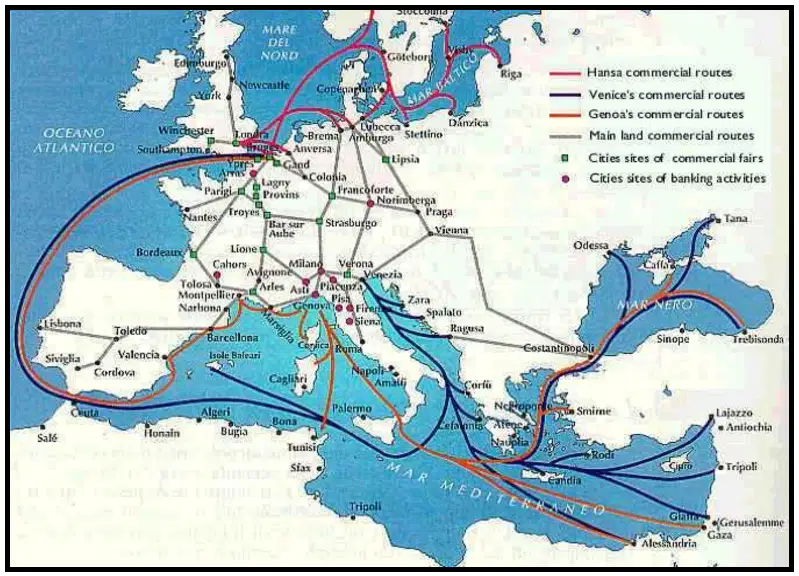
Select the commentary sentence that best describes the map:
a)
Renaissance trade routes were most highly concentrated in northern Europe.
b)
Renaissance trade routes were mostly localized in the Middle East.
c)
Renaissance trade routes connected Europe, the Mediterranean, and the Middle East by water and by land.
d)
Renaissance trade routes did not exist in the Mar Meditrrraneo (Mediterranean Sea).
11.

The map best supports which of the following sentences?
a)
Hansa commercial routes connected northern European countries like England and Denmark
b)
Hansa commercial routes extended all the way into the Mediterranean.
c)
Land routes were limited to just continental Europe.
d)
Venice’s commercial routes doubled the area covered by Genoa’s commercial routes.
12.
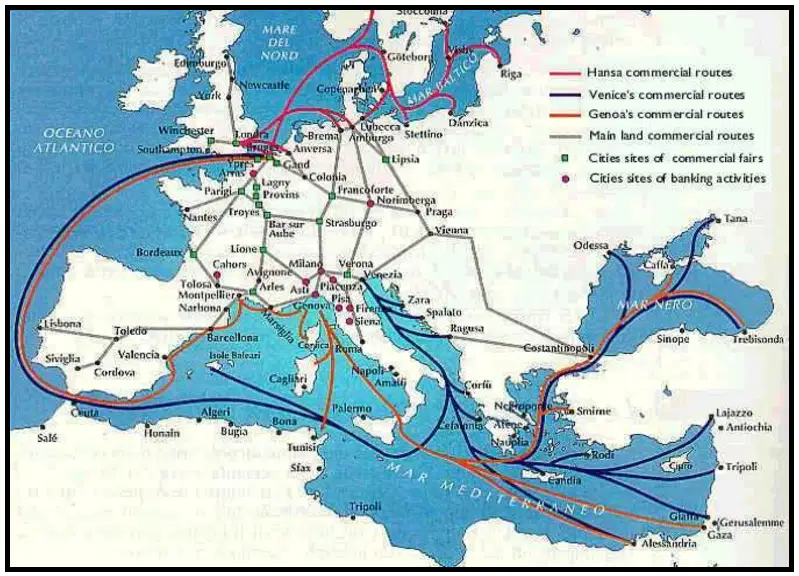
The map best supports which of the following sentences?
a)
Renaissance trade routes brought goods to two types of locations: Asian cities and port cities.
b)
Renaissance trade routes brought goods to two types of locations: cities with commercial fairs and cities with large marketplaces.
c)
Renaissance trade routes brought goods to two types of locations: cities with commercial fairs as indicated by the small squares on the map and cities with banking activities as indicated by the small circles.
d)
Renaissance trade routes brought goods to two types of locations: major cities and mostly port cities along the Atlantic Ocean.
13.

Which source(s) best supports the idea that people living during the plague considered the disease to be an act of God?
a)
Source A
b)
Source B
c)
Source C
d)
Source B and C
14.

Which passage best supports the topic sentence, “While the plague devastated large portions of the population, certain groups of people directly benefited from the high mortality rates.”
a)
Source A
b)
Source B
c)
Source C
d)
Source B and C
15.

Which source(s) best supports the idea that people living during the plague were misinformed about the ways to prevent and cure the disease?
a)
Source A
b)
Source B
c)
Source C
d)
Source B and C
16.

Which of the sources most likely influenced the 8th amendment to the U.S. Constitution: “Excessive bail shall not be required, nor excessive fines imposed, nor cruel and unusual punishments inflicted.”
a)
Source A
b)
Source B
c)
Source C
d)
Source D
17.
These are all reasons for exploration except
a)
to spread Christianity
b)
to spread disease
c)
curiosity about the world
d)
to find better trade routes to Asia
18.
What does the word circumnavigate mean?
a)
go down
b)
go across
c)
go completely around
d)
remain stable
19.
This device used the stars to help explores navigate the seas
a)
astrolabe
b)
time tables
c)
Caravels
d)
magnetic compass
20.
Improvements in these helped explores to have better understanding of the world
a)
oars
b)
ships
c)
spices
d)
maps
21.
Queen Isabella and King Ferdinand of Spain sought to gain wealth and spread this religion
a)
Islam
b)
Judaism
c)
Hindu
d)
Christianity
22.
All of these countries commissioned explorers except
a)
Spain
b)
Portugal
c)
America
d)
France
23.
As a consequence of exploration by Spain most people of Mexico are Christian and speak which language?
a)
Spanish
b)
French
c)
Portuguese
d)
native Mexico languages
24.
This disease was responsible for killing most of the Native American populations
a)
zika virus
b)
chicken pox
c)
the Spanish flu
d)
small pox
25.
The friction between Catholics and Protestants created tinder for war. In France, the French Protestants were known as Huguenots and they had to battle for their religious rights. Protestant English King Henry IV also negotiated the Edict of Nantes to grant religious freedom to Huguenots. In 1618 the Holy Roman Emperor tried to convert all his subjects to Catholicism, which caused Protestants to throw a Catholic priest from a window in Prague. This single rebellious act initiated the 30 Years’ War, a series of battles that went beyond religious issues. Trade rights, political rivalries, and land were all fought over. Finally, the Treaty of Westphalia was signed in 1648. In addition to war, Reformation influenced the structure of town governments, as church congregations made their own laws. National rulers allowed them to share in political control. This separation of power laid the foundation for Federalism.
Source- Instructomania, Historical Snapshot Google Interactive Church Reformation, 2017
Which of the following details best supports the idea that the rise of Protestantism also created a spirit conflict over many issues in Europe?
a)
Protestant English King Henry IV also negotiated the Edict of Nantes to grant religious freedom to Huguenots.
b)
This separation of power laid the foundation for Federalism
c)
Trade rights, political rivalries, and land were all fought over.
d)
Finally, the Treaty of Westphalia was signed in 1648.
26.

Which theses best support the idea that people should be forgiven for sins before they die, not after?
a)
8, 12
b)
8, 75
c)
8, 56
d)
8, 62
27.

Based on the information from the map, you can conclude that the Anglican religion was:
a)
Popular throughout Europe
b)
Limited to the British Isles
c)
In conflict with Calvinists in Scotland
d)
A result of Martin Luther’s 95 Theses
28.

Based on information from Source A, which of the statements is the best explanation for the Calvinist belief in predestination?
a)
The Bible explicitly states that there is no way to find salvation on Earth.
b)
The Catholic Church sold salvation in the form of indulgences, so people thought they could go to heaven without having to earn it by leading decent lives.
c)
John Calvin wanted to set his religion apart from other Protestant faiths.
d)
John Calvin was reluctant to give false hope to his followers because he believed most humans were inherently bad.
29.

Which of the following is a similarity between Calvinism and Lutheranism?
a)
Both religions believed in predestination.
b)
Both religions maintained most of the traditions of the Catholic Church.
c)
Both religions were established in response to issues with Church corruption and policy.
d)
Neither religion was very popular in Europe.
30.
Rain-water must not be employed in cooking, and everyone should guard against exposure to wet weather. If it rain, a little fine treacle should be taken after dinner... Good clear wine should be selected and drunk often, but in small quantities, by day. Olive oil as an article of food is fatal. Equally injurious are fasting and excessive abstemiousness (refraining from eating), anxiety of mind, anger, and immoderate drinking. Young people, in autumn especially, must abstain from all these things if they do not wish to run a risk of dying of dysentery. In order to keep the body properly open, an enema, or some other simple means, should be employed when necessary. Bathing is injurious...Everyone should impress this on his recollection, but especially those who reside on the coast, or upon an island into which the noxious wind has penetrated.
From the passage, you can infer that Medieval doctors were:
a)
Superstitious
b)
Well-educated
c)
Religious
d)
Judicious
31.
Rain-water must not be employed in cooking, and everyone should guard against exposure to wet weather. If it rain, a little fine treacle should be taken after dinner... Good clear wine should be selected and drunk often, but in small quantities, by day. Olive oil as an article of food is fatal. Equally injurious are fasting and excessive abstemiousness (refraining from eating), anxiety of mind, anger, and immoderate drinking. Young people, in autumn especially, must abstain from all these things if they do not wish to run a risk of dying of dysentery. In order to keep the body properly open, an enema, or some other simple means, should be employed when necessary. Bathing is injurious...Everyone should impress this on his recollection, but especially those who reside on the coast, or upon an island into which the noxious wind has penetrated.
According to the passage, people should do all of the following, except:
a)
Consume olive oil
b)
Avoid cooking with rainwater
c)
Drink wine in moderation
d)
Avoid being angry or anxious
32.
Rain-water must not be employed in cooking, and everyone should guard against exposure to wet weather. If it rain, a little fine treacle should be taken after dinner... Good clear wine should be selected and drunk often, but in small quantities, by day. Olive oil as an article of food is fatal. Equally injurious are fasting and excessive abstemiousness (refraining from eating), anxiety of mind, anger, and immoderate drinking. Young people, in autumn especially, must abstain from all these things if they do not wish to run a risk of dying of dysentery. In order to keep the body properly open, an enema, or some other simple means, should be employed when necessary. Bathing is injurious...Everyone should impress this on his recollection, but especially those who reside on the coast, or upon an island into which the noxious wind has penetrated.
The purpose of this passage is to:
a)
Outline ways to cure all diseases
b)
Explain ways to avoid contracting a disease or an illness
c)
Show how much Medieval doctors knew
d)
Explain why rainwater is dangerous to consume
100 %

