
 Worksheets
Revision - Unit 7 - Radioactivity
Total questions: 49
Worksheet time: 25mins
Background radiation is ... level ionising radiation.
low
high
Which radiation has the fastest speed?
Alpha
Beta
Gamma
What is a moderator in a nuclear reactor?
It slows down the chain reaction to ensure safety.
It slows down the neutrons to increase the likelihood of collisions.
What is the critical mass?
The minimum mass of a fissile substance required to create a chain reaction.
The minimum atomic mass required to create a chain reaction.
What do the control rods do?
They slow down the neutrons to increase the likelihood of collisions.
They absorb the extra neutrons.
Where does most of the sun's energy come from?
Fission
Fusion
Radioactive decay
Where does most of Earth's internal energy come from?
Fission
Fusion
Radioactive decay
Where does the energy from a nuclear reaction come from?
It comes from a chemical reaction.
Some mass is converted to energy.
Fission is (1)
Fusion is (2)
1) splitting apart
2) joining together
1) joining together
2) splitting apart
What is used to detect radiation?
A Geiger counter
A seismometer
Ionising radiation comes from a decaying nucleus.
How can a nucleus create beta radiation which is an electron?
Beta radiation is the only radiation that doesn't come from the nucleus.
A neutron splits into a proton and an electron, and the electron is ejected.
Why is it called 'ionising radiation'?
Because it is an ionised wave / particle.
Because if it collides with an atom it can form an ion.
Which radiation has the strongest charge?
alpha
beta
gamma
Which radiation has the strongest ionising potential?
alpha
beta
gamma
What is alpha radiation?
An electron
An EM wave
Two protons and two neutrons.
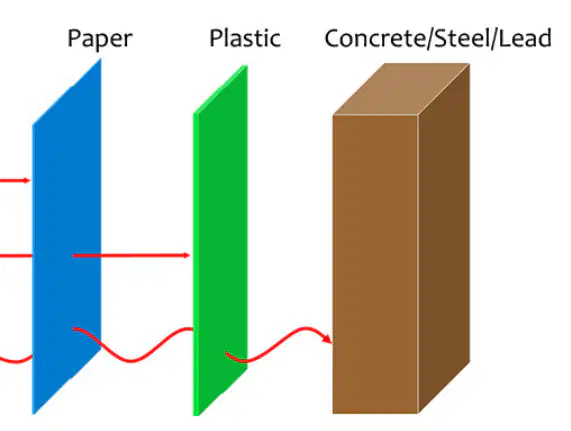
Which radiation has the strongest penetration ability?
alpha
beta
gamma
When an unstable nucleus decays, it gives out ...
ionizing radiation
visible light
neutrons
Can humans influence a nuclei to decay (by changing the temperature or some other parameters)?
Yes
No
An unstable nucleus will eventually ...
decay
radiate
explode
What makes a nucleus unstable?
Too many or too few neutrons.
Too many or too few electrons.
Too many or too few protons.
The protons and neutrons are held together by ...
Nuclear force
Electrostatic force
Gravitational force
Isotopes have differing ...
chemical properties
physical properties
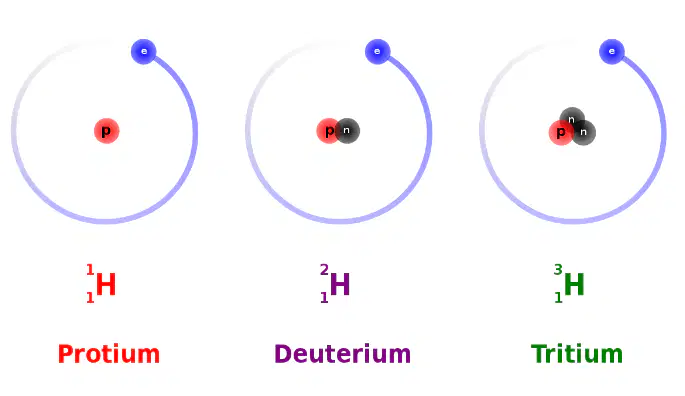
What is the atomic mass of Deuterium?
1
2
3
Isotopes have the same number of (1) but different number of (2).
1) protons
2) electrons
1) protons
2) neutrons
1) neutrons
2) electrons
When we do chemistry, we are manipulating the ...
protons
neutrons
electrons
Protons and __________ have roughly equal mass.
neutrons
electrons
nuclei
If the nucleus were the size of a full stop ( . ), the atom would be about _____ meters in diameter.
2.5 meters
250 meters
What is the overall charge of a nucleus?
positive
negative
no charge
Choose the correct option.
The amount and types of background radiation differ from place to place.
The amount and types of background radiation is the same for all places.
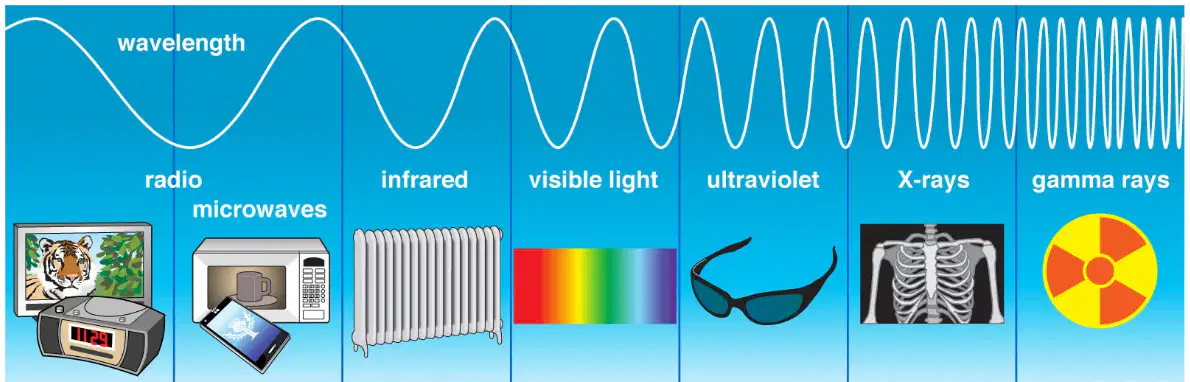
Which waves have ionising potential?
Longer wavelength waves
Shorter wavelength waves
Radon is important because ...
It is the most radioactive substance.
It accounts for the highest percent of background radiation.
It can decay to produce Uranium.
Radon is a ...
solid
liquid
gas
Cosmic Rays are ...
waves produced by U-235 fission.
very energetic particles from space.
Why are cosmic rays relatively harmless for humans?
Because they pass straight through our body.
Because the atmosphere blocks most of them.
Some background radiation has artificial sources. This means that ...
they are the result of human activity.
they are fake radiation, not real.
What is the half-life of a radioactive sample?
The time it takes for roughly half of a sample to decay.
The activity in Bq after roughly half a sample has decayed.
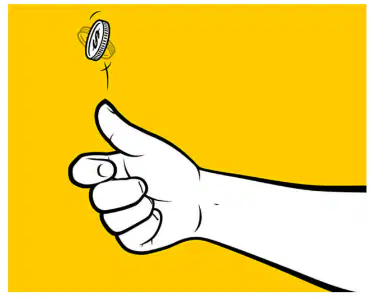
Radioactive decay is similar to flipping a coin.
If we flip 1000 coins how many would we expect to land on heads?
Exactly 500
Between 450 and 550
Between 750 and 1000
Between 0 and 250
Half life has ...
an exponential decay
a relational decay
Radioactivity is measured in ...
Becquerel (Bq)
Sieverts (Sv)
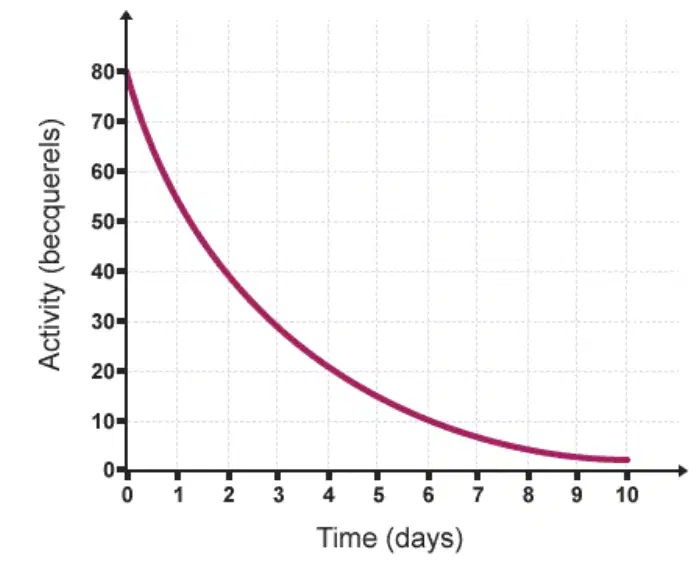
What is the half-life of this element?
10 days
5 days
2 days
1 day
Suppose the half life of a sample is 2 days.
It shows a radioactivity of 3200 Bq. What will the value of Bq be after 8 days?
1600 Bq
800 Bq
400 Bq
200 Bq
What is the unit for radiation exposure?
Becquerel (Bq)
Sievert (Sv)
A substance that emits gamma and can be followed as it moves around the body.
radioactive tracer
radioactive detector
radioactive emitter
Why are gamma emitters used for medical tracing?
Because they are harmless for humans.
Because they have a high penetration ability.
1) A sample is exposed to radiation from a distance but doesn't become radioactive.
2) A sample is exposed to radiation and becomes radioactive.
1) irradiation
2) contamination
1) contamination
2) irradiation
What can gamma be used for?
Long distance communication.
Cooking food.
Sterilising medical equipment.
Which radiation is used in paper factories for testing paper thickness?
alpha
beta
gamma
How is radioactive dating done?
Compare the ratio of parent isotopes to daughter isotopes in the sample.
Put the sample in a room with U-235 and test how much it absorbs.
Which radiation cannot penetrate the skin?
alpha
beta
gamma

