wayground logo

Free Printable Worksheets

Font size

S
M
L
XL
Worksheets

Waves, Sound, and Music

Total questions: 45

Worksheet time: 2hrs 30mins
Name
Class
Date
1.
A disturbance that travels through a medium as a longitudinal wave
a)
sound
b)
wavelength
c)
pitch
d)
frequency
2.
Bending of waves around an object (such as through a doorway)
a)
sound
b)
diffract
c)
pitch
d)
volume
3.
The number of wavelengths that pass a point each second
a)
frequency
b)
wavelength
c)
pitch
d)
amplitude
4.
Material (matter) through which a wave travels
a)
medium
b)
Doppler Effect
c)
sound
d)
pitch
5.
How high or low a sound is; depends on the frequency (greater frequency= higher pitch)
a)
pitch
b)
frequency
c)
sound
d)
medium
6.
A wave in which the vibration is in the same direction as that in which the wave is traveling; sound waves
a)
longitudinal wave
b)
ocean wave
c)
transverse wave
d)
mechanical wave
7.
The part of a longitudinal wave where the particles of the medium are close together.
a)
rarefaction
b)
compression
c)
crest
d)
trough
8.
A part in a longitudinal wave where the particles are spread apart
a)
compression
b)
rarefaction
c)
crest
d)
trough
9.
A reflected sound wave
a)
frequency
b)
pitch
c)
echo
d)
rarefaction
10.
A wave that requires a medium through which to travel
a)
mechanical wave
b)
chemical wave
c)
electromagnetic wave
d)
pitch
11.
You and your father inspect an empty house with the hopes of buying it. You walk through the rooms talking to one another, and you notice that your voices and footsteps are echoing in the big, empty house. What causes the echo?
a)
sound waves reflecting off smooth, flat surfaces throughout the house
b)
sound waves moving around the large rooms
c)
sound waves moving slowly through air
d)
sound waves refracting around corners in the empty rooms
12.
If a wave is traveling at 260 m/s and has a wavelength of 0.8 m/s, what is its frequency?
a)
208 Hz
b)
325 Hz
c)
430 Hz
d)
160 Hz
13.
If you want to change the pitch of a sound, you have to change the ___
a)
frequency
b)
amplitude
c)
speed
d)
volume
14.
This is the unit used to measure the volume of a sound. 
a)
Decibel
b)
Medium
c)
Vibration
d)
Oscilloscope
15.
This is what you get when sound waves are reflected, or bounce back, off of a hard surface.
a)
Amplitude
b)
Pitch
c)
Volume
d)
Echo
16.
The speed of a sound wave depends on
a)
the frequency
b)
the medium
c)
both air temperature and medium
d)
the air temperature
17.
When a sound is louder what measurement gets bigger?
a)
Frequency 
b)
Amplitude 
c)
Wavelength 
d)
Crest
18.
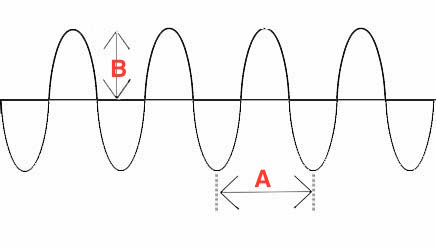
What is B?
a)
crest
b)
trough
c)
compression
d)
rarefaction
19.
regular disturbances that carry energy through matter or space
a)
crest
b)
energy
c)
wave
d)
trough
20.

What property of this wave is represented by the letter "A"

a)

amplitude

b)

crest

c)

trough

d)

wavelength

21.
A mechanical wave cannot travel through...
a)
a vacuum(empty space).
b)
water.
c)
air. 
d)
glass.
22.
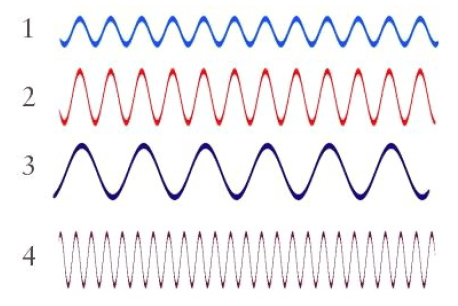
Which wave in the diagram has the greatest frequency?
a)
1
b)
2
c)
3
d)
4
23.
Which of the following can sound travel through?
a)
solid
b)
liquid
c)
gas
d)
all of the above
24.

Electromagnetic waves include the following except

a)

radio waves

b)

X-rays

c)

ocean waves

d)

microwaves

25.
All waves carry
a)
energy
b)
light 
c)
matter
d)
particles
26.
What kind of wave is pictured below?
a)
compressional wave
b)
transverse wave
c)
sound wave
d)
mechanical wave
27.

Which type of wave moves parallel to the direction of the wave?

a)

transverse

b)

longitudinal

c)

surface

d)

electromagnetic

28.

Increasing the amplitude means you are increasing the _______________ of a wave.

a)

frequency

b)

amplitude

c)

energy

d)

wavelength

29.

When a wave bounces back, it is called?

a)

diffraction

b)

refraction

c)

transmission

d)

reflection

30.
Velocity= ________
Wavelength= .5m
Frequency= 150 hertz
a)
.75 m/s
b)
75 m/s
c)
300 m/s
31.
Velocity= 320 m/s
Wavelength= 80 m
Frequency= ___________
a)
4 hertz
b)
.25 hertz
c)
400 hertz
32.
Velocity= _________
Wavelength= 3.0 m
Frequency= 120 hertz
a)
40 m/s
b)
360 m/s
c)
0.025 hertz
33.
Velocity= 190 m/s
Wavelength= _________
Frequency= 1.1875hertz
a)
225.63 hertz
b)
160 hertz
c)
0.00625 hertz
34.
Velocity= 110 m/s
Wavelength= ___________
Frequency= 300 hertz
a)
0.367 m
b)
33,000 m
c)
2.73 m
35.

Six waves go past a fixed point in two seconds. What is the frequency of the wave?

a)

3

b)

6 Hz

c)

3 Hz

d)

2

36.

20 waves go past a fixed point in 10 seconds. What is the frequency of the wave?

a)

20 seconds

b)

20 Hz

c)

2 Hz

d)

2

37.

Compared to a low pitch wave, a high pitch wave will have a

a)

higher frequency and shorter wavelength

b)

higher frequency and longer wavelength

c)

larger amplitude and shorter wavelength

d)

smaller amplitude and shorter wavelength

38.

Particles in a longitudinal wave travel

a)

perpendicular to the direction of travel

b)

parallel to the direction of travel

c)

perpendicular to the direction of peaks

d)

parallel to the direction of the amplitude

39.

The length of 4 waves together is 12m. How long is the wavelength of a single wave?

a)

3 seconds

b)

3 metres

c)

12 metres

d)

3 Hz

40.

A wave has wavelength of 10 m and a speed of 340 m/s. What is the frequency of the wave?

a)

34 m/s

b)

34 hz

c)

3400 m/s

d)

3400 Hz

41.
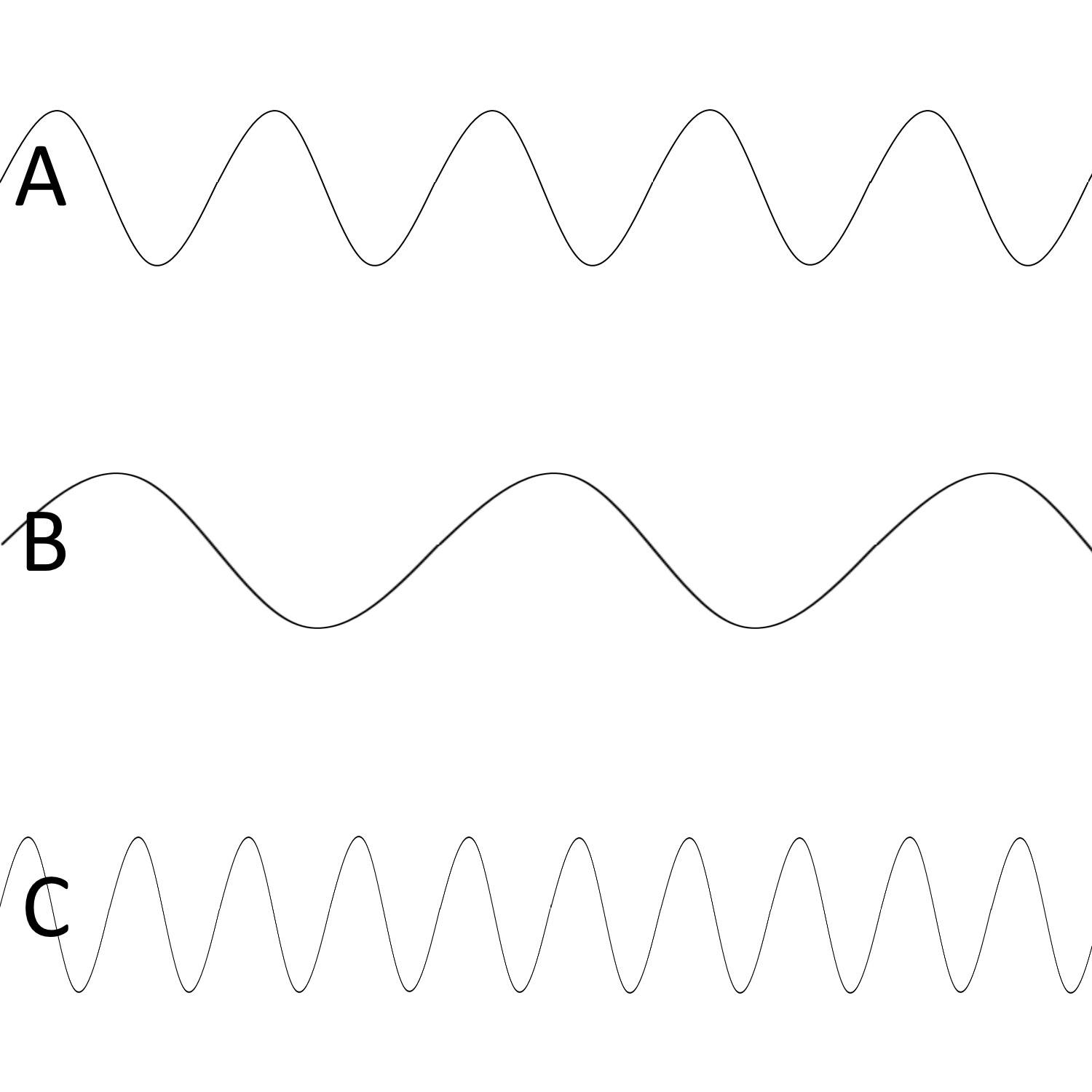
Which wave has the largest wavelength?
a)
A
b)
B
c)
C
d)
None (same wavelength)
42.
Which wave has the largest frequency?
a)
A
b)
B
c)
C
d)
None (same frequency)
43.

The lowest point on a transverse wave is the

a)

compression

b)

crest

c)

rest position

d)

trough

44.

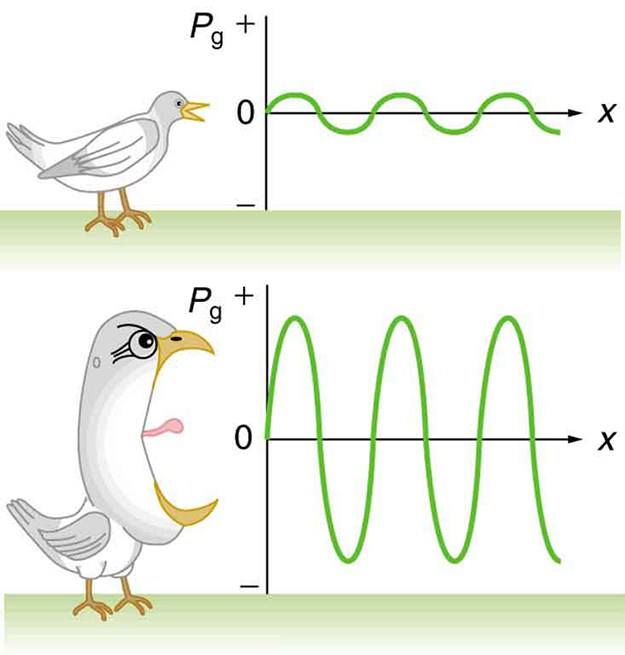
What type of wave is pictured?

a)

Transverse wave

b)

Longitudinal wave

c)

Wave, what wave?

d)

Slinky wave

45.

I know more about waves than I did when we started this unit.

a)

Yes

b)

No