
 Worksheets
Unit 5.2 Study Guide
Total questions: 55
Worksheet time: 41mins

Which layer of the atmosphere do we live in? (click to enlarge picture)
Thermosphere
Mesosphere
Stratosphere
Troposphere

Which layer of the atmosphere contains clouds and weather? (click to enlarge picture)
Therosphere
Mesosphere
Stratosphere
Troposphere

Which gas is most abundant in the atmosphere? (click to enlarge picture)
oxygen
nitrogen
water vapor
argon

What property is used to divide the layers of the atmosphere? (click to enlarge picture)
Air pressure
Temperature
Type of gas
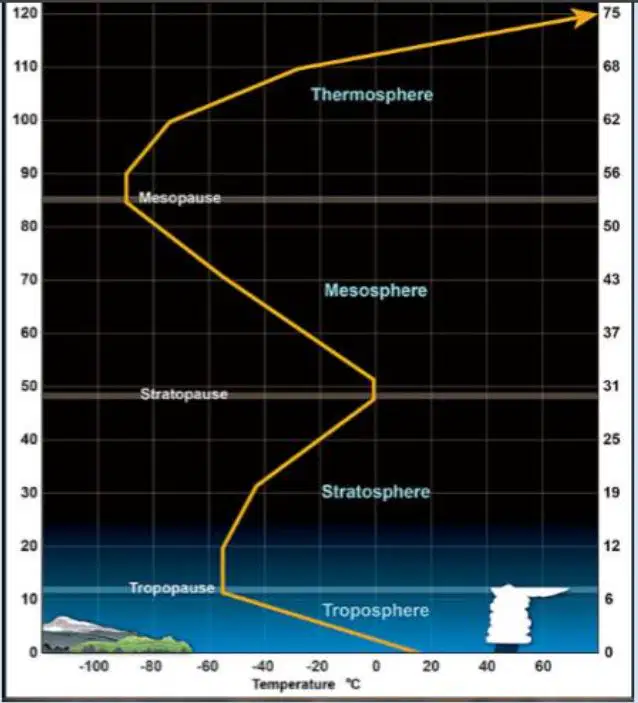
What happens to the temperature at the "pause" between layers?
it increases
it decreases
it stays the same

How does temperature in the Troposphere change as the altitude increases? (click to enlarge picture)
temperature increases
temperature decreases
temperature stays the same
The sun's energy reaches Earth through _____
Radiation - electromagnetic waves
microwaves
UV rays
electromagnetic spectrum
The curving of the path of a moving object as a result of Earth's rotation is called the Coriolis effect.
True
False
Why is Earth's surface rarely impacted by large objects that enter Earth's atmosphere?
***WATCH THE VIDEO OR THE ANSWER***
Because Earth has such a dense atmosphere, friction causes most objects to burn up before they reach Earth's surface
Because Earth's atmosphere is able to catch most objects like a volleyball net, and it bounces these objects back into space.
Because Earth's atmosphere has so much water vapor that it dissolves most objects that travel toward Earth
Because Earth's atmosphere is magnetic and it repels all objects that try to travel toward Earth.
How does the composition of the mesosphere protect life on Earth?
The mesosphere burns most of the debris that enters Earth's atmosphere from space.
The mesosphere traps the Sun's thermal energy to keep the temperature of Earth stable
The mesosphere contains mostly water vapor and sends rainwater down to Earth's surface.
The mesosphere contains a layer of ozone that absorbs most of the Sun's ultraviolet radiation
Why is ozone important to life on Earth?
Ozone in the atmosphere absorbs harmful ultraviolet radiation from space
Ozone in the troposphere destroys excess atmospheric carbon dioxide
Ozone in the thermosphere absorbs energy that is reflected by Earth.
Ozone in the biosphere maintains balanced ecosystem populations.
Which statement correctly compares the ozone found in the troposphere to the ozone found in the stratosphere?
Ozone found in both the troposphere and the stratosphere filters out harmful ultraviolet radiation.
Ozone found in both the troposphere and the stratosphere is considered to be a pollutant with negative health effects.
Ozone found in the troposphere filters out harmful ultraviolet radiation, while ozone In the stratosphere is considered to be a pollutant with negative health effects
Ozone in the troposphere is considered to be a pollutant with negative health effects, while ozone found in the stratosphere filters out harmful ultraviolet radiation.
Convection currents can be caused by...
weather patterns
thermal expansion
unequal heating of the earth's surface
the waves made by crustal plate movement

The table shows temperatures in Atlanta, Georgia on a summer day.
Which explains the temperature pattern shown in the table?
The Sun, like other stars, produces light energy that warms Earth during the day
The Sun, like other stars, produces heat energy that warms Earth during the day
The Sun, like other stars, produces motion energy that warms Earth during the day.
The Sun, like other stars, produces electrical energy that warms Earth during the day
At the beach, a student fills two beach pails, one with sand and one with seawater. She places both pails in the same spot in the bright sunlight. After several hours, what will the student MOST LIKELY observe?
The sand will be warmer than the seawater.
The sand will be cooler than the seawater.
Both will be the same temperature but cooler than before.
Both will be the same temperature but warmer than before.
(a) are responsible for transferring the Sun's energy between the equator and the poles?

Weather Patterns (a)

The heat transferred from the Sun to the Earth by waves is called ________.
conduction
radiation
convection
The flow of heat due to a temperature difference is called...
Heat Transfer
Conduction
Convection
Radiation

This picture is an example of
Conduction
Radiation
Convection
All of the above

Choose the direction that heat moves.
Hot chocolate (a) Spoon
→
←
↔

Choose the way heat moves.
Spoon (a) Hot soup
←
→
↔

Choose the way heat moves.
Hot Coffee (a) Spoon
→
←
↔
motion of the ocean created by wind patterns
waves
currents
tides
Why are ocean currents important?
ocean currents allow people to sail around the world
ocean currents move the continents from one place to another
ocean currents move heat energy from the equator to the poles
Ocean currents affect the rotation of the Earth
In coastal regions wind patterns are most likely to shift direction and move inland from the sea during
(a)
How does Lake Michigan affect Chicago's weather and wind patterns?
Warm air rises from Lake Michigan as cool air from the city sweeps over and cools the lake.
Cool air rises from Lake Michigan as warm air from the city sweeps over and warms the lake
Warm air rises from Chicago's concrete streets and buildings as cool air from Lake Michigan sweeps over and cools the city.
Cool air rises from Chicago's concrete streets and buildings as warm air from Lake Michigan sweeps over and warms the city.

Identify and describe what produces trade winds and what is responsible for deflecting them towards the equator. Feel free to look it up, but you need to put it in your own words....because....THIS IS A QUESTION on the UNIT TEST (How your answer is graded
What type of large scale winds blow constantly, predictably, and over long distances?
land breezes
mountain breezes
global winds
land breezes
Which statement correctly defines wind?
The movement of air from areas of low pressure to areas of high pressure
The movement of air to a colder area in the atmosphere.
The movement of air from areas of high pressure to areas of low pressure.
The movement of air pushed around and bouncing off Earth's surface.

A map of sea surface temperatures is provided. The patterns that are observed are due to the fact that
the earth is wider at the equator, so this area spins faster than the poles.
the equator receives more of the Sun's radiation than other parts of the Earth.
the salt content is greater at the poles than at the equator.
the warm, less dense water near the equator sinks, while the colder water rises.
How will the weather pattern most likely change from summer to fall in most areas of the United States?
From snowy to rainy
From cloudy to sunny
From cool to cold
From warmer to cooler
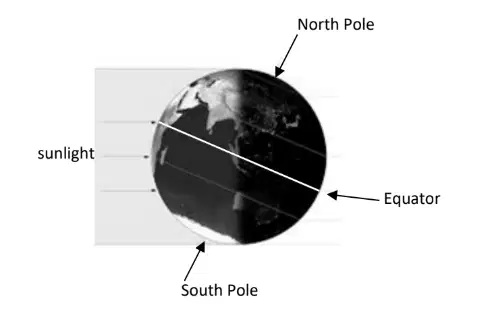
Observe the diagram below then answer the following question. Which best explains the pattern of cooler temperatures at the North and South Poles and warmer temperatures near the Equator throughout the year?
The poles have less snow and ice than areas near the equator
The poles get less of the Sun's light and heat energy than the equator
The poles get more of the Sun's light and heat energy than the equator
The poles and the equator get the same amount of the Sun's light and heat energy
Olivia and her mom took a walk through the park. Olivia looked up and observes gray clouds covering the sky. Her mom suggested they go back to the car because it will probably rain soon. Which type of cloud did Olivia and her mom observe?
Stratus
Cumulus
Cirrus
Humidity


What do hurricanes, tornadoes, and thunderstorms all have in common?
Cold temperatures
Low air pressure
Storm surge
High air pressure
Which climatic control influences the temperature and rainfall pattern.
Altitude
Relief
Pressure and Wind systems
Ocean currents
Which pattern of wind flow would show what would most likely occur during a hot summer season in a coastal location?
A pattern from land to sea toward areas of lower air pressure
A pattern from sea to land toward areas of lower air pressure.
A pattern from land to sea toward areas of higher air pressure.
A pattern from sea to land toward areas of higher air pressure.
Warm air moves upward, while cold air moves downward. Which of the following best explains this pattern of heat transfer?
Differences in density caused by temperature differences create buoyant forces
Gravity pulls cold air downward more strongly than warm air
High-energy particles bounce upward off the ground in large numbers, causing convection.
Gravity acts on particles but not on energy, so thermal radiation rises.

What process is this showing?
Tornado
Thunderstorm
Hurricane
Tsunami
Storms are formed when there are extreme differences in air pressure.
True
False
Where is a thunderstorm most likely to form?
in the center of a large mass of cold, dry air
in the center of a large mass of warm, humid air
where two masses of warm, humid air collide with each other
where a warm, humid air mass collides with a dry, cold air mass
Where is a tornado most likely to form?
in a supercell thunderstorm
over warm, shallow ocean water
near the middle of a cold, dry air mass
at the center of high-pressure system
(a) is the change in any of Earth's surface currents and can result in changes in weather patterns. This change occurs every three to seven years as the winds blowing across the Pacific are lighter than usual. This global weather change can result in increased rainfall, reduced fishing, and even a change in hurricane patterns
Where are the two polar jet streams located?
Near the north and south poles.
Near the equator.
You can't tell.
Only near the north pole.
When the jet stream brings polar air to the southern part of the United States, what happens to the weather in the northern United States?
Northerners experience a longer summer.
Northerners experience a longer winter
The temperatures get warmer
The temperatures get colder.
Where are hurricanes formed?
Cool, arctic waters
Warm, dry land
Cool, moist land
Warm, tropical waters
Which of the following is true of hurricane formation over the ocean?
Hurricanes are more likely to form where water is cold and precipitation is high.
Hurricanes are more likely to form where water is warm and evaporation is high.
Hurricanes are more likely to form where gravity is highest and tides pull air up.
Hurricanes are more likely to form over areas where the salinity is highest.
Warm air can hold (a)
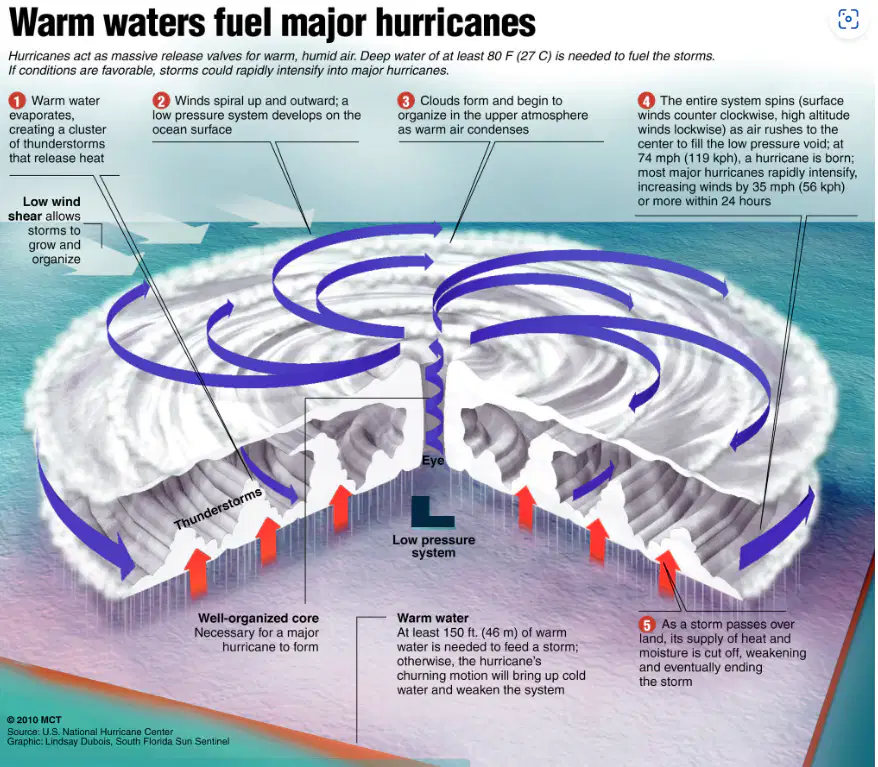
Which statement BEST describes the conditions needed for step 1 and step 4 in the diagram to occur?
Step 1 requires high evaporation, and step 4 requires low pressure.
Step 1 requires low evaporation, and step 4 requires high pressure.
Step 1 requires high evaporation, and step 4 requires high pressure.
Step 1 requires low evaporation, and step 4 requires low pressure.

In the Atlantic Ocean, a hurricane can develop after
cool ocean water condenses and falls back to Earth near the Equator.
cool ocean water evaporates and is blown by winds from western Africa
warm ocean water cools when meeting trade winds
warm ocean water heats when meeting trade winds.

